Journalist Danish Siddiqui was killed by Taliban specifically after verifying his identity: Report
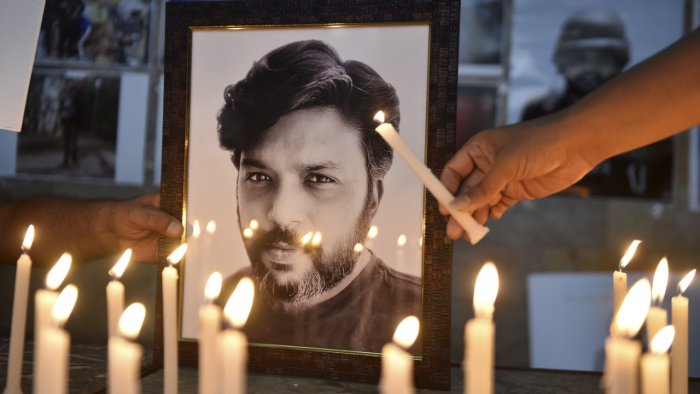
Washington, Jul 30: Pulitzer Prize-winning Indian photojournalist Danish Siddiqui was not simply killed in a crossfire in Afghanistan, nor was he simply collateral damage, but was "brutally murdered" by the Taliban after verifying his identity, according to a report published in a US-based magazine on Thursday.
Siddiqui, 38, was on assignment in Afghanistan when he died. The award-winning journalist was killed while covering clashes between Afghan troops and the Taliban in Spin Boldak district of Kandahar city.
According to the Washington Examiner report, Siddiqui travelled with an Afghan National Army team to the Spin Boldak region to cover fighting between Afghan forces and the Taliban to control the lucrative border crossing with Pakistan.
When they got to within one-third of a mile of the customs post, a Taliban attack split the team, with the commander and a few men separated from Siddiqui, who remained with three other Afghan troops.
During this assault, shrapnel hit Siddiqui, and so he and his team went to a local mosque where he received first aid. As word spread, however, that a journalist was in the mosque, the Taliban attacked. The local investigation suggests the Taliban attacked the mosque only because of Siddiqui's presence there, the report said.
Siddiqui was alive when the Taliban captured him. The Taliban verified Siddiqui's identity and then executed him, as well as those with him. The commander and the remainder of his team died as they tried to rescue him, it said.
While a widely circulated public photograph shows Siddiqui's face recognizable, I reviewed other photographs and a video of Siddiqui's body provided to me by a source in the Indian government that show the Taliban beat Siddiqui around the head and then riddled his body with bullets, wrote the writer Micheal Rubin, who is a senior fellow at the American Enterprise Institute.
The Taliban's decision to hunt down, execute Siddiqui, and then mutilate his corpse shows that they do not respect the rules of war or conventions that govern the behaviour of the global community., the report said.
Siddiqui won the Pulitzer Prize in 2018 as part of the Reuters team for their coverage of the Rohingya crisis. He had extensively covered the Afghanistan conflict, the Hong Kong protests and other major events in Asia, Middle East, and Europe.
Siddiqui was laid to rest at the Jamia Millia Islamia graveyard where a sea of mourners gathered to pay their last respects.
His body arrived at the Delhi airport in the evening of July 18 and was later brought to his residence in Jamia Nagar where a huge crowd, including his family and friends, had gathered.
Let the Truth be known. If you read VB and like VB, please be a VB Supporter and Help us deliver the Truth to one and all.
Bihar: Over 150 children fall ill after consuming 'mid-day meal' in Saharsa

Saharsa (PTI): More than 150 children were taken ill after allegedly consuming food that was part of the mid-day meal in a school in Bihar’s Saharsa district, a senior official said on Thursday.
The incident occurred at a middle school in Baluaha village of the district.
The official said that 115 children were undergoing treatment at the Sadar Hospital, while around 50 students were admitted to Mahishi Public Health Centre.
“We received information that several children fell ill after consuming the mid-day meal in Baluaha. The children were initially treated at the primary health centre, but later, many were referred to the Sadar Hospital,” Saharsa District Magistrate Deepesh Kumar told reporters.
“According to doctors, the health condition of the children has improved, but they will be kept under observation for some time. There is no need to panic. Some kids are having mild fever. They are being treated accordingly,” Kumar said.
Meanwhile, family members of some children claimed that a snake was found in the container in which cooked pulses was stored at the school.
Of the 545 students present in the school, 200 had already eaten their meals by the time the snake was spotted, and later complained of stomach ache and vomiting, they said.
Regarding the claims, the DM said food samples have been collected from the school.
“We will be able to comment on this only after the results of the tested samples arrive,” he said.