Justice Govind Mathur on Ayodhya case: ‘Judgment political; based on faith, not title or possession’
Says Apex Court should reopen case to strengthen people’s faith in judicial system
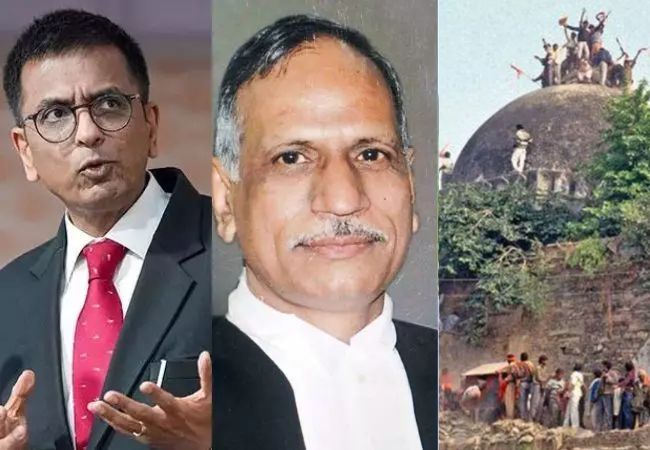
New Delhi: Former Chief Justice of the Allahabad High Court, Justice Govind Mathur, has sharply criticised the Supreme Court’s 2019 Ayodhya-Babri Masjid verdict, saying it does not meet the essential standards of a judicial decision settling rights between parties before a court of law.
Speaking exclusively to Vartha Bharati, Justice Mathur described the judgment as “much more a political solution than the settlement of legal issues.” His strong comments come in the wake of recent remarks by former Chief Justice of India DY Chandrachud, who had called the construction of the Babri Masjid a “fundamental act of desecration.”
Justice Mathur said that the Supreme Court, instead of deciding the question of title and possession based on established principles of civil law, had relied on faith and inconclusive archaeological findings.
“The fundamental of civil law is that property rights must be decided on continuous possession and valid title. The court in this matter should have adjudicated the issue pertaining to the title of the disputed site and also the valid possession thereon, but the apex court based its findings on faith and poor archaeological facts, which in my opinion are neither relevant nor conclusive,” he said.
He warned that such reasoning could set a “highly dangerous precedent” for future property disputes, especially those involving sites with historical backgrounds.
Justice Mathur noted that the court’s findings were based “on probabilities and circumstantial archaeological assumptions” rather than conclusive evidence. “This sets a highly dangerous precedent for deciding sensitive issues of title and possession,” he said.
He pointed out that the Sunni Central Board of Waqfs had produced documentary evidence to show possession and use of the mosque over centuries. However, the court, he said, chose to decide the dispute on a “unique principle of better claim” a concept he described as “alien in civil disputes where definite evidence is available.”
Responding to former CJI Chandrachud’s comments that the mosque’s construction was a “fundamental act of desecration,” Justice Mathur said judges must rise above personal belief and faith while deciding matters of law.
“Justice Chandrachud should not have recused from the case because of his personal belief, but should have examined the matter strictly in accordance with law. Every person has his personal opinion, but judges stand on a different pedestal. They are supposed to go by law and not by their personal faith or understanding,” he said.
Justice Mathur’s remarks directly question the balance the Supreme Court tried to achieve in its 2019 verdict which handed over the disputed site for the construction of a Ram temple while acknowledging the illegality of the mosque’s demolition.
In a significant remark that could reignite debate over the finality of the Ayodhya judgment, Justice Mathur said that to strengthen public faith in the judiciary, the Supreme Court must consider reopening the case on an appropriate occasion.
“To strengthen people’s faith in our judicial system, the apex court on some appropriate occasion must reopen this case,” he said.
Justice Mathur’s statement adds weight to the growing chorus of legal voices including that of Professor Dr. Mohan G. Gopal who have questioned the consistency of the 2019 verdict and called for judicial reconsideration in light of Chandrachud’s recent remarks.
His observations once again underline the discomfort within sections of the legal community over how one of India’s most sensitive disputes was legally settled.
Let the Truth be known. If you read VB and like VB, please be a VB Supporter and Help us deliver the Truth to one and all.
KKR defeat LSG via Super Over
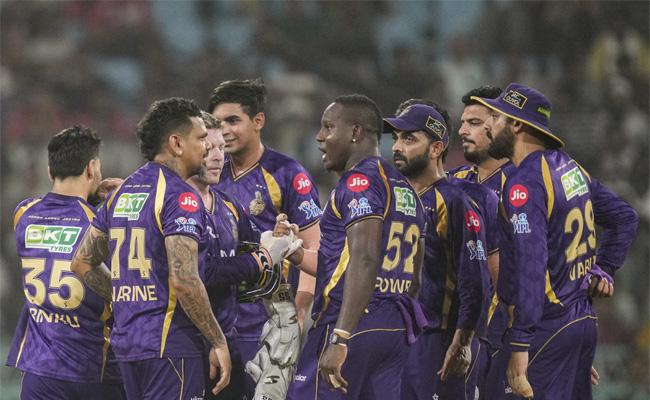
Lucknow (PTI): Kolkata Knight Riders edged Lucknow Super Giants via Super Overs in a battle between two bottom-placed teams in the IPL, here on Sunday.
Chasing a modest 156, LSG suffered a batting collapse and managed to tie the contest and take it to Super Over with No. 9 Mohammed Shami striking a last-ball six against a wayward Kartik Tyagi, who leaked 16 runs in the final over.
But Sunil Narine bowled a stunning Super Over conceding just one run and taking two wickets to give KKR an easy target.
Rinku Singh then finished the chase with a boundary off first ball from Prince Yadav.
Earlier the KKR were in deep trouble with 93/7 in 15 overs but Rinku smashed a sensational 83 not out from 51 balls including four sixes in a row in the final over to lift them to 155/7.
Cameron Green (34) was the only other batter to reach double-digit scores as KKR suffered a familiar batting meltdown with Mohsin taking his maiden fifer.
In reply, LSG continued their dismal show with the bat to succumb to their fifth loss in a row.
Brief Scores:
Kolkata Knight Riders 155/7; 20 overs (Rinku Singh 83 not out, Cameron Green 34; Mohsin Khan 5/23). Lucknow Super Giants 155/8; 20 overs (Rishabh Pant 42). KKR won via Super Over.