Kerala airport halts flights for 5 hours for religious procession

Thiruvananthapuram (PTI): Flight services from the international airport here were suspended for about five hours on Thursday afternoon to make way for the 'Alpassi Arattu' procession of Sree Padmanabhaswamy Temple here.
The flight services were halted around 4.45 pm and resumed at 9 pm after the procession returned back to the temple, TIAL said.
The airport has been pausing operations and rescheduling flights twice every year for decades to enable the bi-annual centuries-old ceremonial procession of the shrine to pass through the runway.
Sree Moolam Tirunal Rama Varma, the present head of the erstwhile Travancore royal family, sporting the traditional green silk cap, an emerald necklace and carrying the ceremonial sword, led the religious procession from the temple to the Shankumugham beach across the airport tarmac.
He was accompanied by a small contingent of police personnel.
The procession began from the shrine at around 5.00 pm and besides the male members of the royal family, a large number of devotees, several caparisoned elephants, a squad of mounted police and a police band were also part of the procession.
The procession moved along the tarmac and reached the beach to the sound of trumpets and drum beats.
After entering the airport premises, the "utsava Vigrahas" (idols) of Padmanabha Swamy, Narasimha Moorthy and Krishna Swami, were kept at the "arattu mandapam" near the runway for some time and later taken to the nearby beach for the rituals.
After a dip in the sea off Shankumugham beach, the idols were then taken back to the shrine in a procession lit by traditional torches marking the conclusion of the festival.
The Thiruvananthapuram International Airport Ltd (TIAL) shared photos of the procession in a Facebook post in which it said, "Amidst the rhythm of devotion and the serenity of the moment, the sacred Arattu procession of Sree Padmanabhaswamy Temple made its ceremonial passage through our runway, a moment where tradition takes flight.
"At #ThiruvananthapuramAirport, we take immense pride in witnessing this timeless ritual unfold, symbolising a beautiful confluence of faith, culture, and modernity."
Flight services resumed at around 9 pm after the procession returned to the temple and the tarmac was cleaned and declared fit for air operations, an airport source said.
The practice of the temple procession passing through the route to reach the Shangumugham beach for the holy bath of the idols began centuries ago, and it has been continuing even after the establishment of the airport in 1932.
When the airport was constructed in the particular place, the then Travancore King Sree Chithira Thirunal had made it clear that facility would be open for public for 363 days in a year and for two days for Lord Padmanabha, the titular deity of the royal family, according to historians.
The royal-era ritual has been continuing even after the Adani Group took over the management of the airport.
The airport issues a NOTAM (Notice to Airmen) twice every year before the runway is closed during the bi-annual Alpassi festival which falls in October-November and the Painkuni festival in March-April.
Let the Truth be known. If you read VB and like VB, please be a VB Supporter and Help us deliver the Truth to one and all.
Annpurna Devi expresses anguish over girl's rape in TN, urges NCW to act
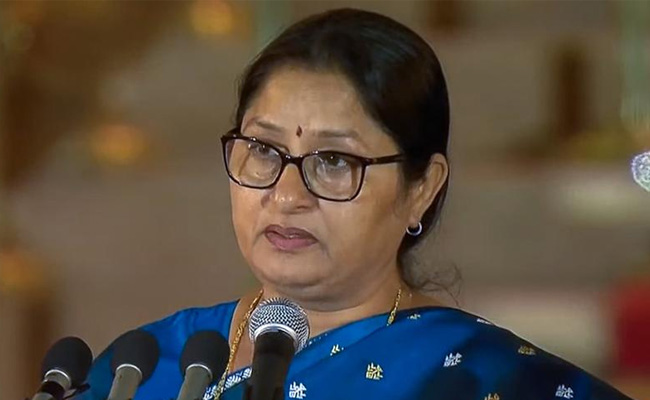
New Delhi (PTI): Union Minister for Women and Child Development Annpurna Devi on Tuesday expressed her anguish over the alleged gang rape of a girl in Tamil Nadu and urged the National Commission for Women to take immediate cognisance of the matter.
In a post on X, Devi said, "Deeply anguished by this horrific incident. I urge the NCW to take immediate cognisance and act swiftly in coordination with the concerned authorities to ensure the strictest action against all culprits."
Devi said, "Justice must be swift and unsparing — the accused must be brought to book without delay," adding, "the safety, dignity, and justice of every daughter of India remain our highest priority."
"We stand firmly with the survivor and her family in this difficult hour," she said.
Reacting to a post by former Tamil Nadu BJP president K Annamalai, who flagged concerns over the law and order situation in the state, Devi said such incidents "expose grave concerns" under the Dravida Munnetra Kazhagam government.
Annamalai, in his post, alleged that a 15-year-old girl from Kanchipuram, who had come to participate in a temple festival near Seyyaru in Tiruvannamalai district, was gangraped.
He said the incident was "deeply shocking and enraging" to him and alleged that such crimes point to a "complete failure" of law and order in Tamil Nadu.
Annamalai demanded immediate arrest of all those involved and the "harshest punishments" for the accused.
He also called for full protection and mental health counselling for the survivor and her family.