Koneru Humpy finishes 12th in blitz competition

Moscow: A hat-trick of losses in the last three rounds ended Koneru Humpy's hopes of a second title at the women's World Rapid and Blitz Championships as the Indian Grandmaster finished 12th overall in the two-day blitz competition here.
Kateryna Lagno of Russia and Norway's Magnus Carlsen defended their titles in the women's and men's blitz competition on Monday.
Humpy, who had claimed the World Women's Rapid Chess Championship title after drawing the Armageddon game against Lei Tingjie of China on Saturday, was placed second with seven points from nine rounds after the opening day of the blitz competition.
However, the 32-year-old Indian failed to continue in the same vein and ended the tournament with 10.5 points out of 17 games. Humpy started the second day of the blitz competition by winning the first two games. She then shared the lead with Lagno after round 13 with two draws.
After round 13, Humpy and Lagno had 10 points each but the Indian then drew against Russia's Alisa Galliamova in the 14th round to drop to the second position, half-a-point behind Lagno, who had claimed another crucial win.
Humpy, who had taken a two-year sabbatical from 2016 to 2018 after she became a mother, then lost the final three games to bow out of contention.
Another Indian Harika Dronavalli finished 25th in women's blitz competition.
Lagno, who had scored 8 points out of 9 games to grab the top position after day one, continued her good run to finish with 13 points out of 17 games to retain the title.
Ukraine's Anna Muzychuk (with 12 /17) finished second while the 3rd and 4th places went to Tan Zhongyi of China and Valentina Gunina of Russia, both finishing finishing with 12 points each.
Let the Truth be known. If you read VB and like VB, please be a VB Supporter and Help us deliver the Truth to one and all.
Who Crossed the Line in Davanagere?
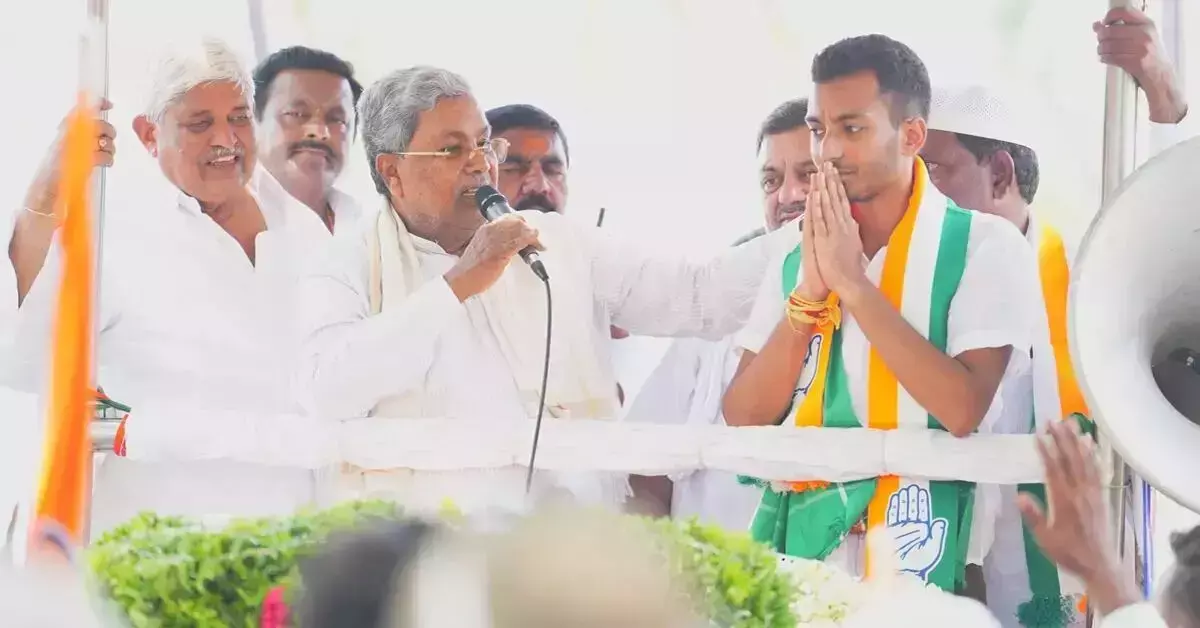
If one closely observes the developments taking place within the state Congress camp after the by-elections, it becomes clear that in trying to justify one mistake as “right,” its leaders are only creating more mistakes. These by-elections, by themselves, are not capable of having any major impact on the state government. However, due to the missteps taken by Congress leaders, these elections have not remained confined to Davanagere and Bagalkot but have begun affecting the entire state unit of the party.
In Davanagere, the wounds the party inflicted upon itself have now worsened and started spreading like poison to other regions. Already, the AHINDA community, which feels it has been denied justice in ticket distribution, is hurting. Congress leaders are now adding salt to those wounds one after another. They are attempting to shift the burden of their own mistakes onto minority leaders and escape accountability. By putting those who have faced social injustice in the dock, branding them as anti-party elements, and attempting to politically isolate them, the Congress seems to be inviting a backlash.
If a socially and economically backward community, which forms the largest population in Davanagere, asking for a ticket is considered anti-party activity, then what meaning remains in the repeated claim of “social justice” that Siddaramaiah often speaks about? This is the question being raised by the AHINDA sections of the state. At the same time, the Congress has not clearly explained what social circumstances justify giving the ticket to the family of late Shamanur Shivashankarappa.
The Shamanur family, which belongs to the Lingayat community, may have made significant contributions to the Congress party. But the party, in return, has already given them enough positions and recognition. Now, asking minority and Dalit communities in Davanagere to sacrifice their opportunity for the sake of this family, and branding minority leaders who question this as anti-party, reflects poorly on the party’s approach.
Shamanur Shivashankarappa passed away as a sitting MLA. His son is already an MLA and has served as a minister. His daughter-in-law has been elected as a Member of Parliament from the Congress. Given the positions already held by the family, giving a ticket to a minority candidate would have been justified in every sense. If not, the Congress could have chosen a candidate from the Dalit community, which is the second-largest in Davanagere. Instead, by imposing an inexperienced grandson of Shamanur on senior Congress leaders in the region, the party leadership has effectively committed an act of betrayal.
Even after making such a serious mistake, the leadership is now attempting to cover it up by putting minority leaders in the dock, initiating inquiries, and using suspensions and expulsions to intimidate minority Congress leaders and workers. This reflects the depth of decline the Congress has reached in the state. People are beginning to wonder whether Surjewala and others are trying to rebuild the Congress in Karnataka by excluding minorities and Dalits altogether.
Even after deciding to give the ticket to Shamanur’s grandson, it was the responsibility of the Congress leadership to take local minority leaders into confidence and involve them in the campaign. However, minority leaders themselves have said that no one approached them or tried to persuade them to participate. This clearly shows the dismissive attitude that both the Shamanur family and the party leadership hold towards minority leaders and workers. Rather than saying minority leaders did not participate in the campaign, it would be more accurate to say that the leadership ensured they were kept out of it.
In connection with the developments in Davanagere, the party high command has announced disciplinary action against two leaders. Even in a court of law, when a death sentence is pronounced, the reasons for the punishment are clearly stated. Here, minority leaders are asking why they are being punished. They have raised several questions, and it is the responsibility of the Congress leadership to answer them.
When late Shamanur Shivashankarappa publicly called upon voters to ensure the victory of BJP leader Yediyurappa’s son, it was not seen as anti-party activity. When Rahul Gandhi and Siddaramaiah insisted that the caste census report must be implemented, Shamanur opposed it, yet even then it was not treated as anti-party behaviour. No suspensions or expulsions followed. Instead, his grandson has now been rewarded with a ticket.
But today, minority leaders who merely asked for a ticket for their community are being branded as anti-party and targeted for punishment. When they say they were not invited to campaign, the leadership should have questioned Minister Mallikarjun and his son as to why they failed to involve them. Instead, those who raised the complaint are being treated as the accused.
There is also talk that the Shamanur family had threatened to shift completely to the BJP if the ticket was not given to them, and that the leadership gave in to this pressure. If this is true, why is such a threat not considered anti-party activity? Why are minority leaders, who remained silent even after being denied a ticket, now being targeted as anti-party elements?
The Congress leadership must answer these questions. Only then will it become clear who actually crossed the lines set by the high command in Davanagere.
In conclusion, there is little doubt that the mistakes committed by the Congress leadership during the Davanagere by-election will cost the party dearly in the upcoming Assembly elections.