LIC says made investments in Adani firms independently, after detailed due diligence
New Delhi (PTI): Life Insurance Corporation of India (LIC) on Saturday said its investments in Adani group companies have been made independently and in accordance with its board-approved policies, following detailed due diligence.
"Department of Financial Services (in the Union Finance Ministry) or any other body does not have any role in such (investment) decisions," LIC said in a statement posted on X.
India's largest insurer has, over the years, made investment decisions across companies based on fundamentals and detailed due diligence. Its investment value in India's top 500 companies has grown 10-fold since 2014 -- from Rs 1.56 lakh crore to Rs 15.6 lakh crore -- reflecting strong fund management.
"The investment decisions are taken by LIC independently as per Board-approved policies after detailed due diligence," LIC said.
"LIC has ensured the highest standards of due diligence and all its investment decisions have been undertaken in compliance with extant policies, provisions in the Acts and regulatory guidelines, in the best interest of all its stakeholders."
The statement was in response to a report in The Washington Post alleging officials orchestrated a plan to steer LIC into investing in the Adani group earlier this year, when the ports-to-energy conglomerate was facing a debt pile and scrutiny in the US.
The report highlighted LIC's May 2025 investment of USD 570 million in Adani Ports & SEZ (APSEZ), which holds the highest 'AAA' credit rating in India.
LIC said the Department of Financial Services or any other body does not have any role in its investment decisions, and the report carries statements "with the intentions to prejudice the well-settled decision-making process of LIC and also to tarnish the reputation and image of LIC and the strong financial sector foundations in India."
The insurer is not a small, single-purpose fund but India's largest institutional investor with over Rs 41 lakh crore (over USD 500 billion) in assets. It invests across 351 publicly listed stocks (as of early 2025) spanning virtually every major business group and sector.
LIC also holds substantial government bonds and corporate debt. Its portfolio is highly diversified, spreading risk.
LIC's exposure to the Adani group is less than 2 per cent of the conglomerate's total debt, helmed by India's second-richest man, Gautam Adani.
Global investors like US’ largest funds BlackRock, Apollo, Japan's largest banks Mizuho, MUFG, and Germany's second largest bank DZ Bank have also invested in Adani debt in recent months, reflecting global confidence in the group.
Sources said Adani's total debt of Rs 2.6 lakh crore is backed by Rs 90,000 crore in annual operating profit and Rs 60,000 crore in cash. This means Adani could knock off its entire debt in under three years if it paused new infrastructure investments.
On the equity side, Adani is not LIC's largest holding — Reliance Industries Ltd., ITC, and the Tata Group are.
LIC owns 4 per cent (Rs 60,000 crore) of Adani stocks versus 6.94 per cent (Rs 1.33 lakh crore) in Reliance, 15.86 per cent (Rs 82,800 crore) in ITC Ltd, 4.89 per cent (Rs 64,725 crore) in HDFC Bank, and 9.59 per cent (Rs 79,361 crore) in SBI. LIC holds 5.02 per cent of TCS worth Rs 5.7 lakh crore.
Let the Truth be known. If you read VB and like VB, please be a VB Supporter and Help us deliver the Truth to one and all.
Sooryavanshi's century in vain as SRH beat RR by 5 wickets
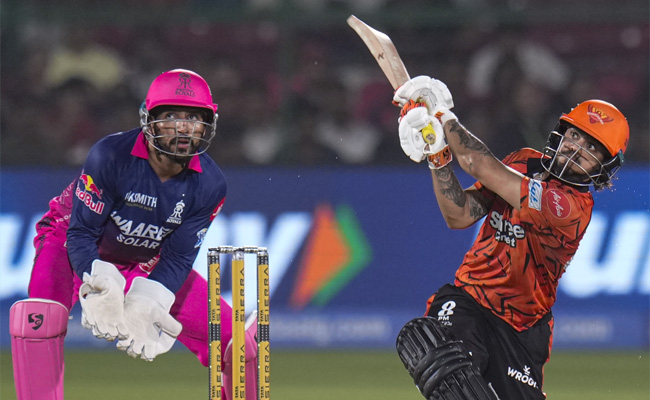
Jaipur (PTI): Vaibhav Sooryavanshi's century went in vain as Sunrisers Hyderabad beat Rajasthan Royals by five wickets in their IPL match here on Saturday.
Sooryavanshi hammered his second hundred in the IPL — a 37-ball 103 — as Rajasthan Royals put on board a strong 228 for six after they were put in to bat first.
Sooryavanshi got plenty of support from Dhruv Jurel, who made a 35-ball 51 and, helped the teenager milk 112 runs for the second wicket. In the death overs, Donovan Ferreira (33) played some big shots as RR went past the 200-run mark.
But, SRH chased down the target of 229 with nine balls to spare, with Ishan Kishan top-scoring with a 74 off 31 balls. Abhishek Sharma chipped in with 57 off 29 deliveries as SRH reached 229 for 5 in 18.3 overs.
Brief Scores:
Rajasthan Royals: 228/6 in 20 overs (Vaibhav Sooryavanshi 103, Dhruv Jurel 51; Pat Cummins 1/27, Eshan Malinga 2/38).
Sunrisers Hydearabad: 229 for 5 in 18.3 overs (Ishan Kishan 74, Abhishek Sharma 57; Jofra Archer 2/34, Brijesh Sharma 2/44).