Lok Sabha adjourned till 12 noon
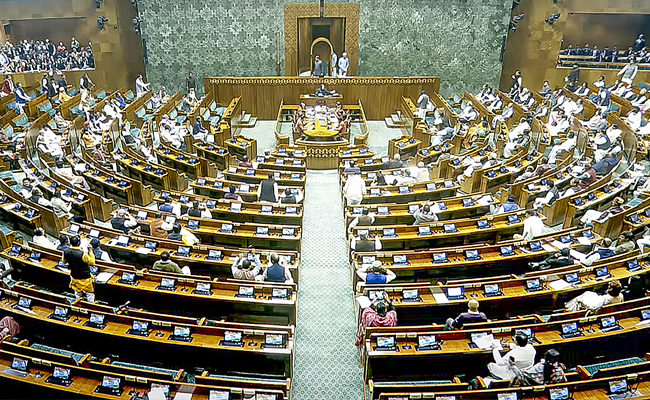
New Delhi (PTI): The Lok Sabha was adjourned till 12 noon on Tuesday amid protests by opposition members seeking to raise various issues.
As soon as the House met, Speaker Om Birla talked about the repeated disruptions of Lok Sabha proceedings over the past few days due to protests by the members.
He said the House has its own respect, high standard and dignity, and no one should try to lower these.
"Ours is the largest democracy in the world and it fulfils the hopes and aspirations of the people. We all have to maintain the dignity of the House. But I have seen that in the last few days certain things have happened which were not good," he said.
Without elaborating, Birla said it was noticed that even senior leaders took part in these incidents, which was not good.
At this, Union Minister of State for Parliamentary Affairs Arjun Ram Meghwal said the opposition should tender an apology for its behaviour.
"Be it opposition or ruling party members, everyone should maintain dignity and work in such a way that a positive message goes out of this temple of democracy," Birla said.
The speaker said agreement and disagreement are part of the healthy democratic process and both sides should sit across the table and iron out their differences.
He said Question Hour, the first hour of the daily business of the House, is very important and everyone should try and ensure it is held smoothly.
After this, Birla started Question Hour.
Immediately, the opposition members were on their feet, seeking to raise their issues.
"You don't want to run the House? Please allow the House to function normally," the Speaker said.
The opposition MPs ignored his pleas, leading to Birla adjourning the House till 12 noon.
The opposition's protests over the BJP's allegations of links between the Congress and Hungarian-American businessman George Soros, and the Adani issue rocked the Lok Sabha on Monday too, leading to the adjournment of the House without transacting any significant business.
The proceedings of the House were washed out in the first week of the winter session starting November 25 due to protests by opposition members demanding discussion on issues like the indictment of industrialist Gautam Adani in a US court and Sambhal violence.
Last week, the House functioned properly for only two days -- Tuesday and Wednesday.
On Thursday, BJP member Nishikant Dubey sought to draw some linkages between a foreign billionaire investor and a section of opposition leaders, and claimed an international conspiracy was afoot to derail India's success story under Prime Minister Narendra Modi.
Congress leader Gaurav Gogoi and others tried to counter the allegations levelled by Dubey, leading to turmoil and adjournment of the House.
Let the Truth be known. If you read VB and like VB, please be a VB Supporter and Help us deliver the Truth to one and all.
What is a ‘substantive motion’? BJP MP initiated one against Rahul Gandhi? Full details here
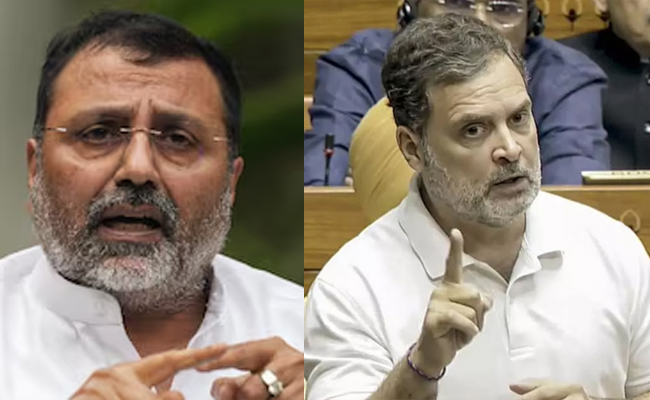
New Delhi: Bharatiya Janata Party (BJP) MP Nishikant Dubey on Thursday said he has initiated a substantive motion against Leader of Opposition in the Lok Sabha Rahul Gandhi, alleging that he was “hand in glove” with “anti-national” forces.
After Dubey raised the matter during the zero hour in the house, protests ensued leading to adjournment for the day.
In his notice, Dubey accused Rahul Gandhi of having engaged with the Soros Foundation, the Ford Foundation, and USAID, and had travelled to Thailand, Cambodia, Vietnam, and the United States to carry out “anti-India” activities.
Speaking to the presspersons outside Parliament, Dubey said he had demanded cancellation of Gandhi’s membership and sought that he be banned from contesting elections for life time.
Dubey had earlier, in February 2025, filed a privilege motion against Rahul Gandhi accusing him of distorting facts and attempting to undermine the prestige of the country through his speech in the Lok Sabha.
While Parliamentary Affairs Minister Kiren Rijiju had indicated that the government might move a privilege motion, but government sources on Thursday said no such decision had been taken.
Responding to the motion, Congress general secretary K. C. Venugopal stated that the Congress party was “not bothered about any motions.”
Venugopal criticised the removal of parts of Rahul Gandhi’s speech during the Lok Sabha debate on the India-U.S. interim trade deal, in which Gandhi had accused the government of compromising national interests.
He also defended the Congress’ move to submit a notice seeking the removal of the Lok Sabha Speaker, stating that the party had not been receiving justice from the Chair.
Responding to the BJP’s criticism, he asked what privilege Gandhi had violated and said that despite past action against him, voters had returned him to Parliament with a higher margin.
What is a substantive motion?
A substantive motion is a formal proposal brought before the Lok Sabha to get a clear and final decision from the House.
It is a complete proposal by itself and is not connected to any other matter being discussed. If the House approves it, the motion becomes the official opinion or decision of the Lok Sabha on that issue.
According to the Lok Sabha rules, such a motion can be taken up only if the Speaker allows it. The Speaker has full authority to accept or reject the proposal and also decides when and how it will be discussed.
If the Speaker admits the motion, members can debate it and then vote on it. In some cases, the matter may also be sent to a special committee to study the issue and submit a report.
A substantive motion forces the House to seriously consider a specific issue and take a clear stand. Since Rahul Gandhi is the Leader of the Opposition, which is a constitutional position, any action against him must follow a proper parliamentary process. A substantive motion provides that proper procedure.