Lok Sabha passes Bill to encourage institutional arbitration
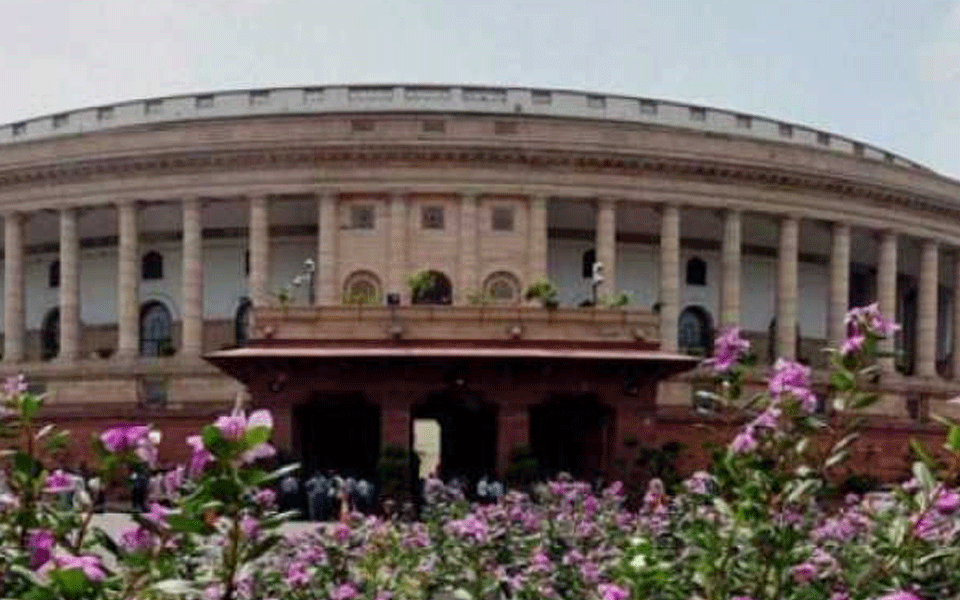
New Delhi, Aug 10 : The Lok Sabha on Friday passed a bill that seeks to encourage institutional arbitration for settlement of disputes and make India a centre of robust Alternative Dispute Resolution (ADR) mechanism.
Replying to debate on the Bill, Law Minister Ravi Shankar Prasad said: "It is a giant leap in favour of institutional arbitration."
"It is a historic moment. We want to make India the hub of domestic and international arbitration. We have very good lawyers, jurists, advocates and judges in India, then why can't we do it," he said.
He said the goverment wants best arbitrators should also come from India.
"It is believed that only the British Queen's Councillors are the best barristers. This is a kind of imperialism. They are monopolising arbitration even in Singapore. They maybe good arbitrators but they are not the best. Our government will not allow a new imperialism to come in arbitration globally which brings in only a particular type of arbitrators," he said.
He said IT professionals should be brought in the process of arbitration and the Bill will give accountability and grading of arbitration a lot of importance.
Referring to Trinamool Congress member Saugata Roy who took part in the debate, Prasad said he could also play a role in the process of arbitration if he decides to leave politics.
The Arbitration and Conciliation (Amendment) Bill, 2018, seeks to establish Arbitration Council of India (ACI) for the promotion of arbitration, mediation, conciliation and other ADRs.
Earlier, moving the Bill, Minister of State for Law and Justice P.P. Chaudhary said commercial disputes have increased manifold due to globalization and the dispute resolution mechanism being created by the government will prove to be a milestone.
Participating in the debate, Congress member Sunil Jakhar said that Rafale fighter jet deal with France would go for arbitration and alleged that 36 fighter jests were being purchased by Modi government at almost the same price negotiated by the UPA government for 126 aircraft.
He claimed that the then foreign secretary "did not know that the deal of this quantum was being signed" and alleged that Official Secrets Act had been breached.
Congress members also raised slogans in favour of a joint parliamentary committee.
The Bill seeks to amend the Arbitration and Conciliation Act, 1996 to facilitate speedy appointment of arbitrators through designated arbitral institutions by the Supreme Court or the High Court, without having any requirement to approach the court in this regard.
It would grade arbitral institution and accredit arbitrators by laying down norms.
It will evolve policy and guidelines for the establishment, operation and maintenance of uniform professional standards relating to arbitration and ADR mechanism. The ACI shall also maintain an electronic depository of all arbitral awards,
The Bill seeks to exclude international arbitration from the bounds of timeline and provides that time limit for arbitral award in other arbitrations shall be within 12 months from the completion of the pleadings of the parties.
The Bill provides that the arbitrator and the arbitral institutions shall keep confidentiality of all arbitral proceedings except award and protect an arbitrator from suit or other legal proceedings from any action or omission done in good faith in the course of arbitration proceedings.
Officials said that the Arbitration and Conciliation Act, 1996, was amended by the Arbitration and Conciliation (Amendment) Act, 2015 in order to make arbitration process user friendly, cost effective and ensure speedy disposal and neutrality of arbitrators.
However, to give a boost to institutional arbitration vis-a-vis ad hoc arbitration and to remove some practical difficulties, a high-level committee under the chairmanship of Justice B.H. Srikrishna, a retired Supreme Court judge, was formed by the Centre.
They said the committee submitted its report on July 30, 2017 and the proposed amendments are in accordance with the recommendations.
Let the Truth be known. If you read VB and like VB, please be a VB Supporter and Help us deliver the Truth to one and all.
Two injuries, one DNF, a DQ as India end messy World Relays campaign
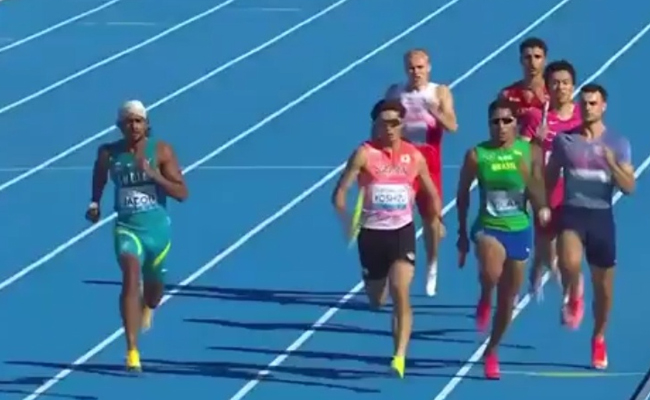
Gaborone (Botswana) (PTI): Amoj Jacob and Ragul Kumar got injured during the men's 4x400m and 4x100 races respectively as India ended their World Athletics Relays campaign in disappointment on the second day of competitions here on Sunday.
The Indian camp had high hopes of making the 2027 World Championships in the men's 4x400m relay but the team did not finish (DNF) the race as Jacob suffered cramps and pulled out of the race after taking the baton from the first leg runner Dharamveer Choudhary. Rajesh Ramesh and Vishal TK were to run in the third and fourth legs.
Those teams which could not qualify for the 2027 Beijing World Championships by reaching the final round of each of the six relay events on Saturday were given another chance in the second qualification round on Sunday.
The top two teams in each of the two heats (in all six relay events) booked the Beijing ticket on Sunday.
India will now have to try and qualify for the World Championships through the Top Lists of the World Athletics, which is a long and tedious process.
In the men's 4x100m race, third leg runner Ragul Kumar fell down the track after failing to hand over the baton inside the exchange zone to fourth leg runner Gurindervir Singh, which clearly showed the lack of coordination among the runners.
Harsh Santosh Raut and Animesh Kujur ran the first two legs.
The Indian quartet was disqualified and Kumar was seen being taken away from the Field of Play with the help of the volunteers.
It was a comedy of errors in the case of the women's 4x100m race, which saw the baton being dropped during an exchange between first leg runner Tamanna and second runner Nithya Gandhe, though the Indians finished the race in 53.09 seconds.
Gandhe started running quite a distance, but after realising that the baton was not in her hand, she turned and ran back to pick it up.
The only silver-lining for the Indian contingent was the national record time in the mixed 4x100m relay race, though the quartet of Ragul Kumar, Nithya Gandhe, Animesh Kujur and Sneha SS finished sixth in heat number two with a time of 41.35 seconds, bettering the previous national mark of 42.30 seconds set in March in Chandigarh.
The mixed 4x400m relay quartet of Theerthesh P Shetty, Kumari Saloni, Nihal William and Rashdeep Kaur ended at fifth in heat number one with a time of 3 minutes and 19.40 seconds.
On Saturday, all the five Indian relay teams had failed to make it to the respective final rounds and thus missed out on the 2027 World Championships berths.