Maha simmers after Pune violence; protests erupt in Mumbai
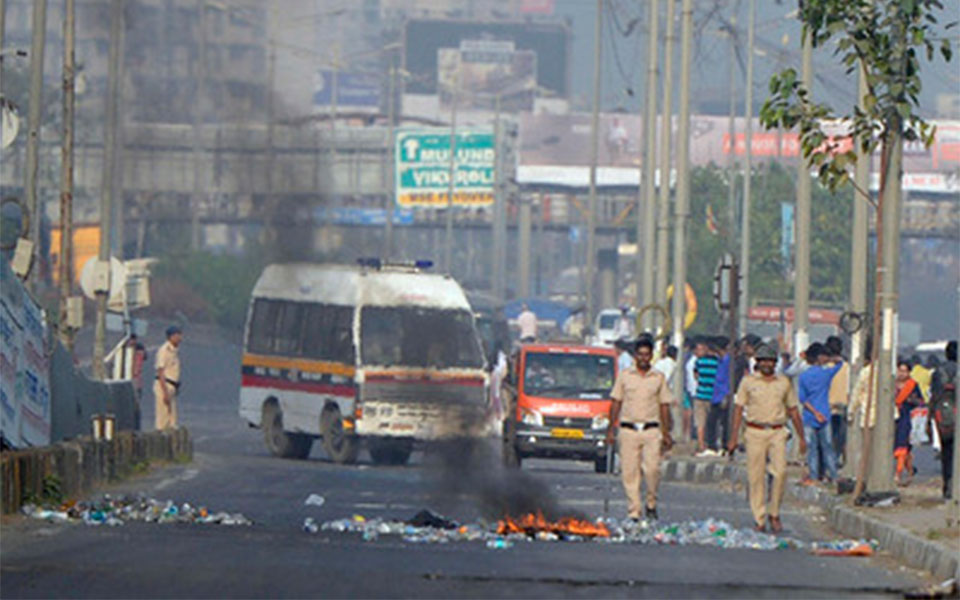
Mumbai: Several towns and cities in Maharashtra were on edge today as Dalit protests against yesterday's violence in Pune spilled over to capital Mumbai, with agitators damaging scores of buses, and disrupting road and rail traffic, officials said.
Clashes between Dalit groups and supporters of right-wing Hindu organisations during the 200th anniversary celebrations of the Bhima-Koregaon battle in Pune district had left a man dead yesterday.
In Pune, cases were registered by the Pimpri police against Milind Ekbote and Sambhaji Bhide, who head the Hindu Ekta Aghadi and Shivraj Pratishthan respectively, for allegedly inciting the violence. The two organisations had opposed the celebration of "British victory" in the battle.
Over 160 buses were damaged in Mumbai by rampaging protesters over 100 of whom were detained, police said.
Chief Minister Devendra Fadnavis ordered a judicial inquiry by a sitting judge of the Bombay High Court into the Pune violence, and appealed for calm. He said it needed to be ascertained if there was a conspiracy behind yesterday's violence.
Fadnavis said a Rs 10 lakh compensation would be given to kin of the youth killed and his death would be probed by the CID.
Prakash Ambedkar, the Bharipa Bahujan Mahasangh leader and grandson of B R Ambedkar, has called a 'Maharashtra bandh' tommorrow to protest against the government's "failure" to stop the violence.
Dalit groups were celebrating the bicetenary of the Bhima-Koregaon battle which the forces of the British East India Company had won over those belonging to the Peshwa.
Dalit leaders commemorate the British victory, as it is believed that soldiers from the Mahar community - then considered untouchable - were part of the East India Company's forces. The Peshwas were Brahmins, and the victory was seen as a symbol of assertiveness by Dalits.
Congress president Rahul Gandhi called the event to celebrate the Bhima-Koregaon battle as a "potent symbol" of resistance to RSS-BJP's "fascist vision".
"A central pillar of the RSS/BJP s fascist vision for India is that Dalits should remain at the bottom of Indian society. Una, Rohith Vemula and now Bhima-Koregaon are potent symbols of the resistance," he tweeted.
In Mumbai, protesters disrupted road traffic in the suburbs and local train services on the Harbour Line. They blocked roads in several areas, forced shops to shut down, and also attacked a journalist of a television news channel.
Protesters staged a rail roko in Chembur.
Groups of protesters held demonstrations in Chembur, Vikhroli, Mankhurd and Govandi, police said.
Hundreds of protesters gathered in Priyadarshini, Kurla, Sidharth Colony and Amar Mahal areas on the Eastern Express Highway, took out processions and raised slogans against the government and the administration.
Protests were also held in Kolhapur, Parbhani, Latur, Ahmednagar, Aurangabad, Hingoli, Kolhapur, Nanded and Thane districts, police said.
Heavy security was deployed in the eastern suburbs of Mumbai.
The Mumbai police, meanwhile, issued a statement appealing to people not to believe in rumours and verify facts with the police before posting anything on social media.
Maharashtra minister of state for home Deepak Kesarkar today visited Bhima-Koregoan and neighbouring villages and said the situation was under control.
NCP chief Sharad Pawar blamed the administration for yesterday's violence and demanded a probe into the incident.
Appealing for peace, Pawar said such situations need to be defused patiently by those in political and social spheres without any provocative speeches being made.
"Since the administration did not take precautions, rumours and misunderstanding spread. A youth in Nanded died unfortunately. People from political and social field should defuse the situation harmoniously and patiently without making provocative speeches," the former Union minister said.
Maharashtra Congress chief Ashok Chavan condemned the violence and urged people not to believe in rumours.
Antisocial elements were trying to create tensions between Dalits and Maratha communities for political benefit, he said.
Leader of Opposition in the Maharashtra Legislative Council Dhananjay Munde said the violence was unfortunate and condemnable.
AAP spokesperson Preeti Sharma Menon said the Fadnavis government failed to keep peace. "The attack has resulted in unrest across the state between upper caste Hindus and Dalits," she said.
Let the Truth be known. If you read VB and like VB, please be a VB Supporter and Help us deliver the Truth to one and all.
T'gana RTC strike: Talks between govt, employees successful

Hyderabad (PTI): Talks between employees of Telangana State Road Transport Corporation (RTC) who were on strike and the state government concluded successfully on Friday as the government agreed to the key demands of the workmen.
Following a day-long marathon of talks between the leaders of the employees' Joint Action Committee (JAC) and the cabinet sub-committee, the government announced after midnight that it acceded to the demands, including a merger of RTC with the government, 11 per cent pay revision and elections to the employees' unions.
A committee comprising officials and employee leaders would be appointed over the merger of RTC with the government, it said.
The RTC management has also agreed to address the remaining issues as well, an official release said.
The employees would call off their strike and the RTC buses would hit the roads shortly, it said.
The employees had been on an indefinite strike since April 22 over a series of demands, including the merger of RTC with the government.
Earlier in the day, a driver of the RTC, who attempted suicide on April 23 during the strike, died at a hospital here in the early hours of Friday.
Shankar Goud, a 55-year-old driver, set himself ablaze by pouring petrol at Narsampet in Warangal district when the employees were staging a protest on Thursday in support of their demands.
Goud suffered serious burns, was initially admitted to a state-run hospital in Warangal, and later shifted to a super-speciality hospital in Hyderabad for advanced treatment.
"He succumbed (to injuries) at about 1.30 am on Friday," a senior official said.
The driver’s body was taken to his relative’s village, Muttojipet in Warangal district, for funeral rites.
Tension prevailed in Muttojipet as his family members and RTC employees attempted to take the body to the Narsampet bus station, where he worked, to enable his colleagues to pay their last respects. However, police did not permit this, citing law-and-order concerns.
This led to a deadlock before the funeral could proceed.
Union Minister Bandi Sanjay Kumar criticised the Telangana government for not allowing the body to be taken to the Narsampet bus station.
Kumar, Minister of State (Home), visited Muttojipet village in Warangal district, where the funeral was held, and paid homage to Goud.
“They (family members) want to take the body to the bus depot for five minutes. Is the RTC bus depot in Pakistan or Bangladesh? They are emotionally attached to taking the body there. The government is hurting sentiments and creating fear among RTC employees,” Kumar told reporters.
He also expressed anger at the police for not allowing the body to be taken to the bus station and staged a protest, according to a release from his office.
RTC employees and BJP workers attempted to take the mortal remains in an ambulance to Narsampet, but were stopped by the police.
Later, after discussions with the police, the family members and RTC employees agreed to conduct the funeral in the village.
Sanjay Kumar, stating he would abide by the family’s decision, left the village after the funeral was conducted there.
Transport Minister Ponnam Prabhakar said an ex gratia of Rs 10 lakh, a house, and a government job would be provided to the kin of Goud.
Chief Minister A Revanth Reddy expressed shock over the employee’s death and conveyed deep condolences to the grieving family, according to the release.
The RTC employees’ JAC had earlier announced an agitation programme from April 24 to 29, including silent marches and submission of memorandums to MLAs and other leaders.