Maldives President Muizzu formally asks India to withdraw military personnel from his country
Male, Nov 18: Less than 24 hours after taking oath as the President of Maldives, Mohamed Muizzu on Saturday formally requested the Government of India to "withdraw" its military personnel from his country, saying the Maldivian people have given a "strong mandate" to make this request to New Delhi.
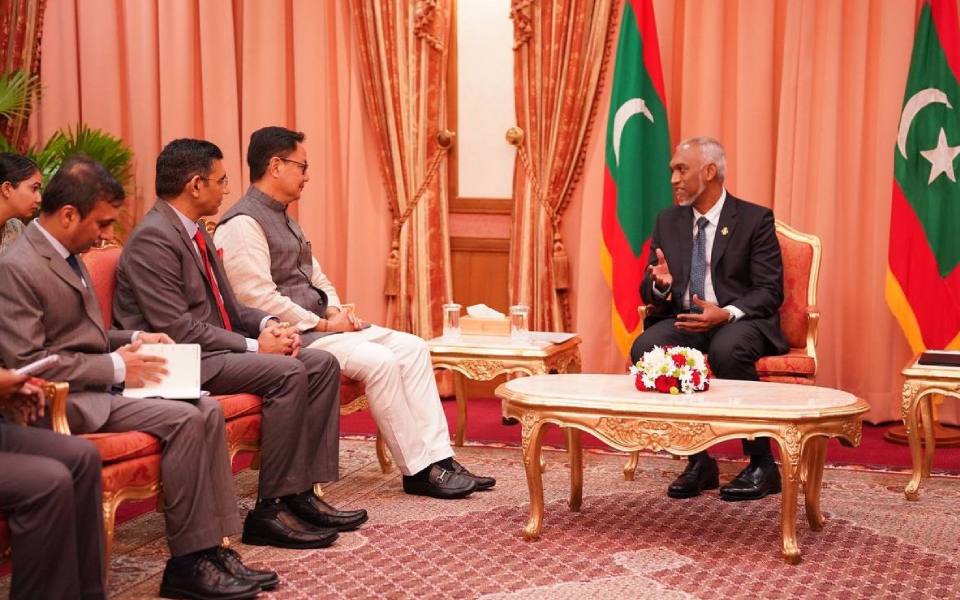
Muizzu's request came when India's Union Minister Kiren Rejiju paid a courtesy call on the new president at the latter's office, the Maldivian President's Office said in a press release.
The exact number of Indian military personnel in the Maldives is not known.
Engineer-turned-politician, Muizzu, 45, took oath on Friday as the eighth president of the strategically-located archipelago nation in the Indian Ocean. Underscoring India's Neighbourhood First Policy', Rijiju represented the country at Muizzu's inauguration ceremony.
A close associate of former Maldives President Abdulla Yameen, who forged close ties with China during his Presidency from 2013 to 2018, Muizzu defeated India-friendly incumbent Ibrahim Mohamed Solih in the presidential runoff held in September. Muizzu had indicated during the election campaign that the withdrawal of Indian military troops from the island nation is among the issues that need to be resolved by the two countries.
Soon after the oath-taking on Friday, Muizzu asserted that he was firmly committed to ensuring that his country remains "free" of any "foreign military presence" to preserve its independence and sovereignty. However, he did not name any country in his inaugural address.
"At the meeting, President Muizzu formally requested the Government of India to withdraw its military personnel from the Maldives.
"The President noted that at the Presidential Election held in September, the Maldivian people had given him a strong mandate to make the request to India and expressed the hope that India will honour the democratic will of the people of the Maldives," the statement from the President's Office said here.
While discussing the matter with Rijiju, Muizzu also acknowledged the significant role of the two helicopters in providing numerous emergency medical evacuations.
Maldives is India's key maritime neighbour in the Indian Ocean Region (IOR) and occupies a special place in the Prime Minister's vision of SAGAR' (Security and Growth for All in the Region) and the Neighbourhood First Policy.'
Maldives' proximity to the west coast of India (barely 70 nautical miles away from Minicoy and 300 nautical miles away from India's West coast), and its location at the hub of commercial sea lanes running through the Indian Ocean gives it significant strategic importance to India.
Rijiju conveyed his best wishes to the President, representing the sentiments of the Government and the people of India, the statement said, adding.
The Minister expressed his aspiration to foster a constructive relationship with the Maldives, acknowledging the presence of a vibrant Indian community residing in the Maldives."
"Privileged to call on President H.E. Dr. Mohamed Muizzu. Conveyed greetings from Hon'ble PM @NarendraModi and reiterated India's commitment to further strengthen the substantive bilateral cooperation and robust people-to-people ties," Rijiju posted on X.
India was the first to assist Maldives during the 2004 Tsunami as well as the water crisis in Male in December 2014.
Muizzu and Rijiju also reviewed the progress of the implementation of various projects in the Maldives with the support of India.
"The President emphasised the importance of accelerating the Greater Male' Connectivity Project (GMCP), highlighted the importance of addressing and overcoming the issues delaying the project," the statement said.
Privileged to call on President H.E. Dr. Mohamed Muizzu.
— Kiren Rijiju (@KirenRijiju) November 18, 2023
Conveyed greetings from Hon’ble PM @NarendraModi and reiterated India’s commitment to further strengthen the substantive bilateral cooperation and robust people-to-people ties. pic.twitter.com/nFa95QD9ES
Let the Truth be known. If you read VB and like VB, please be a VB Supporter and Help us deliver the Truth to one and all.
Three private doctors arrested in illegal scanning case involving 31 minor pregnant girls in KR Pet
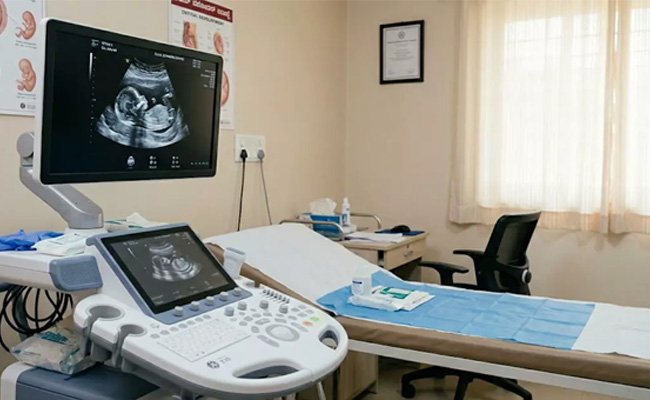
Mandya: Police on Tuesday arrested three private doctors in connection with a case involving alleged illegal scanning of 31 minor pregnant girls at a private diagnostic centre in KR Pet. The accused were later remanded to judicial custody.
The arrested doctors have been identified as Dr. Divyachetan of Chetana Maternity Centre, Dr. Harshit of Navi Diagnostic Centre, and Dr. Harish of Kushal Diagnostic Centre.
Police said Priyanka, a gynaecologist attached to a government hospital, is absconding and efforts are under way to trace her.
The case came to light after Karnataka Lokayukta Police recently conducted raids, during which illegal sex determination tests on minor pregnant girls were allegedly detected at two diagnostic centres in KR Pet town.
Following the raids, District Health and Family Welfare Officer Dr. Mohan, Deputy Director of the Women and Child Development Department P.S. Asha, and District Child Protection Officer Rashmi inspected several diagnostic centres and filed cases at KR Pet Town and Rural police stations.
According to the allegations, Navi Diagnostic Centre conducted scans on 24 minor pregnant girls, including 19 cases in 2024 and five in 2025. Kushal Diagnostic Centre is accused of conducting scans on seven minor pregnant girls.
Meanwhile, Deputy Commissioner Dr. Kumar has directed taluk vigilance committees to inspect all 63 ultrasound scanning centres in the district and submit reports within 10 days.
Officials said the Tahsildar of each taluk has been appointed chairperson of the respective committee.