MobiKwik confirms financial fraud in Haryana; says no impact on user accounts
_vb_23.jpeg)
New Delhi (PTI): Fintech firm One MobiKwik Systems on Thursday confirmed that a technical glitch had led to unauthorised payments in and around one district of Haryana last week, and said remedial measures had been taken with financial impact contained and quantified.
The company, in a statement, clarified that the incident did not affect UPI, wallet payments, or user account balances.
"MobiKwik confirms that an isolated technical issue on September 11-12, 2025, led to certain failed transactions being incorrectly marked as successful, resulting in unauthorised payouts to some merchants in and around the Nuh district of Haryana. A few merchants and users from this area exploited this issue to gain undue financial benefit.
"Upon identification in the early hours of September 12, the Company immediately took corrective action and resolved the issue within 45 minutes. The total financial impact has been contained and quantified," it said, adding that no employees, management personnel or insiders were involved in the fraud.
MobiKwik said it has since strengthened monitoring systems and implemented additional control measures.
Legal Enforcement Agency (LEA) has taken proactive steps to put a debit freeze and lien mark all the bank accounts where the unauthorised settlements were credited, the company had said in a regulatory filing.
"Based on preliminary data, as a risk mitigating measure... FIR was lodged for an amount of Rs 40 crore; out of which, the Company has recovered around Rs 14 crore. Thus, the estimated net impact is Rs 26 crore. The Company is taking aggressive collection efforts while pursuing legal course of action to recover the full amount over a period of time," the filing said.
Police said six people have been arrested so far. The accused were identified as Rehan, a resident of Rewasan village in Nuh district; Waqar Yunus, Mohammad Amir and Mohammad Ansar, residents of Kameda village in Nuh; Wasim Akram of Maroda village in Nuh; and Mohammad Sakil of Utawad village in Palwal district.
"During interrogation, the accused revealed that due to some technical glitch in the MobiKwik app, all the transactions done through the app were getting completed successfully irrespective of whether there was any balance in one's bank account or MobiKwik wallet or not. Even after entering the wrong password in the app, the transactions were being completed successfully.
"The accused committed fraud to earn unfair profits. The bank accounts of about 2,500 people in whose accounts the money was transferred were frozen," a Gurugram police spokesperson said.
The accused were produced before a city court on Tuesday, which remanded them in judicial custody, police added.
Let the Truth be known. If you read VB and like VB, please be a VB Supporter and Help us deliver the Truth to one and all.
PM unveils development projects worth over Rs 4,000 crore in Sikkim
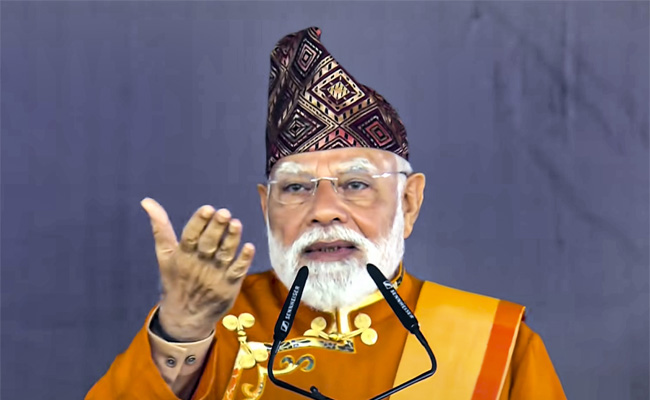
Gangtok (PTI): Prime Minister Narendra Modi on Tuesday launched development projects worth over Rs 4,000 crore in Sikkim while attending the closing ceremony of the state's 50 years of statehood celebrations.
The projects span a wide range of sectors such as infrastructure, connectivity, healthcare, education, power, urban development, environment, tourism and agriculture, the officials said.
These projects are aimed at accelerating holistic and inclusive development in Sikkim.
The PM's visit marks an important milestone in the golden jubilee year of Sikkim's statehood and reflects the government's "continued commitment to the rapid and sustainable development of the Himalayan state", the officials said.