Moderate to heavy snowfall in Kashmir
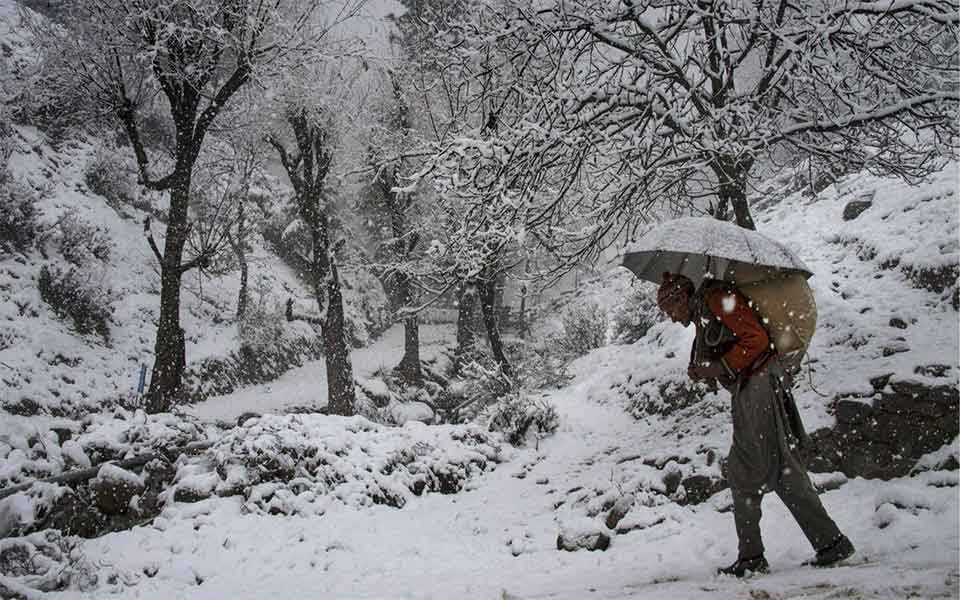
Srinagar, Jan 30 (PTI) The seven-week dry spell ended in Kashmir today with higher reaches of the Valley getting fresh snowfall while rains lashed the plains even as the minimum temperatures rose across the region to breach the freezing point for first time this year.
Moderate to heavy snowfall is going on in higher reaches in north Kashmir, that led to closure of roads leading to Macchil, Keran and Karnah, a police official said.
He said Gulmarg skiing resort also received fresh snowfall and three inches of fresh snow had accumulated there till 10.00 AM.
The plains across the valley received light rainfall since early morning, the official said.
The downpour has ended seven weeks of dry weather in Kashmir, which had resulted in problems for elderly and children, while the minimum temperature also appreciated by several degrees at most places.
Srinagar recorded a minimum temperature of 2.2 degrees Celsius, up from minus 1.6 degrees Celsius the previous night, an official of the MET department said here.
The night temperature in Qazigund town in south Kashmir was 0.2 degrees Celsius compared to minus 3.8 degrees Celsius previous night while nearby Kokernag town registered a low of minus 0.6 degrees Celsius last night, up by nearly two degrees, the official said.
Kupwara in north Kashmir recorded a low of 0.4 degrees Celsius against minus 3.4 degrees Celsius the previous night.
The official said the night temperature in Pahalgam, the famous health resort which also serves as one of the base camps for the annual Amarnath Yatra, settled at a low of 1.2 degrees Celsius against minus 2.3 degrees Celsius previous night.
Gulmarg, the famous skiing resort in north Kashmir, recorded a low of minus 4.6 degrees Celsius against minus 5.6 degrees Celsius previous night.
It was the coldest recorded place in the valley last night.
The mercury in Kargil town, in Ladakh region, remained unchanged at minus 15.0 degrees Celsius, the official said.
He said Kargil continued to be the coldest recorded place in the state.
The nearby Leh town was the second coldest as the mercury there settled at a low of minus 11.9 degrees Celsius up two degrees from previous night.
Kashmir is currently under the grip of Chillai-Kalan, a 40-day harshest period of winter when the chances of snowfall are most frequent and maximum and the temperature drops considerably.
It ends on January 31, but the cold wave continues even after that in the valley.
The 40-day period is followed by a 20-day long Chillai-Khurd (small cold) and a 10-day long Chillai-Bachha (baby cold).
Let the Truth be known. If you read VB and like VB, please be a VB Supporter and Help us deliver the Truth to one and all.
Jaishankar holds talks with Russia's Lavrov; trade, geopolitics top agenda
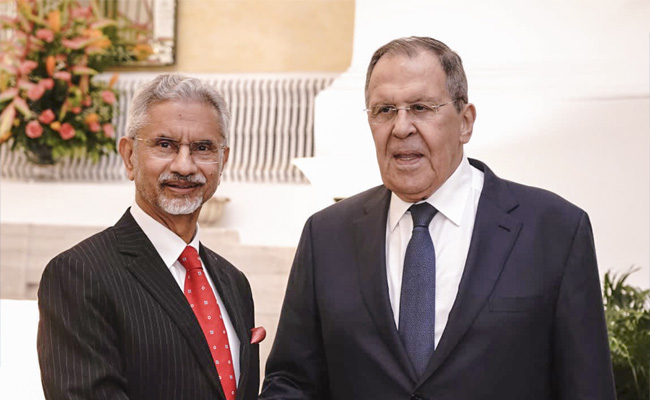
New Delhi (PTI): External Affairs Minister S Jaishankar and Russian Foreign Minister Sergey Lavrov held "productive" talks on Wednesday to advance bilateral cooperation in energy and trade amid shifting geopolitical tensions.
Jaishankar met Lavrov, shortly after the Russian foreign minister landed in New Delhi to attend a two-day conclave of the BRICS member states beginning Thursday.
Iranian Foreign Minister Abbas Araghchi, Brazil's Foreign Minister Mauro Vieira and South Africa's Minister for International Relations Ozzy Lamola are among those who already arrived in the national capital for the BRICS foreign ministerial meeting.
Jaishankar and Lavrov are learnt to have deliberated on the West Asia crisis as well as the Ukraine conflict.
In a social media post, the external affairs minister described his talks with his Russian counterpart as "productive exchange of views".
"Our conversation touched upon several aspects of the India-Russia Special and Privileged Strategic Partnership, including trade and investment, energy and connectivity, science and technology, as well as facilitating mobility of skills and talent," he said.
"Other global and multilateral issues of mutual interest were also discussed," he said.
It is not immediately known if India's procurement of Russian crude oil figured in the talks.
In his televised opening remarks at the meeting, Jaishankar said India and Russia have a shared interest in strengthening multipolarity and could benefit through greater "de-risking" .
"The last few years have seen a steady and sustained growth in our bilateral partnership. Its economic and energy dimensions have become pronounced. Our political cooperation is even more valuable in an uncertain and volatile global environment," Jaishankar said.
"We have expanded our collaboration in science and technology. The mobility of talents and skills has acquired greater salience and our interest in ensuring better connectivity is deeper," he said.
"The complicated international situation also merits an open exchange of views, especially between two trusted partners," he said.
The external affairs minister said India and Russia have a shared interest in strengthening multipolarity.
Jaishankar also held separate bilateral talks with Brazilian Foreign Minister Vieira South Africa's Ozzy Lamola.
The external affairs minister also met Maldivian Foreign Minister Iruthisham Adam.
"Underlined our Neighbourhood First policy and reviewed our bilateral cooperation. Reiterated India's commitment to Maldives' progress and development," he said on X.
India, as the chair of the BRICS, is hosting the conclave of the foreign ministers ahead of the annual summit of the grouping in September.
BRICS, originally comprising Brazil, Russia, India, China, and South Africa, expanded in 2024 to include Egypt, Ethiopia, Iran, and the United Arab Emirates, with Indonesia joining in 2025.
It has emerged as an influential grouping as it brings together 11 major emerging economies of the world, representing around 49.5 per cent of the global population, around 40 per cent of the global GDP and around 26 per cent of the global trade.
The BRICS meeting will be chaired by Jaishankar.