Modi's no-holds-barred attack on Rahul, throws 'phone banking' jibe
New Delhi, Sep 1 : In a no-holds-barred attack on Congress and its chief Rahul Gandhi, Prime Minister Narendra Modi on Saturday accused "one privileged family" of being responsible for the huge scam in bank loans through "phone banking" during the UPA regime and vowed to bring back every rupee that has been caught in NPAs.
He described NPAs as the biggest scam of UPA which it tried to bury by dishing out a figure of Rs 2.5 lakh crore as defaulting loans which was actually Rs 9 lakh crore.
Modi did not take either Rahul Gandhi's name or anyone else in the Congress' first family but he has been using the "naamdaar" (privileged) jibe at Rahul Gandhi and his family.
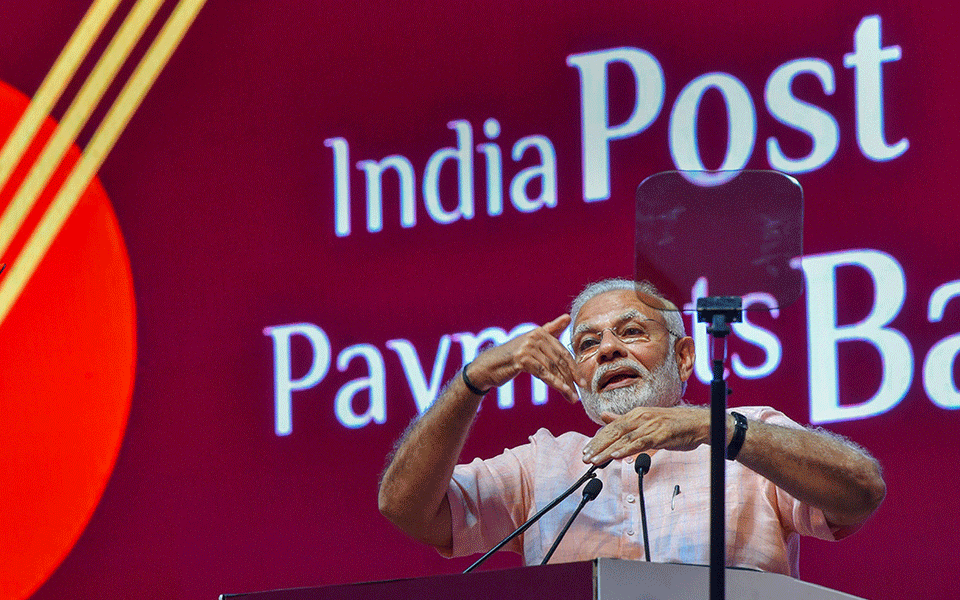
Launching the India Post Payments Bank (IPPB) at a function here, Modi said none of the loans that turned bad were given during the NDA regime. He said his government has identified 12 largest defaulters of pre-2104 period, who failed repay Rs 1.75 lakh crore and action to recover the amount is on.
The government has also identified another 27 defaulters of Rs 1 lakh crore NPAs and the government ws working on its recovery, he said adding that this was found during a review of defaults of above Rs 50 crore after he took charge.
The Prime Minister said earlier the banks used to chase such defaulters but today they were running to the banks to hand over the money as investigative and enforcement agencies were tightening the noose around them.
"Those who were feeling that the loan amount they have taken from banks with the help of 'naamdaar family', will remain always 'incoming' but now 'outgoing' has started from their accounts," he said.
"Every rupee that has been forced into defaults will recovered and used for the development of the poor," he said.
The Prime Minister said the 'privileged' family left a number of landmines in the economy through their indiscriminate lending by phone banking.
"If the government had made it public, it would have had a disastrous effect on economy. The NDA government meticulously brought the country out of this crisis," he said.
The Prime Minister said that his government has taken a number of reform measures like the passage of Fugitive Economic Offenders Bill, which would enable seizure of the assets of defaulters even if they are not in the country, and adoption of a professional approach in the banking system.
He said a new measure that has been introduced in banking through which the passport details of those who take big loans were being collected so that they cannot flee the country after defaulting.
Apparently replying to Rahul Gandhi, who had claimed two days ago that the NPAs were only to the tune of Rs 2.5 lakh crore during UPA, Modi said the reality was to the contrary.
"The claim that it was Rs 2.5 lakh crore was a lie and fraud. In fact the real figure was Rs 9 lakh crore. At a time when huge scams were coming to the fore, they (Congress) were busy in suppressing their biggest scam," he said.
He said the UPA government knew that some day the fraud would be unearthed. So they hatched a conspiracy and misled the country by hiding the real figures.
"Instead, when the loans were turning bad, the "privileged" put pressure on the banks to give further loans in the name of 'restructuring' which was another fraud. The banks knew that the money would not come but the officials continued to advance loans recklessly because they had the 'blessings' of the 'naamdaars', he said.
"After independence till 2008, the banks had advanced loans to the tune of Rs 18 lakh crore while in six years alone between 2008-14, it jumped up to Rs 52 lakh crore," he said.
Let the Truth be known. If you read VB and like VB, please be a VB Supporter and Help us deliver the Truth to one and all.
26 killed, 61 injured in blast at fireworks factory in China
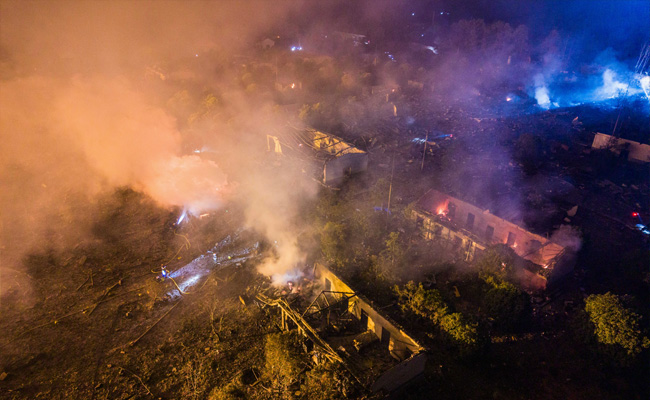
Beijing (PTI): At least 26 people were killed and 61 others injured in a massive explosion at a fireworks factory in China's Hunan province, officials said on Tuesday.
The explosion occurred on Monday afternoon at the plant operated by the Huasheng fireworks manufacturing and display company in Liuyang, a county-level city under Changsha, the provincial capital.
Videos circulating on Chinese social media showed massive destruction of property spanning several kilometres.
ALSO READ: Will of people supreme, says Mahua Moitra after BJP's landslide victory in Bengal
More than 480 rescuers, organised into five teams, have been deployed for relief operations, with three rescue robots pressed into service.
Officials said 26 people were killed and 61 others were injured. The injured have been rushed to hospitals for treatment, while a second round of search operations is underway.
China is a leading manufacturer and exporter of fireworks.
As the explosion site is located near two black powder warehouses, the rescuers have evacuated nearby residents and set up a buffer zone to prevent a secondary accident, the state-run Xinhua news agency reported.
The Ministry of Emergency Management has dispatched experts to the scene to guide rescue efforts.
The person in charge of the company has been detained by police and the cause of the accident is being investigated, the report said.