National emblem only for govt functions: JK CM after Ashoka Stambh plaque vandalised at Hazratbal
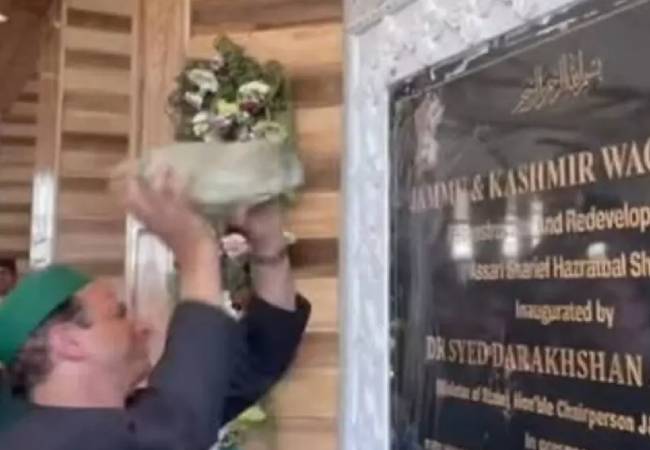
Anantnag (PTI): Jammu and Kashmir Chief Minister Omar Abdullah on Saturday criticised the use of the national emblem on a renovation plaque by the Waqf Board at Srinagar's Hazratbal mosque, asserting that the symbol is meant for government functions and not religious institutions.
Abdullah, who is touring the flood-affected areas in south Kashmir, said the Jammu and Kashmir Waqf Board should apologise for the "mistake" that has hurt religious sentiments.
His comments follow a major controversy that erupted after the plaque bearing the Ashoka emblem was placed inside the revered Hazratbal shrine and vandalised by unidentified people shortly after prayers on Friday.
Police on Saturday registered a case on charges of breach of peace, rioting and criminal conspiracy against unidentified persons in connection with the incident.
"First, the question arises whether the national emblem should have been used on this stone or not. I have never seen an emblem being used in this way in any religious place," Abdullah told reporters while visiting flood-affected areas here.
"Mosques, shrines, temples and gurdwaras are not government institutions. These are religious institutions and government emblems are not used in religious institutions," he said.
The controversy escalated when Waqf Board Chairperson Darakshan Andrabi called for legal action, including booking the "hooligans" under the stringent Public Safety Act (PSA), for removing the emblem.
Abdullah condemned Andrabi's response, saying that the board "played with the sentiments of the people" and is now using threats.
"First, at least, they should have apologised for it. They should admit the mistake. It should not have happened," the CM said.
Abdullah also questioned the necessity of the plaque itself, noting that National Conference (NC) founder Sheikh Mohammad Abdullah completed work on the shrine without seeking any credit.
"What was the need for this plaque? Was the work done not enough? Sheikh Mohammad Abdullah gave shape to this shrine... Even today, people remember his work, despite the fact that he did not use a stone in his name. There was no need to use a stone," the chief minister said.
He said that nowhere in the country is the national emblem used on any religious place. "Google search and you will find that the national emblem is only used in government functions," he said.
During his visit to the flood-affected areas here, Abdullah interacted with the affected families, assuring them that his government stands with them in these testing times and will take all possible measures to help them.
He also held a review meeting in Anantnag to assess the post-flood situation and directed the district administration to expedite relief and rehabilitation, restore essential services, repair damaged infrastructure, strengthen vulnerable embankments and ensure adequate supply of food, medicines and drinking water for the affected population.
Jammu and Kashmir Police on Saturday registered a case against unidentified persons under the provisions of the Bharatiya Nyaya Sanhita (BNS) and the Prevention of Insults to the National Honour Act.
"A case under FIR number 76 of 2025 has been registered at Nigeen police station into the incident at Hazratbal on Friday in which the national emblem was damaged," officials said.
The case has been registered under sections 300 (voluntarily disturbing an assembly lawfully performing religious worship or ceremonies), 352 (addresses intentional insults intended to provoke a breach of the peace or another offence), 191 (2) (rioting), 324 (cause wrongful loss or damage to any person or the public) and 61 (4) (criminal conspiracy) of the BNS.
Friday's incident has drawn widespread criticism from political leaders and the public. Devotee Tanvir Sadiq and NC Srinagar MP Ruhullah Mehdi argued that placing a sculpted figure inside the shrine violates the Islamic principle of monotheism, which forbids idol worship.
The People's Democratic Party (PDP) said it "seems that Muslims are deliberately being provoked" and criticised the call for the use of the PSA as a reflection of a "punitive and communal mindset".
Let the Truth be known. If you read VB and like VB, please be a VB Supporter and Help us deliver the Truth to one and all.
4 held for sexually assaulting woman, girl on moving bus after social media alert in UP's Agra

Agra (UP) (PTI): Four people were arrested, after a prompt response by police following a social media alert, for allegedly sexually assaulting a woman and a girl inside a moving bus here, officials said on Tuesday.
According to an official police statement, at 12:27 am on April 27, information was received on the social media platform X about an incident of sexual assault on a bus travelling from Kanpur to Ahmedabad, which was approaching Namner crossing in Agra.
Acting under the direction of Police Commissioner Deepak Kumar, the Agra Police social media team immediately alerted the Rakabganj police station within minutes and coordinated with the victims to confirm the incident and obtain the exact location, it stated.
Police teams launched intensive checking at Namner crossing and intercepted the bus as it reached the spot. The four accused involved in the incident were apprehended on the spot, and legal action was initiated against them, the statement said.
The police said the swift response and coordination between the social media team and field units ensured timely action, bringing relief to the victims and other passengers, who expressed gratitude towards the police, it added.