Nayab Singh Saini govt in 'minority', Haryana Cong tells governor; seeks dissolution of Assembly
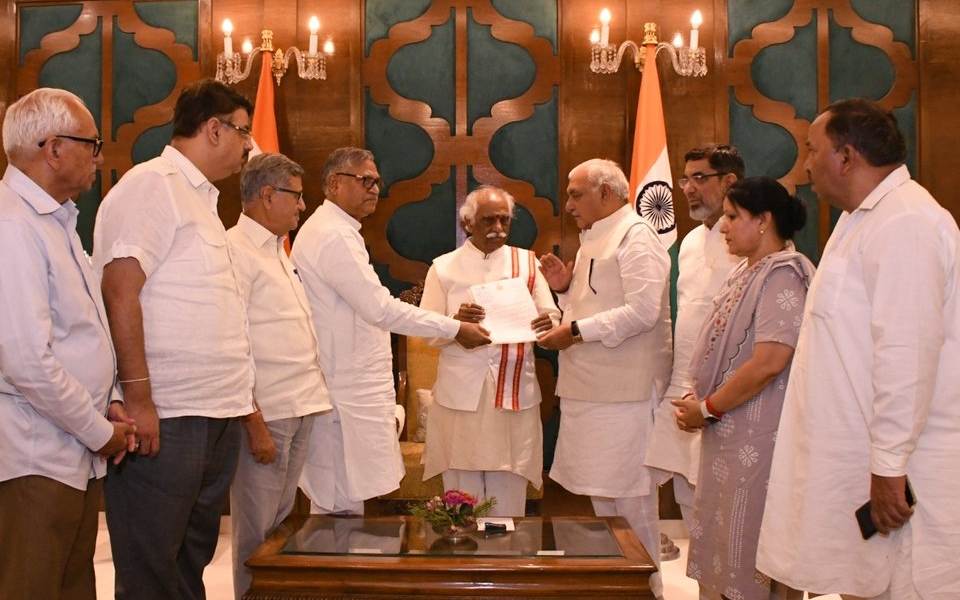
Chandigarh, Jun 21: A delegation of the Haryana Congress met Governor Bandaru Dattatreya here on Thursday, claiming the Nayab Singh Saini's BJP government is in the "minority" and demanding dissolution of the Assembly as well as holding fresh polls.
A party delegation headed by Leader of Opposition Bhupinder Singh Hooda met the governor at the Raj Bhavan here in the evening and submitted a memorandum to him.
Later interacting with reporters, Hooda said, "The government does not have the moral right to stay in power... We have demanded that the House should be dissolved and fresh elections should be held."
In the memorandum to Dattatreya, the opposition party claimed the present government lacks a majority in the House "unless it indulges in horse-trading or use of unconstitutional means".
"Therefore, as the protector of the Constitution, His Excellency the Governor should immediately dismiss the minority government and impose President's rule in the state," the memorandum stated.
"To stop horse trading, which will bring a bad name to the state, the assembly should be dissolved. This is what we have urged (the governor)," Hooda told reporters.
He said in the 90-member Assembly, which currently has an effective strength of 87, BJP has 41 MLAs and has the support of the lone legislator of the Haryana Lokhit Party and Independent member Nayan Pal Rawat.
The total number of MLAs supporting the government is only 43. Whereas at present the number of MLAs in the House is 87 and the majority figure is 44, Hooda said.
Replying to a question, Hooda also stated that Kiran Choudhry, the MLA from Tosham, who switched over to BJP from the Congress, has not resigned as assembly member. So the current strength of the Assembly as of now is 87, he said.
"This makes it amply clear that the present government is in the minority. According to the Constitution and democratic norms, the BJP has no right to continue in the government. To avoid horse trading and ensure the survival of democracy, this minority government of the BJP should be dismissed immediately," the memorandum stated.
"We earnestly request you to discharge your constitutional obligation and dismiss this minority government immediately and impose President's rule in the state to maintain the sanctity and purity of democracy in the state.
"Fresh elections to the assembly should be held to enable people to elect a popular government in the state in accordance with law," the memorandum to the Haryana governor read.
The governor has assured the delegation that he would consider the memorandum, the former Haryana chief minister said.
"We are adopting constitutional means. The governor is the constitutional head and we will wait for his decision," Hooda said in reply to a reporter's question.
On May 10, the Congress submitted a memorandum to the governor demanding the dismissal of the "minority" BJP government in the state and order fresh elections under the President's rule.
Last month, three Independent MLAs -- Sombir Sangwan, Randhir Singh Gollen and Dharampal Gonder -- withdrew support to the ruling BJP in Haryana and announced that they would back the Congress. After that, the Congress delegation met the governor last month claiming that the government was in the "minority".
When asked that state BJP leaders have countered that the Saini government was not in the minority as it had won the trust vote in March and the opposition should parade its MLAs before the governor if they think they have the numbers, Hooda quipped, "It is the government which has to make clear that numbers are on their side."
To another question, Hooda said, "Till the time Kiran Choudhry does not resign or the Speaker does not take any decision (on Haryana Congress' plea seeking her disqualification after she joined the BJP), the strength of Assembly will remain 87."
Hooda was also asked if the Congress would field a candidate for the Rajya Sabha seat held by Deepender Singh Hooda that fell vacant after his election to the Lok Sabha seat from Rohtak.
To this, he said the Congress does not have adequate numbers. If there is a consensus in the opposition, then it might be thought of, Hooda said, adding it was too early to comment on the matter.
Asked if Kiran Choudhry quitting the party would have an impact, the leader of the opposition said the Congress is strong and if anyone sees their future somewhere else, it is up to them.
About Kiran Choudhry and senior Congress leader Kumari Selja having raised questions on ticket distribution on some Lok Sabha seats in Haryana, the former chief minister said, "Ticket distribution is the party's decision. I did not distribute the tickets. Moreover, if anything has to be said, these things should be said before the high command."
As far as Kiran Choudhry's joining the BJP is concerned, State Congress chief Udai Bhan quipped, "Former chief minister Manohar Lal Khattar himself has made a big disclosure about it. At her joining event (in Delhi), he said that for a long time, Kiran Choudhry's heart was in the BJP, only her body was in the Congress."
आज चंडीगढ़ में कांग्रेस के प्रतिनिधिमंडल ने हरियाणा के महामहिम राज्यपाल को ज्ञापन सौंपकर विधान सभा भंग करके राष्ट्रपति शासन लागू करने और जल्द चुनाव के निर्देश देने की मांग दोहराई।
— Bhupinder S Hooda (@BhupinderShooda) June 20, 2024
हरियाणा विधान सभा में बीजेपी सरकार के पास बहुमत नहीं है। इसलिए अल्पमत सरकार को नैतिकता के आधार पर… pic.twitter.com/YjzgoWVv0D
Let the Truth be known. If you read VB and like VB, please be a VB Supporter and Help us deliver the Truth to one and all.
Man arrested with Rs 2.54-crore heroin in Mumbai

Mumbai (PTI): Police have arrested a man and seized over 500 grams of heroin worth Rs 2.54 crore in the illicit market from him in Mumbai, officials said on Friday.
The police's Anti-Narcotics Cell (ANC) made the drug seizure in Santacruz in the western suburbs. The operation was conducted by the Kandivali unit of the ANC on Thursday as part of a special crackdown against drug trafficking in the area, they said.
Acting on specific inputs, an ANC team conducted a raid in Santacruz (East) and intercepted a man. During a search, the team recovered 508 grams of high-grade heroin from his possession, an official said.
The seized contraband, a highly addictive, opioid drug derived from morphine, is estimated to be worth Rs 2.54 crore in the international market, he informed.
Following the seizure, a case was registered against the man under relevant sections of the Narcotic Drugs and Psychotropic Substances (NDPS) Act, 1985, and he was formally placed under arrest in the early hours of Friday.
The police are currently investigating the source of the drug and trying to identify the intended recipients of the consignment, he said.