NDA government committed to Assam Accord: PM Modi
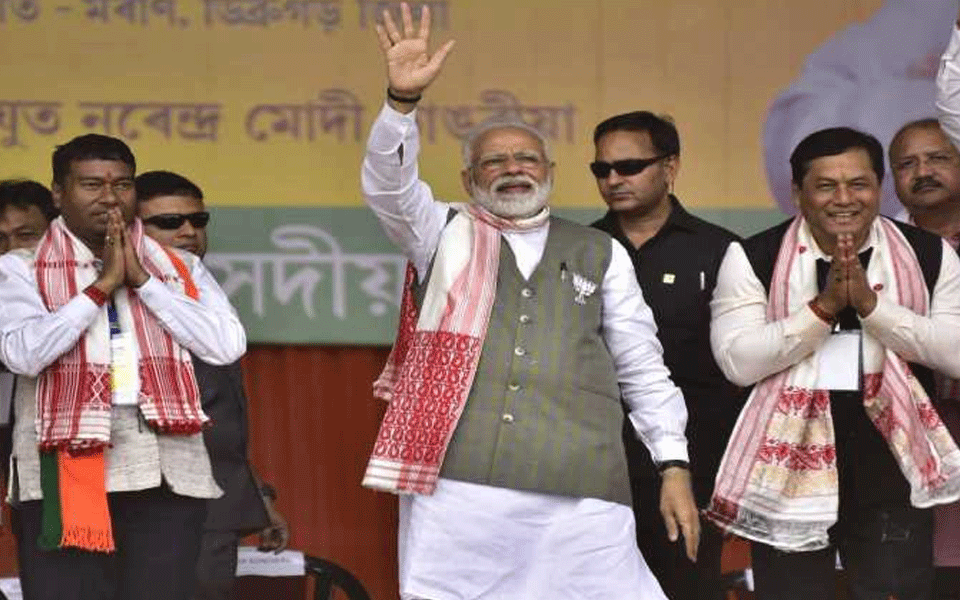
Moran: Prime Minister Narendra Modi Saturday asserted that the NDA government is committed to the Assam Accord and mulling granting Scheduled Tribe (ST) status to six communities in the state.
The Assam Accord provides for deportation of all illegal immigrants who entered Assam after March 1971, irrespective of their religion.
The Centre is trying its best to implement the Assam Accord that was suspended by the Congress, Modi said.
"We have made efforts to protect the people of Assam, its culture and interests. The NDA is seriously considering granting ST status to six communities -- Tai Ahom, Muttock, Moran, Chutiya, Koch Rajbongshis and the tea tribes," he said.
Lashing out at opposition Congress, he said Assam, where only 40 per cent homes had power and gas connections till several decades after independence, now has electricity and cooking fuel in almost every home.
"The way you have supported me, blessed me, it has boosted my confidence to do better work for the underprivileged, poor and the tribal population. Barring the Congress and the terrorists, everybody is happy with the BJP government," Modi said.
Listing his government's achievements, he said over five lakh people in Assam have been given homes by the NDA govt, 27 lakh families have received health insurance of Rs 5 lakh each and farmers have been given aid to take care of their regular expenses.
Addressing the tea belt communities, Modi, who used to sell tea at a railway station in his early years, said "only a 'chaiwala' (tea seller) can understand the pain of fellow 'chailwalas'".
"The NDA government has taken initiatives to open bank accounts for tea garden workers. Lakhs of families in the tea belt have received Rs 5,000 as aid in two instalments, the government has also decided to provide free rice and two kilograms of sugar to four lakh families in the tea belt," he said.
"This 'chaiwala' is committed to improve the condition of the tea gardens and its people in both Assam and West Bengal," he added.
Modi also asserted that the northeast has the power to become a new India's energy hub and the government is working hard to develop the region to realise this dream.
The prime minister, who paid tribute to legendary musician Bhupen Hazarika prior to his speech, said, "The government is committed to protect the rights, culture and interests of the indigenous people of this region".
Polling for the 14 Lok Sabha seats in Assam will be held in three phases on April 11, 18, 23. The results will be declared on May 23.
Let the Truth be known. If you read VB and like VB, please be a VB Supporter and Help us deliver the Truth to one and all.
EAM Jaishankar meets Jamaican PM, gifts over 10 BHISHM Cubes
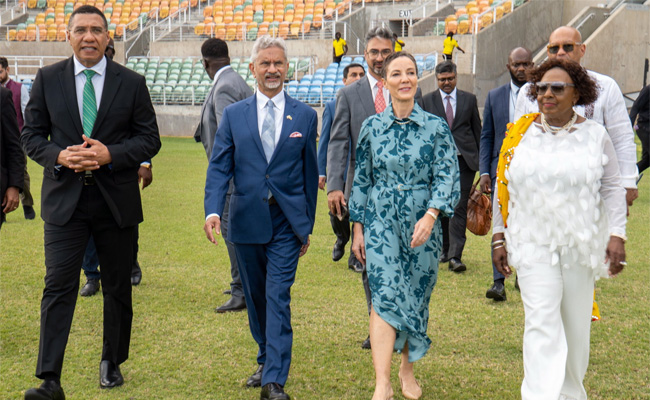
Kingston (PTI): External Affairs Minister S Jaishankar on Monday met Jamaican Prime Minister Andrew Holness and discussed ways to further deepen "political, economic and people-to-people cooperation."
Jaishankar also conveyed greetings from Prime Minister Narendra Modi to Holness.
"Pleased to call on Prime Minister @AndrewHolnessJM in Kingston. Conveyed the greetings of PM @narendramodi," Jaishankar posted on X.
"Discussed deepening our political, economic and people-to-people cooperation. Value his commitment towards further strengthening India-Jamaica relations," the post further read.
Also, the external affairs minister handed over 10 BHISHM (Bharat Health Initiative for Sahyog Hita & Maitri) Cubes as a gift to Jamaica.
"Formally handed over 10 BHISHM Cubes as a gift from India to Jamaica, in the presence of PM @AndrewHolnessJM, Health Minister @christufton and FM @kaminajsmith," Jaishankar posted on X.
"The BHISHM Cube mobile hospital system, designed for rapid deployment, will help Jamaica during disasters and emergencies. The gift of these cubes is a statement of friendship, a commitment to disaster preparedness, and an outcome of innovation," the post said.
Jaishankar arrived in Kingston on Saturday evening, marking the first leg of his nine-day tour of Jamaica, Suriname, and Trinidad and Tobago, aimed at further strengthening India's strategic and cultural ties with the Caribbean nations.
Earlier in the day, he interacted with the Indian diaspora and discussed India's ongoing transformation in infrastructure, human development and technology-driven governance and entrepreneurship with them.
He also highlighted the cricket bond between both countries as India gifted a scoreboard to Jamaica.
A scoreboard was dedicated at Sabina Park in Kingston. It is the home of the Jamaica cricket team and is the only Test cricket ground in the Caribbean island nation.
The minister expressed hope that the new scoreboard would witness many memorable innings, including those symbolising the enduring friendship between the two countries.
Cricket has long been a strong cultural bridge between India and Jamaica, which is part of the West Indies cricket team.
Jamaican players, including Chris Gayle, Courtney Walsh and Michael Holding, have played a major role in shaping the legacy of West Indies cricket in the international arena, contributing to its dominance in earlier decades and its continued global appeal.