Neutrality of polls can't be assured if EC dependent on contestants: Justice Nagarathna
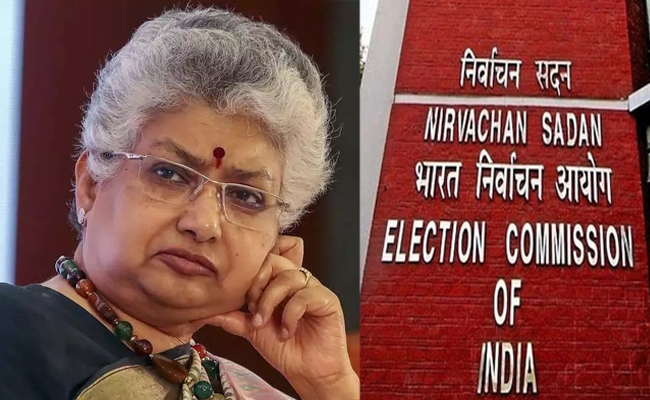
New Delhi (PTI): Supreme Court judge Justice BV Nagarathna, while highlighting that the Election Commission is the primary institution entrusted with maintaining the integrity of polls, has said if those who conduct elections are dependent on those who contest them, the neutrality of the process cannot be assured.
The apex court judge raised a critical concern regarding the structural independence of those tasked with overseeing the ballot while delivering the Rajendra Prasad Memorial Lecture at the Chanakya Law University in Patna on Saturday.
Citing a 1995 verdict where the Supreme Court recognised the Election Commission as a constitutional authority of high significance, entrusted with ensuring the integrity of elections, she said, "The concern, once again, was structural: if those who conduct elections are dependent on those who contest them, the neutrality of the process cannot be assured."
Justice Nagarathna said elections are not merely periodic events but a mechanism through which political authority is constituted.
"Our constitutional democracy has amply demonstrated smooth changes in government due to elections being held on a timely basis. Control over that process is, in effect, control over the conditions of political competition itself," she said.
The Supreme Court judge said power is not exercised only through formal institutions but also through the processes that sustain them, including elections, public finance, and regulation.
"A constitutional structure that seeks to restrain power must therefore go beyond its classical forms and address these fourth-branch institutions. A set of institutions, while not always fitting within the classical tripartite scheme, is nonetheless central to the maintenance of constitutional order," she said.
Justice Nagarathna said the unmistakable lesson of history is that constitutional collapse occurs through the disabling of its structure, and the violation of rights merely follows.
"The dismantling of structure, in turn, occurs when institutions stop checking each other. At that moment, elections may continue, courts may function, laws may be enacted by Parliament, and yet, power is effectively not restrained because the structural discipline no longer exists," she said.
The apex court judge also urged the Centre to view states as "coordinates and not subordinates" and asserted that the separation of powers was a "constitutional arrangement of co-equals."
Justice Nagarathna also called for keeping aside "inter-party differences" in the matter of "Centre-state relations", underscoring that governance must not depend on "which party may be ruling the Centre and which other party may be ruling at the state level".
Let the Truth be known. If you read VB and like VB, please be a VB Supporter and Help us deliver the Truth to one and all.
Assam Police at Pawan Khera's residence in national capital, Delhi Police assisting

New Delhi (PTI): An Assam Police team on Tuesday is at the Delhi residence of Congress leader Pawan Khera for questioning in connection with a case linked to allegations made against Assam Chief Minister Himanta Biswa Sarma and his family, official sources said.
The team formally informed Delhi Police upon arrival, following which a local police team joined and is assisting in the proceedings, the source said.
The development comes amid a political tussle after Sarma alleged that the Congress used "false information" sourced from a Pakistani social media group to level charges against his wife regarding multiple passports and overseas assets. He termed the allegations an attempt to influence the Assam elections and a punishable offence.
Khera had recently sought clarifications on Sarma's wife's alleged foreign assets, prompting a complaint and subsequent police action.