Newly elected DU President Ankiv Basoya of ABVP submitted fake degree
Twitterati declare him future PM and Union Minister
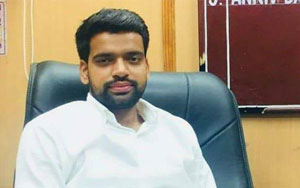
New Delhi : Days after getting elected as the new president of the Delhi University Students’ Union, Ankiv Basoya of the RSS’s student wing ABVP, has found himself in a considerable spot of bother. Several media reports have said that Basoya submitted fake marksheet and certificate for admission in the DU from Thiruvalluvar University in Tamil Nadu.
The revelation was made after the Congress’s student wing, the NSUI, in Tamil Nadu reportedly wrote to the college asking for the authenticity of Basoya’s marksheet. The university, said media reports, stated that his degree was fake.

NSUI released a letter from Thiruvalluvar University sent in response to a communication from the student’s body, saying the BA certificate submitted by Baisoya from the university was fake.
ABVP, however, said the university allowed Baisoya’s admission after due verification of document submitted by him. In a statement, the ABVP termed the NSUI allegation “propaganda”.
“Delhi University gave admission to Ankiv Basoya after due verification of its documents. It’s the process of DU. Even today DU has all the right to verify documents of any student enrolled in university. But it’s not the job of NSUI to provide certificates to any person. DU has all the right to verify documents of not only Ankiv but all DUSU office bearers to stop rumours in future,” PTI quoted a statement by the ABVP.
Newly elected DU President Ankiv Basoya of ABVP, furnished fake marksheet & certificate for admission in DU, from Thiruvalluvar University. When NSUI in Tamil Nadu wrote to the college regarding the authenticity of the marksheet, university replied saying it's a fake certificate pic.twitter.com/YgBHOVZXrx
— TIMES NOW (@TimesNow) September 18, 2018
Meanwhile, Twitterati have begun poking fun at the ABVP leader likening his notoriety to that of the fake degree charges levelled against Prime Minister Narendra Modi and his cabinet colleague, Smriti Irani.
Just like the leaders in BJP e.g. @smritiirani @narendramodi https://t.co/ReJOaKvx1H
— Divya Spandana/Ramya (@divyaspandana) September 18, 2018
Evidence shows that the new DUSU ABVP president @AnkivBaisoya_DU got his university admission on a FAKE DEGREE!
— Anupam (@AnupamConnects) September 18, 2018
So he may not be qualified enough for admission to DU, but has proven himself to be a true Modi follower and seems qualified to get into BJP leadership. pic.twitter.com/XW52rnySbq
Newly elected DU President of ABVP, furnished fake mark sheet & certificate for admission in DU.
— Jet Lee(Vasooli Bhai) (@Vishj05) September 18, 2018
Great, he is now eligible to be next HRD Minister of India.
Future Modi, A PM candidate of BJP is born. Newly elected DU President Ankiv Basoya of ABVP, furnished fake marksheet & certificate The university replied saying it's a fake certificate #AnkivBasoya #dusuelections2018 pic.twitter.com/PAManA1slH
— Arun Mysore (@arunmsk) September 18, 2018
courtesy : jantakareporter.com
Let the Truth be known. If you read VB and like VB, please be a VB Supporter and Help us deliver the Truth to one and all.
Trump pauses Project Freedom, claims great progress for final agreement with Iran
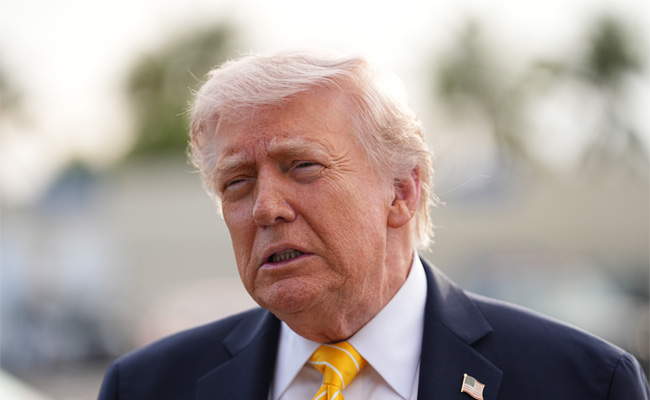
Washington (PTI): President Donald Trump has suspended “Project Freedom,” to escort ships through the Strait of Hormuz, claiming progress in negotiations with Iran toward an agreement to end the war.
In a post on Truth Social on Tuesday, Trump said, “Great progress has been made toward a complete and final agreement with representatives of Iran.”
“Based on the request of Pakistan and other Countries, the tremendous Military Success that we have had during the Campaign against the Country of Iran and, additionally, the fact that Great Progress has been made toward a Complete and Final Agreement with Representatives of Iran, we have mutually agreed that, while the Blockade will remain in full force and effect, Project Freedom (The Movement of Ships through the Strait of Hormuz) will be paused for a short period of time to see whether or not the Agreement can be finalized and signed," Trump said.
Project Freedom was launched on Monday to escort ships, stranded due to the closure of the Strait of Hormuz, out to safety. Trump had announced the operation on Sunday and the US Central Command began implementing it the next day.
However, the Project led to friction in the vicinity of the narrow seaway, a key route for transporting one-fifth of the global oil supplies, with the UAE claiming that its ships were attacked by Iran. The US also claimed to have destroyed several Iranian small boats.
Trump’s statement on Truth Social came hours after US Secretary of State Marco Rubio announced that Operation Epic Fury, launched on February 28, had concluded as its objectives have been achieved.
"Operation Epic Fury is concluded. We achieved the objectives of that operation. We're not cheering for an additional situation to occur. We would prefer the path of peace. What @POTUS would prefer is a deal... that is, so far, not the route that Iran has chosen," Rubio told a press conference at the White House on Tuesday.
On Project Freedom, Rubio said the goal was to rescue almost 23,000 civilians from 87 different countries who were trapped inside the Persian Gulf and left for dead by the Iranian regime.
"This is not an offensive operation. This is a defensive operation, and what that means is very simple: there’s no shooting unless we're shot at first. We’re not attacking them, but if they're attacking us or they’re attacking a ship, you need to respond to that," Rubio said.