No evidence linking me to 2020 Delhi riots violence: Umar Khalid to SC
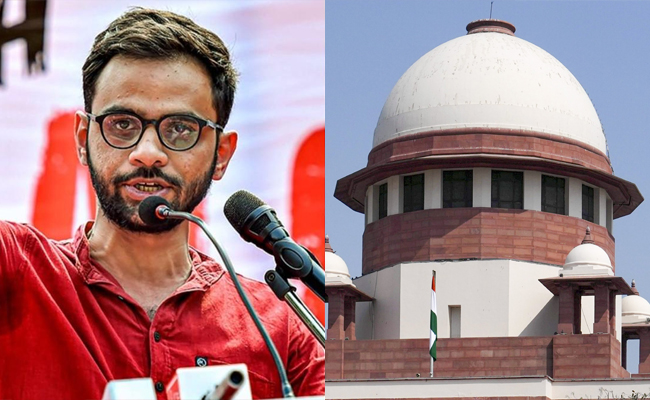
New Delhi (PTI): Seeking bail in the UAPA case linked to February 2020 riots in Delhi, activist Umar Khalid on Friday told the Supreme Court that there is no evidence linking him to violence and denied conspiracy charges against him.
Senior advocate Kapil Sibal, appearing for Khalid, told a bench of Justices Aravind Kumar and N V Anjaria that there has been no recovery of funds, weapons or any material evidence linking him to the 2020 Delhi riots.
"There are 751 FIRs, I am charged in one, and if it's a conspiracy, it's a bit surprising!
"If I (Umar Khalid) conspired riots. On dates in which riots took place, I was not in Delhi," Sibal said and added that no funds, weapons and physical evidence connecting me to violence have been found yet.
"No witness statement actually connects petitioner to any act of violence," he pointed out.
Sibal submitted that Khalid is entitled to bail on grounds of parity, noting that fellow activists Natasha Narwal, Devangana Kalita and Asif Iqbal Tanha were granted bail in June 2021.
Sibal said that the Delhi High Court, while denying bail, had termed Umar Khalid's speech at Amravati on February 17, 2020, as "inflammatory."
"It is available on YouTube. It was a public speech where I (Khalid) spoke about Gandhian principles," Sibal added.
Senior advocate Abhishek Singhvi, appearing for Gulfisha Fatima, argued that she has been in jail for five years and five months since April 2020.
Singhvi pointed out that while the main chargesheet was filed on September 16, 2020, the prosecution has made it an "annual ritual" to file supplementary chargesheets every year.
He submitted that there has been an inordinate delay in the consideration of the bail plea of Fatima, which has been listed over 90 times since 2020.
Singhvi stated that the allegation against his client is merely that she created a WhatsApp group to coordinate or mobilise support.
"But the real test in law, as laid down by the Supreme Court, is whether there was any intent to incite violence or create disharmony," he said.
Senior advocate Siddharth Dave, appearing for Sharjeel Imam, submitted that the police took three years to complete its investigation.
"Out of the five years I have spent in custody, three went by because the probe was still ongoing.
"The speeches were delivered by me (Imam) nearly two months before the riots," Dave said and argued that there is no direct or proximate link to suggest that he could have incited the violence.
The hearing remained inconclusive and will continue on November 3.
The Delhi Police on Thursday opposed the bail pleas of activists, saying that they conspired to strike at the sovereignty and integrity of the country by a "regime change operation" executed under the guise of "peaceful protest".
Khalid, Imam, Gulfisha Fatima and Meeran Haider were booked under the Unlawful Activities (Prevention) Act (UAPA) and provisions of the erstwhile IPC for allegedly being the "masterminds" of the February 2020 riots, which left 53 people dead and over 700 injured.
The violence erupted during the protests against the Citizenship (Amendment) Act (CAA) and the National Register of Citizens (NRC).
Let the Truth be known. If you read VB and like VB, please be a VB Supporter and Help us deliver the Truth to one and all.
BJP to resolve decades-old Gorkha issue within 6 months of forming govt in Bengal: Shah
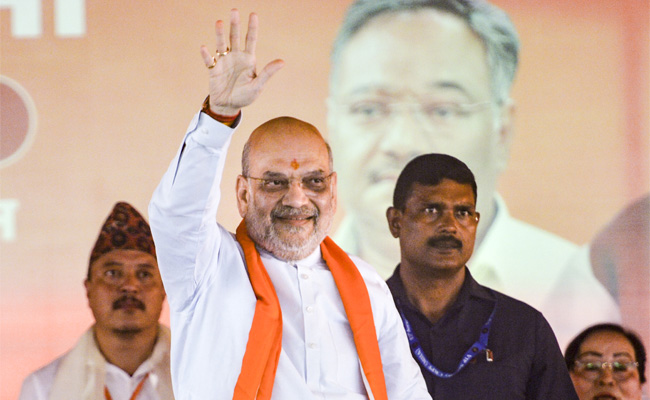
Kurseong (WB) (PTI): Seeking to strike an emotional chord with the politically crucial hill electorate, Union Home Minister Amit Shah on Tuesday promised that the BJP would resolve the decades-old Gorkha issue within six months if the BJP comes to power in West Bengal.
He said no party other than the BJP could find a solution acceptable to the Gorkhas.
Addressing a rally at Kurseong in Darjeeling district, Shah said the BJP understands the concerns and aspirations of the Gorkhas and would work towards a settlement on their terms.
"Within six months of the BJP forming the government in West Bengal, every Gorkha will have a smile on his face. We will find such a solution to the Gorkha issue that Gorkhas can live in peace," he said.
The Gorkha issue refers to the century-old demand for a separate state in the Gorkha-majority hill districts of north Bengal, although Shah did not utter the words 'Gorkhaland' or 'statehood' in his speech.
Instead, echoing the BJP's long-standing promise of a "permanent political solution" to the hill question, Shah said the issue would be resolved in accordance with the aspirations of the Gorkhas.
ALSO READ: APCR fact-finding team reports gaps between records, public narrative in Nashik TCS case
"I am leaving today after promising you that as soon as the BJP government is formed, the decades-old Gorkha issue will be resolved according to the Gorkhas' terms," he said.
The BJP, which has won the Darjeeling Lok Sabha seat in every election since 2009, has consistently promised a permanent political solution to the hill issue without committing itself to a separate state.
The home minister accused the Mamata Banerjee government of refusing to engage with efforts to resolve the issue and said that after becoming home minister, he had convened three meetings on the matter.
"After becoming home minister, I convened three major meetings to resolve the Gorkha issue, but not even once did a representative from Mamata's side attend," Shah said.
"Mamata Didi, we are not dependent on you for a solution to the Gorkha issue. We have appointed an interlocutor who is preparing a report by engaging with Gorkha organisations here and officials of the West Bengal government," he added.
Claiming that the BJP alone understands the concerns of the hill residents, Shah said, "We understand you and your problems. No one except the BJP can resolve the Gorkha issue."
The home minister alleged that the Congress and the TMC had betrayed the people of the hills for decades.
"The Congress and the TMC have done injustice not only to Darjeeling but also to our patriotic Gorkha brothers," he said.
Seeking to broaden the BJP's pitch beyond the Gorkha issue, Shah sought to portray the election as a battle to free north Bengal and the hills from what he called years of neglect and injustice under the TMC rule.
"This election is to free the entire West Bengal from TMC's crimes. In a way, it is an election to gain freedom from the injustice happening for decades in north Bengal and Darjeeling," he said.
Referring to the Sandeshkhali controversy, Shah said, "The whole of West Bengal has decided that it is time for Didi to step down. This election is about protecting our sisters across the state. The Sandeshkhali incident has brought shame to the state."
The BJP leader told the gathering that while Darjeeling had repeatedly backed the BJP, the party needed support from the rest of West Bengal this time.
"For three elections, Darjeeling has been voting for the BJP anyway, but the rest of West Bengal did not provide as much support. But this time, the whole of West Bengal has made up its mind that it's time to oust Didi," he said.
Shah also raised the issue of Gorkhas' names being allegedly deleted from the electoral rolls during the Special Intensive Revision (SIR) exercise.
"The names of some Gorkhas were deleted during SIR. Once the BJP government is formed in West Bengal, all such names will be included in the electoral rolls again," he said.
He further alleged that hundreds of false cases had been slapped on Gorkha activists and promised that these would be withdrawn if the BJP formed the government.
"They have filed hundreds of false cases against our Gorkha brothers and sisters. The results will come out on May 4, and a BJP government will be formed on May 5. Before July 31, the BJP government in West Bengal will withdraw all cases against Gorkha brothers and sisters," Shah said.
The home minister also attacked the Mamata Banerjee government over budgetary allocations for the tribals.
"For tribal development, for Adivasis, for the hills, and for north Bengal, the Mamata government's total budget is Rs 2,000 crore. But for Muslims and madrasas, the Mamata government's budget is Rs 5,800 crore. This injustice will not last much longer," he said.
The demand for Gorkhaland and greater political autonomy for the Darjeeling hills has remained one of the most enduring and emotive political issues in north Bengal, often shaping electoral outcomes in the region.
Successive agitations -- from the Subhash Ghising-led GNLF movement in the 1980s to the later stir spearheaded by Bimal Gurung and the GJM, have repeatedly convulsed the hills.
Yet, despite the BJP's rise in Darjeeling and its continued dominance in the Lok Sabha seat since 2009, the party has so far stopped short of endorsing a separate state as it would have an adverse impact on south Bengal, preferring instead to speak of a "permanent political solution".