No 'Modi wave'; non-BJP, non-Congress front likely to form govt: Owaisi
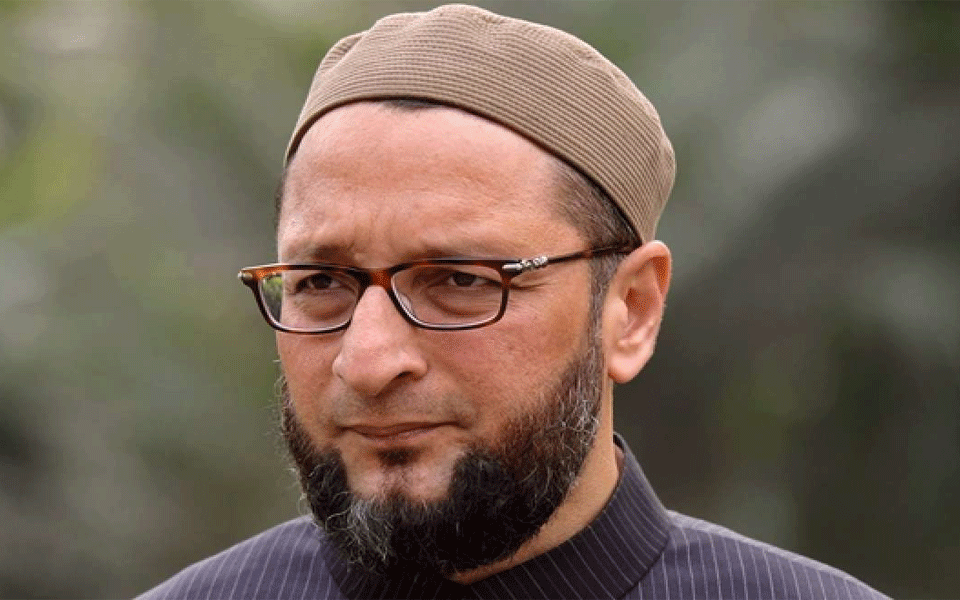
Hyderabad: Claiming there is no 'Modi wave' in this Lok Sabha polls like in 2014, AIMIM president Asaduddin Owaisi Thursday said a 'non-BJP, non-Congress' front is likely to form the government at the Centre with a regional leader emerging as a prime minister.
Owaisi, a three-time MP from the Hyderabad parliamentary constituency, also said the upcoming Lok Sabha polls will be an "open election" and there will be a fight for every single seat of the total 543 constituencies.
"Unlike 2014, there is no Modi wave this time. It is an open election and there will be a fight on every seat, including Hyderabad," he told PTI in an interview.
Owaisi, who will be contesting from Hyderabad seat again this time, said his party All India Majlis-e-Ittehad-ul-Muslimeen (AIMIM) is definitely a part of the 'non-BJP, non-Congress' front led by Telangana Rashtra Samithi (TRS) founder and chief minister K Chandrashekar Rao.
This front would be necessary to represent India's political diversity and there are many regional leaders who are much more capable than Prime Minister Narendra Modi and Congress president Rahul Gandhi, Owaisi added.
He claimed that the BJP out of "desperation" is bringing national security narrative in the poll discourse to "hide its failures", but people will not fall again on his 'jumlas' (false promises) and will vote responsibly.
"There was surgical strike, then Balakote air strike and now anti-satellite missile test (Mission Shakti) -- the poll narrative is changing everyday. All these are signs of desperation to win this election" Owaisi said.
"Why it took five years for such a crucial test? Why he waited for election time. Was he waiting some auspicious moment? Was he was worried about losing space along with people and TV? Why did he choose this time just days before polls? he asked, adding that the PM is only doing "jumlebazi" to divert focus from unemployment, inflation and other issues.
As the BJP's defeat is inevitable, going forward, its poll discourse will therefore change everyday, he stated.
"You will hear how PM's poll narrative will change going forward. Modi will warm up in the first phase and the debate will heat up from the second phase till the festival of Ramadan. But people will not fall for his gimmicks," he said.
Asked about the 'non-BJP, non-Congress' front, the AIMIM chief said, "I am definitely a part of it and I am supporting the TRS on this issue."
He, however, did not share details how the 'non-BJP, non-Congress' front will take shape post polls nor did he disclosed probable prime ministerial candidate who can lead the front, even as he expressed confidence that the regional parties will play a decisive role in the national politics.
Owaisi, referring to a report, said there is a direct fight between the BJP and the Congress in 100 out of the 543 Lok Sabha constituencies. But in over 320 seats, there is a triangular fight between the BJP, Congress and the regional parties.
"Regional parties will play key role in national politics. We tried the 280-plus NDA government, we tried 210 government of UPA, What came out of it? I want India's diversity should be represented. Wait for the results," he said.
The BJP will not gain much in the five southern states, which comprise 130 Lok Sabha constituencies, except for a few seats in Karnataka. The saffron party is likely to lose its lone seat in Secunderabad this time, Owaisi added.
Asked about the TRS considered as a B-team of the BJP that could support the saffron party post polls, Owaisi said, "Not at all. This narrative is given by the Congress. It is completely wrong. They have allergy with regional parties."
Expressing concern over the lack of political representation to the Muslim community, he said, there was no single Muslim MP in 280 seats won by the BJP in 2014 general election as the saffron force wants to run democracy represented by only the majority communities.
"If I talk against Modi that does not mean I am against majority communities. I believe a majoritarian form of democracy will not run in Hindustan. There is no place for this in India's Constitution. I was never against majority communities. I am against BJP and RSS, I will continue to be," he added.
The Hyderabad Lok Sabha seat is a stronghold of the AIMIM and the party has won this seat in the last eight elections.
The Hyderabad Lok Sabha seat has seven Assembly segments -- Malakpet, Karwan, Goshamahal, Charminar, Chandrayangutta, Yakutpura and Bahadurpura.
Out of the seven assembly segments, six are currently held by the AIMIM and one by the BJP.
Let the Truth be known. If you read VB and like VB, please be a VB Supporter and Help us deliver the Truth to one and all.
Maharashtra sets up state vaccination task force to strengthen immunisation programme

Mumbai (PTI): The Maharashtra government has set up a State Vaccination Task Force to strengthen the regular immunisation programme and review the progress of related campaigns, a health department official said on Monday.
The State Vaccination Task Force will comprise at least 29 members and will be headed by the administrative head of the health department, he informed.
The government has also constituted separate district-level and municipal vaccination task forces to improve implementation and address challenges at the grassroots level, he said.
Municipal task forces, chaired by respective civic commissioners, have been constituted in view of the vast urban population in Maharashtra and the role of civic bodies in implementing different health programmes.
The district-level task forces will function under the chairmanship of collectors.
"Complete immunisation of children at the appropriate age is an extremely simple, cost-effective and highly effective measure to reduce child mortality and the prevalence of diseases among kids. Immunisation is a powerful tool for reducing illness in children," maintained the official.
To ensure full vaccination of all children, the state government implements various campaigns from time to time as per the central government guidelines, he pointed out.
"Active participation and cooperation of other relevant government departments are essential (in making these campaigns successful)," according to the official.
The state-level body will review the regular immunisation programme, associated campaigns and vaccine-preventable diseases in detail. It will also conduct focused assessments of high-risk districts and municipal corporations, including vacancies at district, municipal and sub-district levels, availability of cold chain equipment, resource gaps and training requirements, he noted.
The state task force will review allocation and utilisation of funds for immunisation and ensure timely action by officers concerned based on reports from district and municipal task forces and state-level monitoring mechanisms, the official said.
It will also ensure active coordination and participation of other government departments in immunisation drives, while district and municipal task forces will carry out similar functions at their respective levels, the official added.