No one can stop us from rewriting history to free it from distortions: Amit Shah
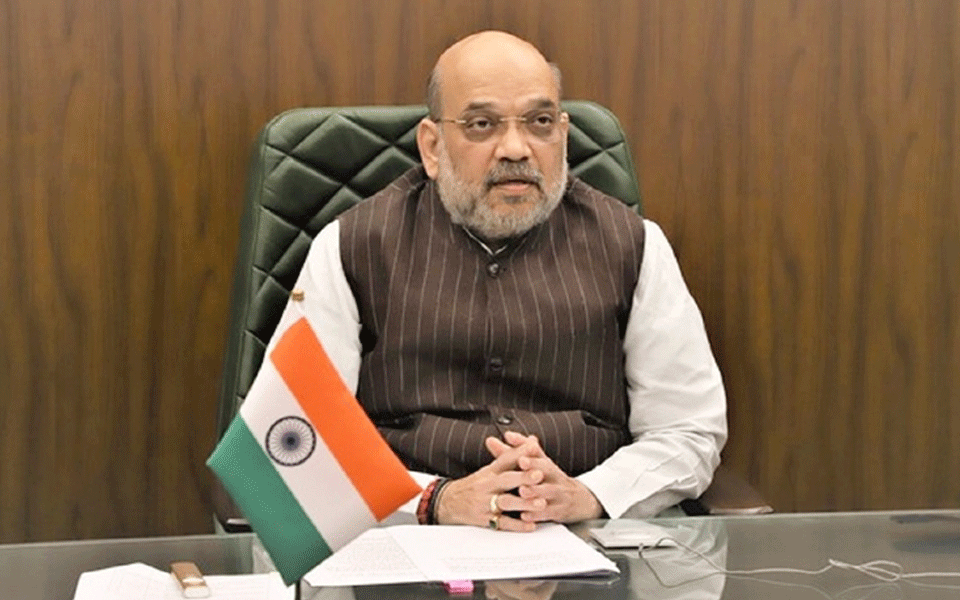
New Delhi (PTI): Home Minister Amit Shah has said no one can stop rewriting of history to free it from "distortions" as he urged academicians to research and write about 30 great Indian empires and 300 warriors who showed exemplary valour to fight for the motherland.
The home minister said on Thursday had it not been for Veer Lachit Barphukan, the Northeast would not have been a part of India. He was addressing a plenary session of the 400th birth anniversary celebrations of the legendary Ahom general.
He protected not only Northeast India but the entire Southeast Asia from "religious fanatic" Aurangzeb, Shah said.
The home minister asked Assam Chief Minister Himanta Biswa Sarma to translate literary work on the life and times of Lachit Barphukan into 10 Indian languages, including Hindi, so that children can take inspiration from him.
"I often come across complaints that our history has been distorted and tampered with. These allegations could be true. But who stops it from being corrected now? Who stops us from writing the correct history now," he said.
Shah urged historians and students to identify 30 great empires in Indian history that ruled for more than 150 years in any part of the country and 300 warriors who showed exemplary courage to fight for the independence of the country and conduct research and write extensively about them.
"If we do this, we will see that the true history of India will be established and the lies will end spontaneously. In India, we now have a government which supports any endeavour to promote the glory of the country. We will work towards reviving India's glorious history," Shah said at the event organised by the Assam government.
Shah said a nation that does not derive pride from its glorious past, that does not garner inspiration from its heroes can never create a bright future for itself and cannot create better citizens and a golden future.
The minister said Barphukan fought the Saraighat battle in adverse circumstances by taking together different tribes, using local resources to build small arms and boats to take on the mighty army led by Ram Singh of Amer.
"The Mughal army did not have that iota of patriotism and dedication for the country that Barphukan and his soldiers had. This was a victory of patriotism. They won and not only secured the sovereignty, culture and heritage of Ahom but also saved entire Southeast Asia from religiously fanatic invader Aurangzeb," he said.
The home minister said that after this crushing defeat, foreign invaders from Delhi could never gather the courage to invade Assam again.
"If Lachit Barphukan was not there in Assam during those times, Assam and Northeast India would have never become a part of India," Shah said.
He further said that the 400th birth anniversary of Lachit Borphukan unveils a new episode of India's history in which Assam rulers defeated Muslim invaders of different ages and secured the sovereignty of their motherland.
Shah said Assam Chief Minister Sarma unveiled stories of glorious stories of Ahom warriors from Maharaj Prithu who defeated Bakhtiar Khalji in 1206 to Lachit Barphukan who defeated the Mughals in 1671 and urged students of history to look at the exhibition organised on the occasion.
Shah said that right from 1206 to 1671 Assam was invaded 22 times by Muslim invaders but could not keep it under the thumb of Muslim rule for long because of the relentless commitment of its people to independence.
He said it is because of this attitude, the Northeast has kept its culture intact. Its beautiful region, language, culture, dresses, music and food remained untouched by foreign influences.
He said be it Akbar or Aurangzeb, Qutb ud-Din Aibak or Iltutmish, Bakhtiyar Khalji or Iwaz Khali, Muhammad bin Tughluq or Mir Jumla, everyone has faced defeat in Assam by the valour of Ahom Kings.
Shah said the times in which Lachit Barphukan raised his sword against the Mughals, Chhatrapati Shivaji in the south of India, Guru Govind Singh in the north, and Veer Durgadas Rathore in Rajasthan waged the same battle against the same enemy.
"On account of their relentless efforts, exemplary courage and sacrifice, the Mughal empire collapsed," he said.
Union Minister for Ports, Shipping and Waterways Sarbananda Sonowal, Union Minister of State for Petroleum and Natural Gas Rameswar Teli, Assam Chief Minister Himanta Biswa Sarma, Minister of Water Resources and Public Affairs Pijush Hazarika, Assam Legislative Assembly Speaker Biswajit Daimary, and Justice (Retd) Ranjan Gogoi attended the event.
Let the Truth be known. If you read VB and like VB, please be a VB Supporter and Help us deliver the Truth to one and all.
Two injuries, one DNF, a DQ as India end messy World Relays campaign

Gaborone (Botswana) (PTI): Amoj Jacob and Ragul Kumar got injured during the men's 4x400m and 4x100 races respectively as India ended their World Athletics Relays campaign in disappointment on the second day of competitions here on Sunday.
The Indian camp had high hopes of making the 2027 World Championships in the men's 4x400m relay but the team did not finish (DNF) the race as Jacob suffered cramps and pulled out of the race after taking the baton from the first leg runner Dharamveer Choudhary. Rajesh Ramesh and Vishal TK were to run in the third and fourth legs.
Those teams which could not qualify for the 2027 Beijing World Championships by reaching the final round of each of the six relay events on Saturday were given another chance in the second qualification round on Sunday.
The top two teams in each of the two heats (in all six relay events) booked the Beijing ticket on Sunday.
India will now have to try and qualify for the World Championships through the Top Lists of the World Athletics, which is a long and tedious process.
In the men's 4x100m race, third leg runner Ragul Kumar fell down the track after failing to hand over the baton inside the exchange zone to fourth leg runner Gurindervir Singh, which clearly showed the lack of coordination among the runners.
Harsh Santosh Raut and Animesh Kujur ran the first two legs.
The Indian quartet was disqualified and Kumar was seen being taken away from the Field of Play with the help of the volunteers.
It was a comedy of errors in the case of the women's 4x100m race, which saw the baton being dropped during an exchange between first leg runner Tamanna and second runner Nithya Gandhe, though the Indians finished the race in 53.09 seconds.
Gandhe started running quite a distance, but after realising that the baton was not in her hand, she turned and ran back to pick it up.
The only silver-lining for the Indian contingent was the national record time in the mixed 4x100m relay race, though the quartet of Ragul Kumar, Nithya Gandhe, Animesh Kujur and Sneha SS finished sixth in heat number two with a time of 41.35 seconds, bettering the previous national mark of 42.30 seconds set in March in Chandigarh.
The mixed 4x400m relay quartet of Theerthesh P Shetty, Kumari Saloni, Nihal William and Rashdeep Kaur ended at fifth in heat number one with a time of 3 minutes and 19.40 seconds.
On Saturday, all the five Indian relay teams had failed to make it to the respective final rounds and thus missed out on the 2027 World Championships berths.