Nothing alarming in Wangchuk's condition, can't release him on health grounds: Centre tells SC
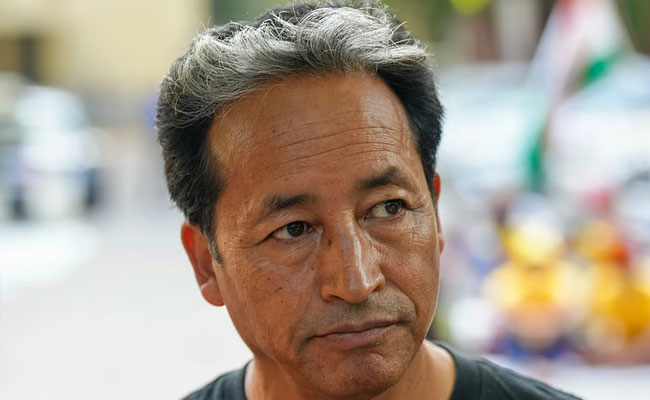
New Delhi (PTI): The Centre on Wednesday told the Supreme Court that climate activist Sonam Wangchuk has been examined medically 24 times since his detention and he is "fit, hale and hearty" and there is nothing alarming.
Solicitor General Tushar Mehta told a bench of justices Aravind Kumar and PB Varale that grounds on which Wangchuk's detention order was passed continue and it will not be possible to release him on health grounds.
"We have examined his health periodically for 24 times. He is fit, hale and hearty. He had some digestive issue, he is being treated. There is nothing to worry, nothing alarming. We can't make exceptions like this.
"The grounds on which the detention order was passed, continues. It will not be possible to release him on health grounds. It may not be desirable also. We have given utmost consideration," Mehta told the bench.
During the hearing, Additional Solicitor General KM Nataraj submitted that Wangchuk was a chief provocateur in the violent protests and he instigated youths by giving examples of Nepal and Arab Spring.
Nataraj stated that Wangchuk referred to the violent agitation in Nepal and said the same thing can happen in India.
At this juncture, the bench asked, "Where does he say that? He is saying they (the youth) have taken it. He himself is surprised."
The ASG replied that the statement has to be inferred.
"Please come to next ground. He says deployment of armed forces in Ladakh is unfortunate. He says youth say peaceful methods have not proved effective," Nataraj said.
The bench then observed, "He is saying that the youth is saying that. Read the complete sentence. He is saying this is something worrying. If somebody expresses that violent method is not the proper way. You are doing too much of reading."
The top court was hearing a habeas corpus petition filed by Wangchuk's wife Gitanjali Angmo seeking to declare his detention under the National Security Act (NSA), 1980, as illegal.
The NSA empowers the Centre and states to detain individuals to prevent them from acting in a manner "prejudicial to the defence of India". The maximum detention period is 12 months, though it can be revoked earlier.
Angmo said the unfortunate events of violence in Leh on September 24 last year cannot be attributed to the actions or statements of Wangchuk in any manner.
Wangchuk himself condemned the violence through his social media handles and categorically said violence would lead to the failure of Ladakh's "tapasya" and peaceful pursuit of five years, Angmo said, adding it was the saddest day of his life.
Let the Truth be known. If you read VB and like VB, please be a VB Supporter and Help us deliver the Truth to one and all.
Rickelton's ton in vain as SRH beat MI by 6 wickets
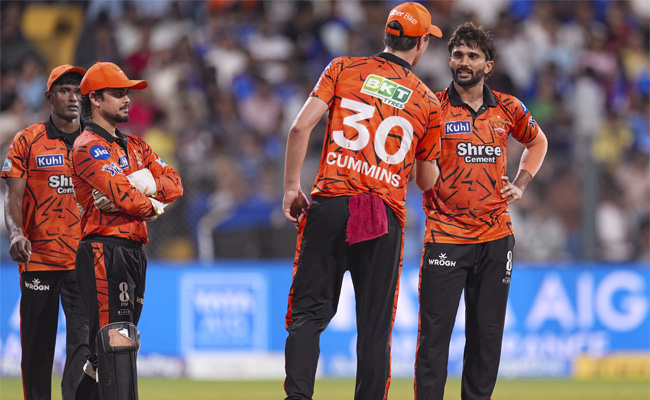
Mumbai (PTI): Ryan Rickelton's whirlwind unbeaten ton was overshadowed by Heinrich Klaasen's unbeaten 65 as Sunrisers Hyderabad defeated Mumbai Indians by six wickets in an IPL match here on Wednesday.
Chasing an imposing 244-run target, Travis Head (76 off 30) and Abhishek Sharma (45 off 24) shared 129 runs for the opening wicket to set the platform for SRH.
Klaasen (65 not out off 30 balls) then displayed his all-round hitting abilities to guide SRH home with the help of Nitish Kumar Reddy (21) and Salil Arora (30 not out off 10) in 18.4 overs.
Earlier, Rickelton's knock powered MI to 243 for five.
MI rode on a 93-run stand between Rickelton (123 not out off 55 balls) and Will Jacks (46 off 22) in 7.1 overs for the opening stand to power the side.
MI skipper Hardik Pandya scored a valuable 31 off 15 balls before being dismissed.
Praful Hinge (2/54), Eshan Malinga (1/29), Sakib Hasan (1/39) and Nitish Kumar Reddy (1/31) were the wicket-takers for SRH.
Brief Scores:
Mumbai Indian: 243 for 5 in 20 overs (Ryan Rickelton 123 not out; Praful Hinge 2/54).
Sunrisers Hyderabad: 249 for 4 in 18.4 overs (Travis Head 76, Heinrich Klaasen 65 not out; AM Ghazanfar 2/51).