Nothing pending from Centre to Karnataka, says FM Sitharaman, rejecting Cong govt charges
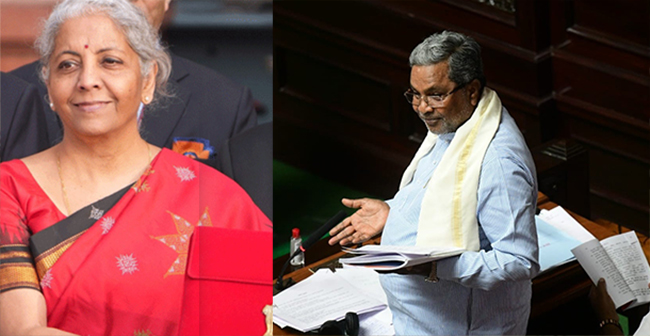
Bengaluru, Nov 30: Union Finance Minister Nirmala Sithraman on Thursday said there is "nothing pending" from the Central government to Karnataka and the National Disaster Response Fund (NDRF) for the drought relief to the state, which is due, will be decided once the high-power committee decides.
Speaking to reporters here, she said because Prime Minister Narendra Modi has been Chief Minister of a state for more than 10 years, he knows what it is for states to get their money in time.
"The state government can throw the allegations. He can send me the letter and much before the letter reaches me he can put it in social media, the minister or the chief minister. And I say not just this in Bengaluru, I've even, two days ago, when I was in Kerala, I said that," Sitharaman said in response to a question on Congress government here alleging delay in release of Central funds to Karnataka.
"There is nothing pending from our side for Karnataka, I'm a MP from the state, I have a responsibility also. There's nothing pending. Well if the state doesn't send me the required paper, I will keep waiting for the paper to send it. I can't send money, without authorisation of the Accountant General. So that's the truth behind any allegation, the allegation without facts in them," the Rajya Sabha member from Karnataka added.
Chief Minister Siddaramaiah had last month alleged that the BJP-led Union government has burdened our state by not releasing funds for 61 Centrally sponsored schemes across 23 departments, and slashing Karnataka's tax share, resulting in a Rs 45,000 crore loss since 2020.
To add to that, Finance Minister Nirmala Sitharaman, who supposedly represents Karnataka in the Rajya Sabha, decided not to approve the Rs 5,495 crore special grant that was promised, he had posted on 'X', adding that "alarmingly, Karnataka receives just 15 paise for every rupee it contributes in tax."
Responding to a question on the release of NDRF funds for drought relief to Karnataka, Sitharaman said, "For NDRF, there is a committee. The Home Minister looks into it. I had Minister (Revenue Minister of Karnataka) Krishna Byre Gowda come and meet me. Even there I explained to him saying the money whichever is being decided will be -- and the SDRF money is in the hands of the state government to spend."
Stating that it's not as if NDRF money will not come, she said, "the assessment team, the technical team, they all came and made a team assessment, they've submitted to the high powered committee. The moment the committee recommends the money is going to come. It is due to the state. Nobody's going to stop it."
The Karnataka government has declared 223 out of the total 236 taluks in the state as drought hit, and the state government has been repeatedly attacking the Centre for delay in release of drought relief funds, as per NDRF norms.
The FM further said, for the north Karnataka farmers, she has asked the ITC group to come and procure stock that is there with them, so that immediately some money can go into the hands of the farmers. "Even that team has come."
Sitharaman today visited a 'Jan Aushadi Kendra' on Subedar Chatram Road here.
Noting that the Prime Minister dedicated to the nation the landmark 10,000th Jan Aushadi Kendra at AIIMS, Deoghar in Jharkhand, the FM said, all over the country Jan Aushadi Kendras are steadily becoming popular among families. Particularly the middle class and also the poorer sections are getting better informed that the same medicine equally effective is available as a generic medicine drug.
Let the Truth be known. If you read VB and like VB, please be a VB Supporter and Help us deliver the Truth to one and all.
4 held for sexually assaulting woman, girl on moving bus after social media alert in UP's Agra

Agra (UP) (PTI): Four people were arrested, after a prompt response by police following a social media alert, for allegedly sexually assaulting a woman and a girl inside a moving bus here, officials said on Tuesday.
According to an official police statement, at 12:27 am on April 27, information was received on the social media platform X about an incident of sexual assault on a bus travelling from Kanpur to Ahmedabad, which was approaching Namner crossing in Agra.
Acting under the direction of Police Commissioner Deepak Kumar, the Agra Police social media team immediately alerted the Rakabganj police station within minutes and coordinated with the victims to confirm the incident and obtain the exact location, it stated.
Police teams launched intensive checking at Namner crossing and intercepted the bus as it reached the spot. The four accused involved in the incident were apprehended on the spot, and legal action was initiated against them, the statement said.
The police said the swift response and coordination between the social media team and field units ensured timely action, bringing relief to the victims and other passengers, who expressed gratitude towards the police, it added.