Oil prices up due to Russia-Ukraine war: Union Minister Nitin Gadkari
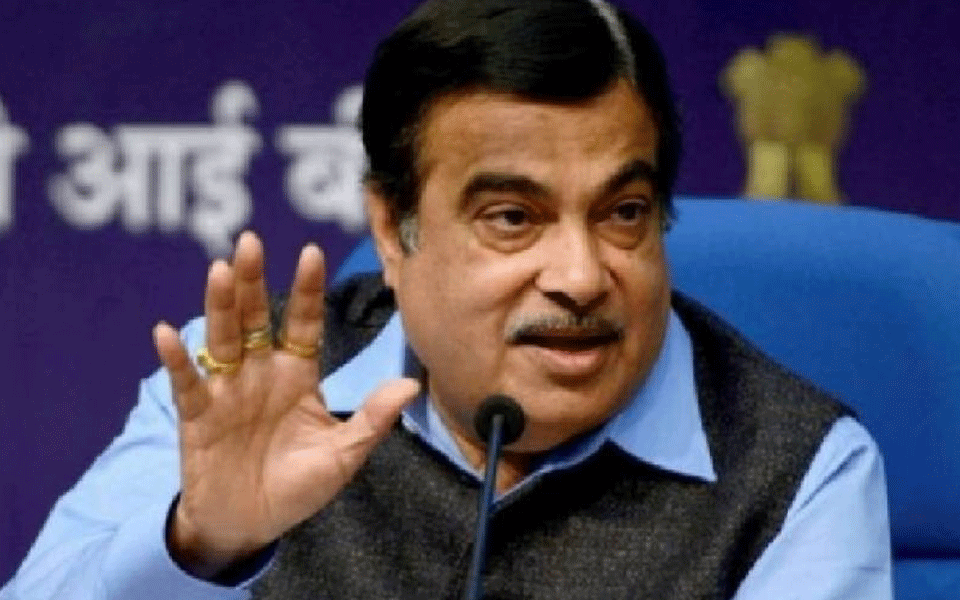
Mumbai(PTI): Union Minister Nitin Gadkari on Friday justified the hikes in fuel prices, thrice in the last four days, saying that the oil prices had gone up within the international market owing to the ongoing war between Russia and Ukraine, which was beyond the Indian government's control.
Speaking at a session titled New India, New Manifesto-Sab Ka Saath, Sab Ka Vikas, at the ABP Network's inaugural deas of India' summit here on Friday, Gadkari, Minister for Road Transport and Highways, also said that, Sometimes, Hindutva is projected in a wrong way.
In India, 80 per cent of the oil is imported. Amid the ongoing war between Russia and Ukraine, the oil prices have spiralled up within international markets and we can not do anything about that, he said when asked about the high petrol and diesel prices and how the government was planning to the issue.
The minister said that he has been making a pitch for making India self-reliant since 2004, with which, we need to make our own fuel, while laying stress on the need for developing indigenous energy generation capabilities.
Petrol and diesel prices were hiked by 80 paise a litre each on Friday, the third increase in four days, as oil firms recoup losses from holding rates during the period prior to the recently-concluded assembly elections.
These hikes are the steepest single-day rise since the daily price revision began in June 2017.
With three increases beginning March 22, petrol and diesel prices have gone up by Rs 2.40 a litre.
A record 137-day hiatus in rate revision ended on March 22 with an 80 paise per litre increase in rates, and similar hikes have followed in the subsequent days.
The prices had been on a freeze since November 4 ahead of the assembly elections in five states -- a period during which the cost of crude oil soared by USD 30 per barrel.
India will soon have a Rs 40,000 crore ethanol, methanol and bio-ethanol production economy, reducing our dependence on petroleum imports, he said.
Leading car and two-wheeler manufacturers in India are working on developing products with flex-fuel engines which will be launched in the coming months, he mentioned.
Highlighting the manufacturing capabilities of India in developing battery and green hydrogen technology, he said, The prices of IC (internal combustion) engines and electric vehicles will be on par in India in the next two years. We are working on developing green hydrogen production indigenously in the country by harnessing it from sources like sewage water and biomass.
Emphasising that the BJP does not accept any discrimination based on caste, religion, language or gender, he said, Sometimes, Hindutva is projected in a wrong way. The basic principle of Hindutva is justice for all and appeasement of none.
According to Gadkari, in the BJP's philosophy, nationalism is the primary focus.
The second focus lies in good governance and development while the third most important pillar is Antyodya, under which we try to uplift those who belong to socially and economically backward classes, he said.
Stating that the Supreme Court has rightly described Hindutva as a way of life , Gadkari said that religion and community are different from each other.
So sometimes, Hindutva is interpreted as anti-Christian and anti-Muslim. In the last seven years (since the Modi-led NDA government came into power), none of the Central government schemes have been discriminatory against anyone. There was no communal approach in our schemes, he said.
On the non-BJP states not declaring the movie The Kashmir Files' tax-free, unlike some BJP ruled states, he said, The Indian Constitution has a Federal structure. Every state government has a right either to make or not to make a movie tax-free. We respect that.
On being asked about the lack of a strong opposition in the country, Gadkari said, I want to tell the opposition that in politics, no defeat is ultimate.
He quoted former US president Richard Nixon, A man is not finished when he is defeated but a man is finished when he quits.
Let the Truth be known. If you read VB and like VB, please be a VB Supporter and Help us deliver the Truth to one and all.
Karnataka launches drug monitoring portal for NSQ detection, NDPS misuse
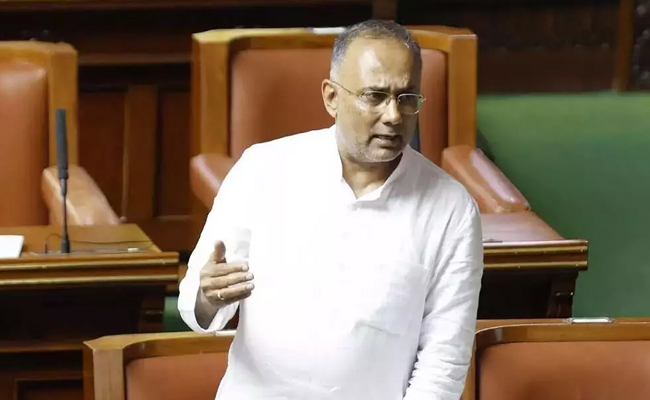
Bengaluru (PTI): Karnataka Health Minister Dinesh Gundu Rao on Thursday launched a monitoring portal for the detection of NSQ drugs and the prevention of misuse of NDPS, aimed at strengthening surveillance, transparency and accountability in public health.
To effectively monitor and control the movement of such drugs, the Food Safety and Drug Administration department has developed the portal to track Not of Standard Quality (NSQ) drug batches available with stockists and retailers, officials said.
Through this system, identified NSQ batches will be automatically locked, preventing any further sale or transaction of those products. The portal also provides real-time information to the department regarding available stock, stock-in-hand details and quantities returned to suppliers, ensuring better monitoring, transparency and public safety, they said.
Addressing a press conference here, the health minister said the main objective is that whenever any medicine is found to be not of proper quality or not up to standard, action needs to be taken.
He said that earlier, when samples were collected and tested, if a medicine was found to be substandard, it would already have reached the market - distributors, retailers, pharmacies and others.
"There was no system to recall those medicines. We could only try to stop future supplies, but we had no control over medicines that had already entered the market, even if we knew they were of poor quality. As a result, such medicines could still be purchased and sold to the public," Rao said.
Officials noted that the Food Safety and Drug Administration department has recalled medicines worth Rs 1.85 crore in the year 2025-26.
"Today, we are launching this portal... Whenever any drug is newly identified as substandard, we will immediately upload that information on the portal. The portal is integrated with databases of wholesalers and stockists," the minister said.
According to him, the moment a batch is declared substandard and uploaded, messages are instantly sent to all wholesalers and retailers. Wholesalers have been linked to this system. Once the information is updated, further sale of that batch will automatically stop.
"Whether it is in warehouses, distribution chains or stockists' inventories, the stock will be frozen automatically. They will not be able to sell those medicines further," he said.
Around 15,000 stockists and wholesalers are currently part of this system, the health minister said, adding that in the next stage, "We will bring in about 45,000 retailers and pharmacists into the database. For now, at the wholesale and stockist level, this system will completely block the sale of such medicines. Those batches will have to be returned, and the companies concerned will be held responsible. The recall process will happen in real time".
"Once testing and verification are completed and the drug is proven substandard, we can instantly alert the entire state. Every stock point holding that batch will be frozen immediately. Even if someone wishes to continue selling it, they will not be able to do so. The process will stop automatically," he said.
Stressing that this is a major reform and a very positive step, Rao said, "As far as I know, no other state in the country has introduced such a system. Karnataka is introducing it today." Apart from this, the minister said the portal will also help in monitoring narcotic and psychotropic drugs regulated under the Narcotic Drugs and Psychotropic Substances (NDPS) Act.
Earlier, when pharmacies sold such medicines, they only had to maintain physical records containing the patient's name, the doctor's details and the prescription. Irregularities would come to light only during inspections conducted at pharmacies.
Under the new system, Rao said that pharmacies selling narcotic or psychotropic drugs will have to upload all details onto the portal. "This means we will have data on where and how much is being sold, who is purchasing these medicines, whether excessive quantities are being sold under one person's name, or whether a particular doctor is prescribing unusually high amounts," he said.
Rao said the data can be analysed to identify suspicious patterns or unusual sales of such medicines.
"If certain doctors are issuing too many such prescriptions, we can monitor them closely. Likewise, if any pharmacy is selling unusually high quantities of these medicines, we can inspect them and take action," he added.