“Only god will do justice”: Father of Bihar youngster arrested for abusive remarks against PM
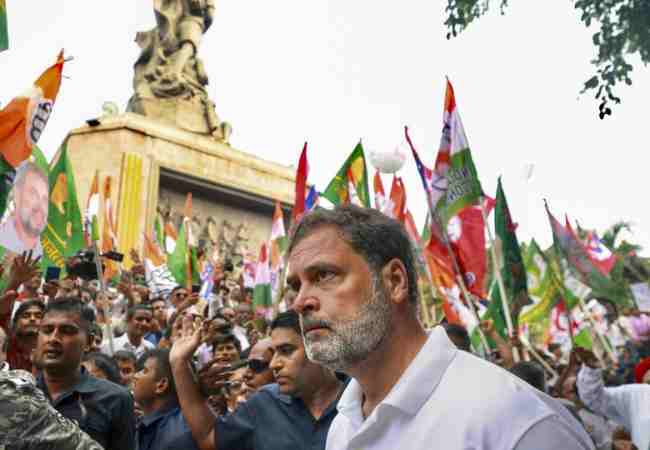
Bharwara: The father of Mohammed Rizvi alias Raja, the young man jailed after a video surfaced of him using abusive language against Prime Minister Narendra Modi during Rahul Gandhi’s Voter Adhikar Yatra in August, says the family has been left devastated financially, socially, and emotionally.
Speaking to The Hindu, Rizvi’s father, Mohammed Anish, who runs a small two-wheeler repair shop in Bharwara village, said he has not been able to afford legal help for his son, nor has the family received a copy of the FIR from the police.
“I don’t have the means to fight a case. The police beat him so much that when I saw him, he looked half-dead,” Anish told The Hindu. “What was his crime, other than being poor?” he asked, his voice breaking.
The incident occurred on August 27 near Bithauli Mor on National Highway-27, where a local Congress unit had set up a reception stage for Rahul Gandhi’s Voter Adhikar Yatra. After the leaders left, Rizvi was recorded on the same stage making derogatory comments against the Prime Minister. Once the video spread widely on social media, the BJP’s Darbhanga district president filed a complaint. Later that night, police from Simri and Singhwara stations arrested Rizvi from his home.
Anish said his son used to work as a casual car driver to support the household. Since the arrest, the family’s livelihood has collapsed. Customers have stopped coming to his shop, and rent arrears have piled up.
“I run this shop on rent,₹15,000 a month. I have not been able to pay for several months,” he said. “Some days I go home with nothing. I feel helpless.”
His wife, Chand Bibi, is a heart patient, and the stress has further weakened her health.
Anish, the only Muslim resident in the locality, said he has now taken a vow not to speak about the incident due to emotional exhaustion. “If I break my vow, Allah will not forgive me,” he told The Hindu. “I have left everything to God.”
Rizvi is the third of eight siblings. Family members say he is weak in jail and suffering from continuous headaches, but they cannot afford medical treatment.
When asked how he expects his son to be released without legal intervention, Anish responded softly: “He will be released only when God wills.”
Let the Truth be known. If you read VB and like VB, please be a VB Supporter and Help us deliver the Truth to one and all.
Man booked for duping 7 persons of Rs 91 lakh on promise of awarding govt works

Mumbai (PTI): The Mumbai police have registered a case against a man for allegedly duping seven persons of Rs 91 lakhs on the promise of awarding them works of different government departments, an official said on Tuesday.
The accused was identified as Satish Kadam, a resident of Nanded in Marathwada region, an official said.
A complaint was filed by Hanumant Vadje, who alleged that the accused cheated him and six others of around Rs 91 lakh by promising to give them various works of Urban Development and Social Justice Department, he said.
The fraud occurred between 2024 and 2026, with Kadam collecting money in cash and into his accounts, police said, adding he had returned some amount to them partially.
Multiple cheques issued by the accused bounced, prompting the victim to lodge a complaint at the Marine Drive police station. Based on the complaint, a case of cheating and criminal breach of trust was registered against him.
The case is under further investigation, the official said.