'Operation Sindoor 2.0 seems inevitable as Pakistan fixated on Kashmir issue with Chinese support'
Gandhinagar (PT): Lieutenant General Dushyant Singh (retd) on Sunday said the Indian armed forces must remain prepared as "Operation Sindoor 2.0" is inevitable, mainly because Pakistan's military remains fixated on the Kashmir issue with support from China and Turkiye.
Singh said the "ceasefire" during Operation Sindoor in May remains “fragile” due to repeated violations by Pakistan on the Line of Control (LoC).
He also highlighted the need to improve narrative-building capabilities by India, which he described as one of the shortcomings during the military operation.
ALSO READ: Boy called ‘Fauji’ by APJ Abdul Kalam at age 3 becomes Lieutenant at 22
Singh, Director General of the New Delhi-based think tank Centre for Land Warfare Studies (CLAWS), was addressing a gathering at the headquarters of the Indian Air Force’s South Western Air Command (SWAC) near Gandhinagar, Gujarat.
His address was part of the ninth edition of the Late Flying Officer Nirmal Jit Singh Sekhon (PVC) Annual Memorial Lecture, organised by the Air Force Association, Gujarat Branch.
"Operation Sindoor was not the end, but it was the beginning of new dynamics of escalation management. So, what are the chances of any future conflict with our adversary? The answer is yes. 'Operation Sindoor 2.0' is not merely a possibility; it is inevitable. The earlier we prepare for it, the better we are," said Singh.
He added that the likelihood of another 'Operation Sindoor' remains high as Pakistan’s military continues to remain fixated on the Kashmir issue, with backing from China and Turkiye.
Singh, however, expressed confidence in the Indian government’s ability to deal with future threats.
"One of the successes of Operation Sindoor was the doctrinal shift. It discarded restraint and exposed Pakistan's weaknesses. For the first time since the 1971 war, a tri-service synergy was achieved. Political clarity translated into military precision, air defence innovation, and surprised global observers," said Singh.
Operation Sindoor was India's swift, targeted military response in May 2025 to a major terrorist attack in Pahalgam, aiming to destroy terrorist infrastructure and launchpads inside Pakistan and Pakistan-Occupied Kashmir.
Highlighting shortcomings, Singh said India was weak in international narrative management.
"Diplomatic missions were not briefed aggressively, and pro-India lobbies abroad remained under-utilised. Narrative warfare was not fully leveraged. This is a gap we cannot afford in the future," the retired Army officer said.
ALSO READ: BJP people 'gaddar', 'dramebaaz'; need to be removed from power: Kharge
He noted that Pakistani social media influencers flooded platforms such as TikTok, with amplification support from Chinese social media networks, and even targeted youth audiences in Bangladesh.
Singh also pointed to intense cyber warfare during the four-day operation.
"Cyber attacks on India were heavy during the four days of Operation Sindoor, but our counter-offensive cyber operations were either not clearly articulated or we were not aware of them," he said.
Singh said cyber attacks on government networks had surged sevenfold during the four-day period.
"The power sector witnessed nearly two lakh cyber attacks, while the National Stock Exchange faced around 40 crore cyber attacks. Had any been successful, it could have triggered a financial crisis," he said.
Singh emphasised that modern conflicts extend beyond land, sea and air, underscoring that multi-domain warfare is now a reality.
"We need coordinated information propagation during conflicts. On the information warfare front, Chinese media were deeply engaged in data analysis and crafting messages to amplify India’s fault lines," he said.
He recommended codifying a "national security strategy.
"India needs a well-documented national security strategy. We also need to reform intelligence and internal security, fast-track the integrated theatre command, raise defence spending by 3 per cent of the GDP, excluding pensions, and focus on outcome-based budgeting, not process-driven," the retired officer said.
ALSO READ: Gunmen kill at least 11 people at Jewish event at Sydney's Bondi Beach
Singh also called for the creation of dedicated Cyber Warfare and Cognitive Warfare Commands, and stressed the need to overhaul India’s strategic communications.
"We need to mend India's strategic communication for better narrative building. Siloed messaging by agencies such as the MEA and MoD led to delayed rebuttals during the operation, which amplified Pakistan’s narrative. These things are equally important because they affect India's overall image.
"Weak technology integration failed to counter viral claims about Indian jets. We must deploy AI for disinformation tracking and engage the 32 million-strong Indian diaspora as narrative amplifiers," Singh added.
Air Vice Marshal Anil Golani (retd), Director General of the Centre for Air Power Studies (CAPS), spoke about the relevance of air power and the future of the Indian Air Force.
He said Operation Sindoor was a strategic shift from restraint to "deterrence by punishment".
Claiming that Pakistan's aggressive moves against India during the military conflict exposed collusion between China and Pakistan, Golani said China used the conflict to test its weapons. PTI PJT NSK
Let the Truth be known. If you read VB and like VB, please be a VB Supporter and Help us deliver the Truth to one and all.
India describes attack on Fujairah 'unacceptable'
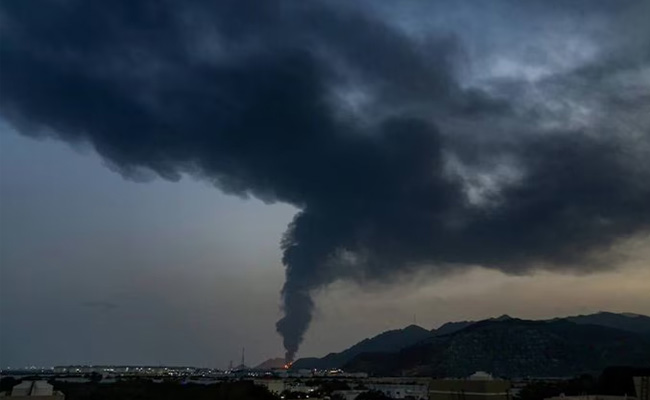
New Delhi (PTI): India on Tuesday described the wounding of three Indians in an attack on the United Arab Emirates' port city of Fujairah as "unacceptable" and pressed for an immediate cessation of hostilities targeting innocent civilians.
New Delhi's reaction came a day after the Indians were injured after a drone attack caused a fire at a major oil industry zone in Fujairah. The UAE had accused Iran of carrying out the strike.
"The attack on Fujairah that resulted in injury to three Indian nationals is unacceptable," External Affairs Ministry spokesperson Randhir Jaiswal said.
"We call for immediate cessation of these hostilities and the targeting of civilian infrastructure and innocent civilians," the spokesperson said.
Jaiswal said India continued to stand for dialogue and diplomacy to deal with the situation so that peace and stability could be restored across West Asia.
"We also call for free and unimpeded navigation and commerce through the Strait of Hormuz in keeping with international law. India stands ready to support all efforts for a peaceful resolution of issues," he said.
The attack on Fujairah city came as the ceasefire between the US and Iran came under strain in the Strait of Hormuz.
The Strait of Hormuz, through which roughly one-fifth of the world's oil and gas pass, remains a major sticking point in the talks. Shipping through the narrow Gulf waterway has been severely disrupted by the conflict, triggering a sharp increase in oil prices and energy shortages in several countries.
The UAE's defence ministry on Monday said its air defence systems engaged 12 ballistic missiles, three cruise missiles and four drones launched from Iran.
The ministry affirmed that it "remains fully prepared and ready to deal with any threats and will firmly confront anything that aims to undermine the security of the country."