Opposition parties, Shiv Sena pitch for election through ballot papers
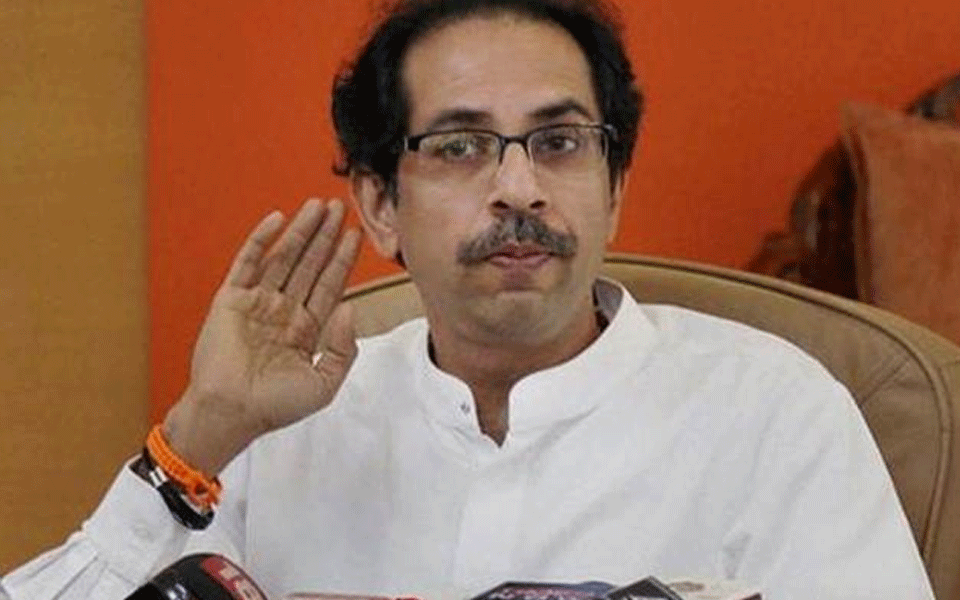
New Delhi, Aug 27 : Several opposition parties and ruling NDA constituent Shiv Sena on Monday pushed for reverting back to ballot paper in place of Electronic Voting Machines (EVMs) and opposed simultaneous elections at a meeting convened by the Election Commission which also saw some parties pitching for state funding of elections.
The Shiv Sena differed with its ally BJP to support the polls through ballot paper and the CPI-M too differed from other opposition parties and said it was not for returning to the old system of holding elections. It sought more safeguards in EVMs.
Chief Election Commissioner O.P. Rawat said after the meeting that the poll panel will take a call on all the issues raised by parties including on EVMs and ballot paper, integrity of electoral rolls and ceiling on expenditure by political parties.
"We will definitely look into the issues presented by them. There will be a satisfactory solution to them," Rawat said.
Parties like the Congress, CPI, Trinamool Congress, BSP, DMK and Shiv Sena said that there should be a return to ballot papers while the BJP and BJD said they were satisfied with electronic voting machines (EVMs).
The AAP said either the count to verify electronic voting machine (EVM) results with Voter Verifiable Paper Audit Trail (VVPAT) should be increased or there should be a return to ballot paper while the AIADMK said it was fine both with EVMs and ballot paper.
Congress leader Mukul Wasnik said the party supported "the demand of using ballot paper in the election in the present situation." He said malfunctioning of EVMs was a major issue.
"VVPATs were introduced but are not being cross-checked. We demanded that at least 30 per cent of the votes should be cross-checked," Wasnik said.
He said more transparency was required in the voters list as a number of cases had surfaced in the recent past where lakhs and lakhs of bogus voters were found. "These bogus voters affect the entire electoral process."
Shiv Sena leader Anil Desai said: "We have made a point... Let us go back to ballot papers. We have insisted on ballot papers for elections to the largest democracy."
BJP leader and union minister J.P. Nadda said the Election Commission's efforts to match EVM results with VVPAT was a good move.
"We should think ahead. The Election Commission has properly replied to all questions raised about the EVMs and we should look forward. (Using) VVPAT is a good move and it should be taken forward," he said.
Asked about the Congress demand for a return to ballot paper, he said that party's "habit of looking forward has ended".
Nadda said the BJP laid emphasis on correct identification of voters and proper training of people involved in the process. "(For) accurate voting there should be accurate identification. There should not be proxy identification."
Nadda said the voter slip should not be the only way for identification as it can be purchased by an influential candidate and it should also be on the basis of six other identified documents.
"The other thing we said was that deletion of a voter from electoral rolls should be with a reason and should not take place below the level of district magistrate," he said.
Bahujan Samaj Party's Satish Misra said EVMs can be hacked. He said almost every party, except one, had made the demand and the world had gone back to the ballot paper.
Kalyan Banerjee of Trinamool Congress said they were demanding state funding of elections to check corruption.
He said there was time still to implement voting through ballot paper before the Lok Sabha elections.
CPI-M's Nilotpal Basu said they mainly raised the question of funding of elections because this was the issue agitating the minds of electorate.
"Corporate funding has been promoted in such a big way." He said some parties want to go back to the ballot box but the CPI-M wanted much more "thorough-going reforms.
"We are not for returning. We are for further strengthening the safeguards which can make them more transparent and can really remove the "doubts in public mind," he said.
He said simultaneous polls were not discussed but in the written submission the party had said that the suggestion was "totally anti-Constitutional."
The AIADMK said it was not against the ballot paper or EVMs.
"We are ready to face anything. At the same time, we suggested there should not be any malpractice, any doubt regarding EVM machines during the elections," senior AIADMK leader and Lok Sabha Deputy Speaker M. Thambidurai said.
He said state funding was the only answer to stop election malpractices.
CPI's Atul Kumar Anjan said there was a need to put an end to electronic voting system as many people in this country have sugar and eyesight related problems.
"Within eight seconds they cannot see to whom they have voted. There are lots of troubles with these machines."
BJD's Pinaki Mishra said: "We would ideally like the EC to lay down as to what percentage of the VVPAT paper trail they are going to count. Once that is done, I believe everyone should be reasonably satisfied."
He said his party supports the idea of simultaneous elections.
AAP's Raghav Chadha said EVMs can be easily hacked and there were incidents where these machines have created trouble during elections.
"At least 20 per cent voter verifiable paper audit trail (VVPAT) machines and electronic voting machines (EVMs) should be verified or paper ballot system should be implemented," he said.
LJP leader and Union Minister Ram Vilas Paswan told reporters that the party had not received "notice" for the meeting.
Let the Truth be known. If you read VB and like VB, please be a VB Supporter and Help us deliver the Truth to one and all.
Maharashtra sets up state vaccination task force to strengthen immunisation programme

Mumbai (PTI): The Maharashtra government has set up a State Vaccination Task Force to strengthen the regular immunisation programme and review the progress of related campaigns, a health department official said on Monday.
The State Vaccination Task Force will comprise at least 29 members and will be headed by the administrative head of the health department, he informed.
The government has also constituted separate district-level and municipal vaccination task forces to improve implementation and address challenges at the grassroots level, he said.
Municipal task forces, chaired by respective civic commissioners, have been constituted in view of the vast urban population in Maharashtra and the role of civic bodies in implementing different health programmes.
The district-level task forces will function under the chairmanship of collectors.
"Complete immunisation of children at the appropriate age is an extremely simple, cost-effective and highly effective measure to reduce child mortality and the prevalence of diseases among kids. Immunisation is a powerful tool for reducing illness in children," maintained the official.
To ensure full vaccination of all children, the state government implements various campaigns from time to time as per the central government guidelines, he pointed out.
"Active participation and cooperation of other relevant government departments are essential (in making these campaigns successful)," according to the official.
The state-level body will review the regular immunisation programme, associated campaigns and vaccine-preventable diseases in detail. It will also conduct focused assessments of high-risk districts and municipal corporations, including vacancies at district, municipal and sub-district levels, availability of cold chain equipment, resource gaps and training requirements, he noted.
The state task force will review allocation and utilisation of funds for immunisation and ensure timely action by officers concerned based on reports from district and municipal task forces and state-level monitoring mechanisms, the official said.
It will also ensure active coordination and participation of other government departments in immunisation drives, while district and municipal task forces will carry out similar functions at their respective levels, the official added.