Owaisi slams Kishan Reddy's reported comments on terror in Hyderabad
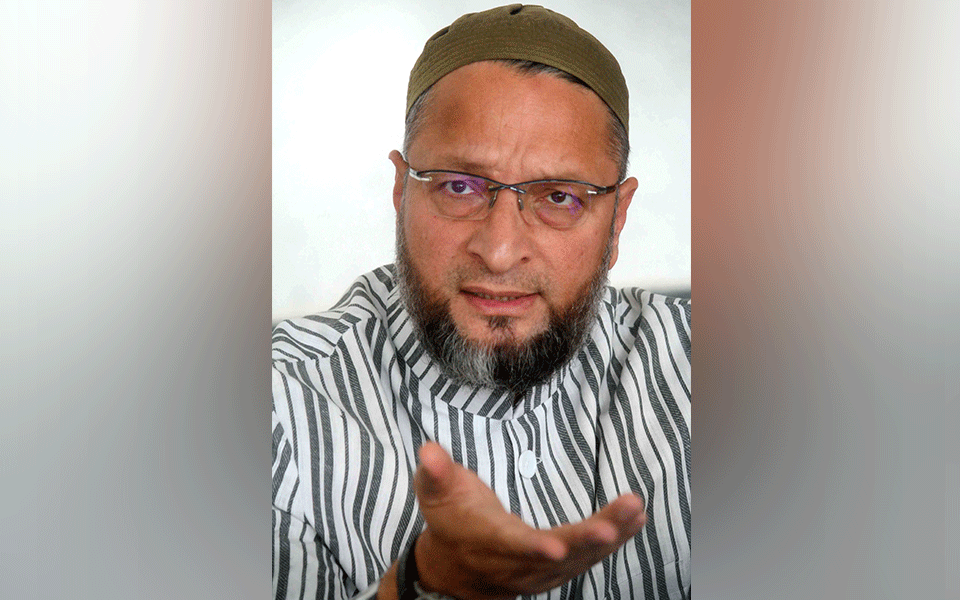
Hyderabad, Jun 1: Hitting out at Minister of State for Home G Kishan Reddy for his reported comment that Hyderabad has become a safe zone for terrorists, AIMIM president Asaduddin Owaisi Saturday said such remarks will hurt the city's image.
Reddy assumed charge as minister of state for home in Delhi on Saturday.
"He (Reddy) did not even take charge of his post, but makes such... comments. I am asking him, and his ministry tell people of Hyderabad how many written advisories NIA, IB and RAW gave in the last five years that Hyderabad is becoming a den for terror," Owaisi told reporters.
It is lamentable that such comments are made although peace prevails in Hyderabad for the last five years, said the AIMIM chief, who is also the MP from Hyderabad.
Hyderabad is second only after Bengaluru in software exports in the country, Owaisi claimed.
Reddy could not be reached for comments.
The AIMIM president asked, "Why do they have this enmity towards Telangana, Hyderabad. Don't they like (to see) Hyderabad grow..."
"Big companies are coming (to the city) and the minister of home speaks such things. It conveys how much hatred they have for Telangana and Hyderabad," Owaisi said.
BJP leaders fear that investment is coming to Telangana under the leadership of Chief Minister K Chandrasekhar Rao, he alleged.
On ISIS sympathisers being found in Hyderabad, he asked whether such people have not been caught in Uttar Pradesh in the highest number. "Has that (UP) become a den," he said.
"...Because, it is their mentality. Wherever they see a Muslim, they feel that he is a terrorist," Owaisi said.
Claiming that hate crimes against Muslims are happening at places like Gurugram and Begusarai even after Prime Minister Narendra Modi spoke (about inclusiveness), he said mere lip service would not do.
"Their policy that..Modi would say one thing and Kishan (Reddy) would say something else. Modi would say one thing and VHP would say something else....
"It is their theory of confusion. They keep practicing that... We have understood them. That's why I say, you practice," he said.
Noting that composite culture prevails in Telangana where progress is being achieved under the leadership of Chief Minister Rao, Owaisi claimed the BJP would prove to be unsuccessful in its attempts to grow in Telangana.
Let the Truth be known. If you read VB and like VB, please be a VB Supporter and Help us deliver the Truth to one and all.
Trump says EU has until July 4 to approve last year's trade deal or it will face higher tariffs
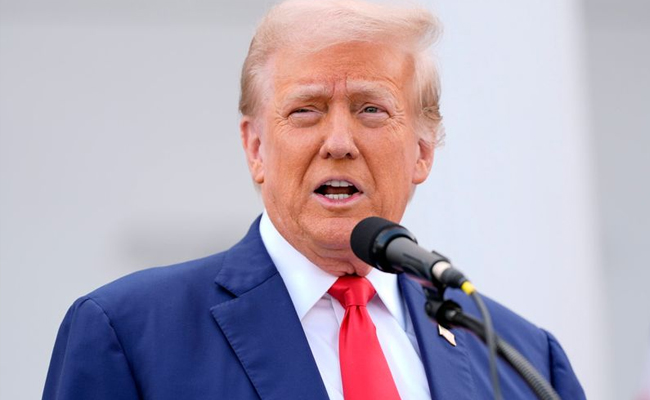
Washington (AP): President Donald Trump has said in a social media post that goods from the European Union would face higher tariff rates if the 27-member bloc fails to approve last year's trade framework by July 4.
The announcement on Thursday appeared to be a deadline extension after the president said last Friday that EU autos would face a higher 25 per cent tariff starting this week. Trump made the updated announcement after what he described as a "great call" with European Commission President Ursula von der Leyen.
Still, the US president was displeased that the European Parliament had yet to finalize the trade arrangement reached last year, which was further complicated in February by the US Supreme Court ruling that Trump lacked the legal authority to declare an economic emergency to impose the initial tariffs used to pressure the EU into talks.
"A promise was made that the EU would deliver their side of the Deal and, as per Agreement, cut their Tariffs to ZERO!" Trump posted. "I agreed to give her until our Country's 250th Birthday or, unfortunately, their Tariffs would immediately jump to much higher levels."
It was unclear from the post whether Trump was implying that the tariff rates would jump on all EU goods or the increase would only apply to autos.
His latest statement indicates he might be backing away from his earlier threat on EU autos by giving the European Parliament several more weeks to approve the agreement.
Under the original terms of the framework, the US would charge a 15 per cent tax on most goods imported from the EU.
But since the Supreme Court ruling, the administration has levied a 10 per cent tariff while investigating trade imbalances and national security issues, aiming to put in new tariffs to make up for lost revenues.