Pandit who writes in Prophet’s praise
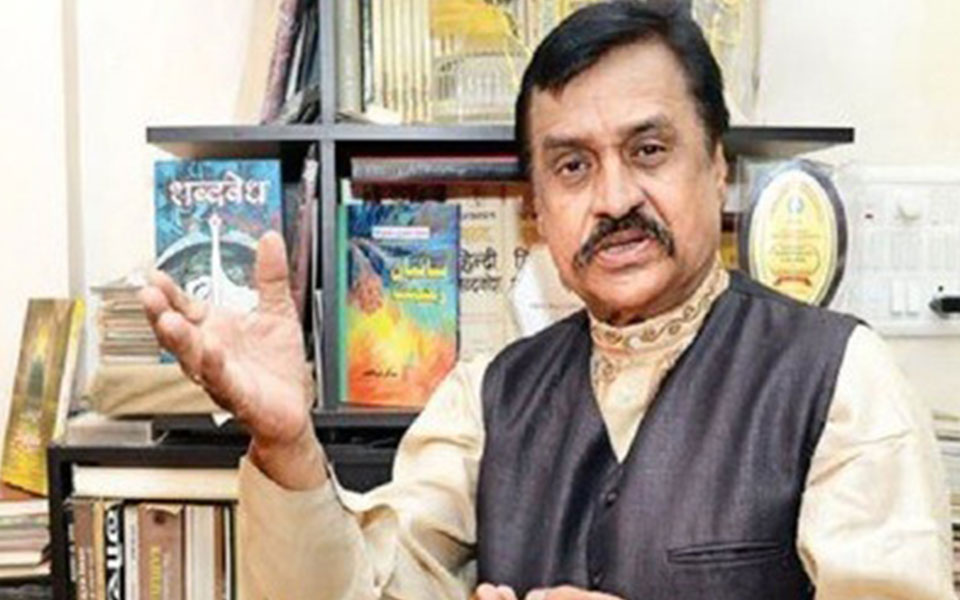
Mumbai, May 27: At a time of anxieties over prayer locations and portraits of historic figures, in a quiet, sea-facing flat in Mumbai’s Colaba, Pandit Ram Sagar Prithvipal Tripathi, or simply Sagar Tripathi, reverentially opens Saibaan-e-Rahmat (Tent of Mercy), his collection of 'natiya shairi’ or devotional poems penned in praise of Prophet Muhammad.
The 68-year-old, hailing from a family that patronises the Ram Lalla Vinyas, a temple trust in Ayodhya, is also world president of the Vishwa Brahmin Parishad. But that’s not what he’s well known for. He has become a famous face at mushairas (traditional soirees where Urdu poets recite couplets) for his poetry, and in particular for always opening his session with a 'hamd' (penned in praise of God) and a ‘natiya kalam,’ a panegyric extolling the Prophet and his message.
‘Prophet belongs to all of humanity, not just Muslims’
In his house, dozens of awards and citations that he’s won for his works jostle for space with copies of the Quran, biographies of the Prophet, the Bhagavad Gita and the Ramayana. Behind a huge sofa are placed several prayer mats that he spreads often for Muslim guests who want to pray if they wish to.
Tripathi’s collection of poems on the Prophet unambiguously declares not just his devotion to Islam’s founder,but also his yearning for peace and communal harmony. His verses, in Urdu and Devanagri scripts, epitomise India’s famed Ganga-Jamuni tehzeeb (composite culture). They celebrate a tradition where Ram inhabits space along with Rahim and where Hindus and Muslims don’t just tolerate each other; they co-exist and cooperate.
"Prophet Muhammad doesn’t belong to Muslims alone. He is for humanity, and there is nothing wrong if I seek some blessings from him," says Tripathi. He captures this belief in a couplet: 'Sirf ek quom ke nahin hain woh/Rahmate aalminee hain aaqa (He doesn’t belong to just one community/He is mercy for the universe).’ Such ‘shers’ predictably draw wide applause and appeals for an encore from the predominantly Muslim crowds at mushairas in India and abroad.
Born in a village in UP’s Sultanpur district, Tripathi says there was a lot in his background to prepare him for a career as a poet, though he earns from his business, properties investments and shares. While he was an undergrad and masters’ student at Allahabad University, he came under the tutelage of the famous Urdu poet Raghupati Sahai Firaq Gorakhpuri. His grandfather wanted him to become an IAS officer and had bought a house for him near Firaq’s place, but Tripathi never sat for the UPSC exams as he fell in love with poetry. His passion grew as he got dazzled by the leading lights of Urdu poetry.
"I would bring chai paani and listen to these greats," laughs Tripathi,who moved to Mumbai in the 1970s primarily “to make money”. "I earned loads of money but always found a hollowness within me. Poetry filled this gap as it became therapy, a way to get catharsis," he says. Tripathi donates the money from his book sales to fund the education of poor Muslim children.
"Sagar sahib is an important name in the contemporary Urdu mushaira scene and his contributions are admirable,” says noted Urdu poet Abdul Ahad Saaz.
As a member of a ‘pandit’ family from Ayodhya, what does he have to say about the long-delayed resolution of the Ramjanmabhoomi-Babri Masjid dispute? "I don’t want to say much on the dispute as it is sub judice," he says, "but it can be resolved if people stop making it an ego issue and politicians are kept away from it.”
Courtesy: timesofindia.indiatimes.com
Let the Truth be known. If you read VB and like VB, please be a VB Supporter and Help us deliver the Truth to one and all.
BJP repealed MGNREGA as they have 'allergy' to Mahatma Gandhi’s name: CM Siddaramaiah
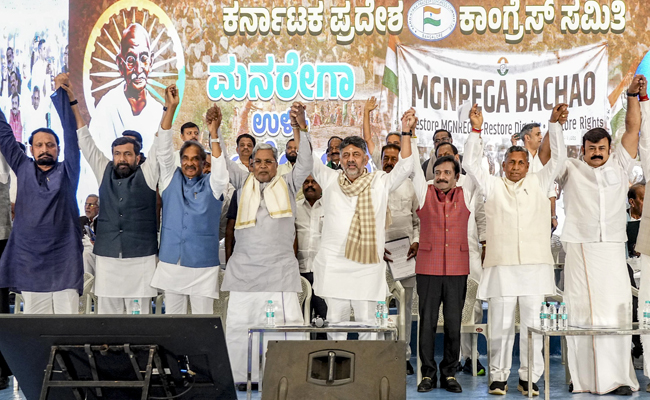
Bengaluru (PTI): Karnataka Chief Minister Siddaramaiah on Tuesday launched a sharp attack on the BJP-led Centre, alleging that the MGNREGA was repealed out of "allergy" to Mahatma Gandhi’s name.
He also called for sustained, people-led agitation until the law is restored and the new VB-G Ram G Act is withdrawn.
The CM alleged that the BJP "killed" Mahatma Gandhi as the RAM in the Viksit Bharat – Guarantee Rozgar and Ajivika Mission (Gramin) (VB-G RAM G) represents Nathuram Godse, the "killer" of Gandhi, and not Lord Rama.
Addressing a preparatory meeting of the Mahatma Gandhi Employment Guarantee Scheme Bachao Sangram, organised by the Congress state unit here, Siddaramaiah said the struggle must continue "until MGNREGA is reinstated and the VB-G Ram G Act is repealed," urging party workers to turn it into a mass movement from the village to the state level.
The chief minister said, "The Centre has scrapped the Mahatma Gandhi National Rural Employment Guarantee Act and brought in a new law called VB-G RAM G. Mahatma Gandhi’s name itself causes them an allergy."
He said the issue was discussed seriously at the recent All India Congress Committee (AICC) executive committee meeting, which viewed the scrapping of MGNREGA as a grave matter.
Drawing parallels with farmers’ protests in north India, Siddaramaiah said a similar sustained movement was needed to force changes in laws. He recalled that MGNREGA was enacted during Manmohan Singh’s tenure to make the right to work a basic right for the rural poor.
"Along with employment guarantee, landmark laws like the Right to Food, Right to Information, Right to Education and Forest Rights Act were introduced to address unemployment, hunger and the problems of forest dwellers," he said.
The CM noted that the scheme, which had been in force for nearly 20 years, had provided employment to 12.16 crore workers across the country, including 6.21 crore women.
Criticising the replacement of law, Siddaramaiah alleged that the Modi government had diluted workers’ rights.
"Earlier, rural workers could demand work for up to 365 days in their own villages and even approach courts if work was denied. Now, the Centre decides through notifications where people should work," he said.
Taking a swipe, he remarked, "This is not Dasharatha Ram or Sita Ram or Kaushalya Ram. This is Nathuram — the one who killed Mahatma Gandhi. Through VB-G RAM G, Gandhi is being killed once again."
Siddaramaiah also objected to the increased financial burden on states, stating that states now have to bear 40 per cent of the cost, forcing Karnataka alone to spend around Rs 2,500 crore.
"That is why we have launched the MGNREGA Bachao Andolan. It must transform into a people’s movement," he said.
Addressing the gathering, Deputy Chief Minister D K Shivakumar alleged that the Centre will decide the works and not the villages.
According to him, no state government will accept it. Even the BJP ruled states will not implement the scheme.
"Due to the VB-G RAM G, Panchayats will not be allowed to carry out works. After losing works worth Rs one crore to Rs two crore, what is left with the Panchayats," Shivakumar, who is also Congress state president, asked.
He asked his party cadres to hold meetings in every corner of the state to spread awareness about repealing the MGNREGA.
In his address, Rural Development and Panchayat Raj Minister Priyank Kharge said, the BJP hates Mahatma Gandhi so much that they abolished the law and snatched the livelihood of poor people in the rural areas.
He also preferred calling the new scheme as "VB-Gram G" and not VB-G RAM G as the BJP has called it.
"For us, the livelihood of people is important, not the name of the scheme, but the BJP wants to trap us between the names of Gandhi Ji and Ram. We should not go for that fight. You name whatever you want, but give our villagers employment. If needed, we will change the name of the scheme once our government comes to power," Kharge, son of Congress president Mallikarjun Kharge, said.
According to him, the "VB-Gram G" has been introduced to align it with PM Gati Shakti national master plan.