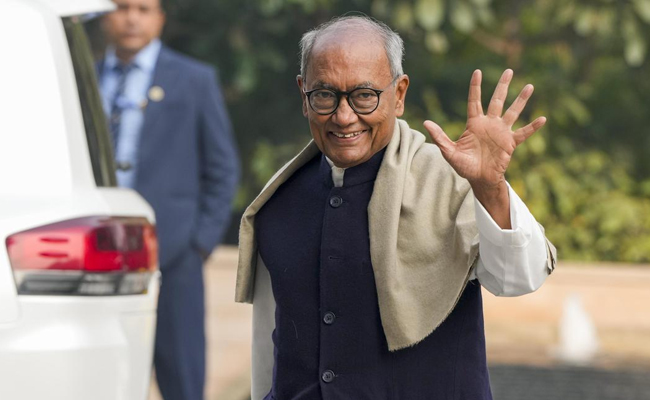
New Delhi: The Indian National Congress on Sunday saw a public difference of opinion after senior leader Digvijaya Singh praised the organisational structure of the Rashtriya Swayamsevak Sangh, prompting a sharp response from the party’s media chief Pawan Khera.

Khera, who heads the Congress’ media and publicity department, said the party had “nothing to learn” from the RSS and distanced the Congress from Singh’s remarks. Taking a strong ideological stand, Khera linked the RSS to Nathuram Godse, Mahatma Gandhi’s assassin, and said, “What can an organisation known for Godse teach an organisation founded by Gandhi?”

ALSO READ: 20,000 police to be deployed for New Year celebrations in Bengaluru: Minister Parameshwara

The controversy followed Singh’s social media post in which he shared an old black-and-white photograph showing Narendra Modi seated on the floor beside senior BJP leader L. K. Advani during an event in Gujarat in the 1990s. Singh said the image illustrated the “power of organisation,” pointing to how grassroots workers of the RSS and the Jan Sangh could rise to become chief minister and prime minister.

In his post on X, Singh tagged several Congress leaders, including party president Mallikarjun Kharge, MPs Rahul Gandhi and Priyanka Gandhi Vadra, as well as Jairam Ramesh, along with Prime Minister Modi. He described the photograph, sourced from Quora, as “impressive” and said it demonstrated organisational strength.

Speaking to ANI later, Singh clarified that he opposed the ideology of the RSS but admired its organisational capacity. He said the RSS did not respect the Constitution or laws and remained an unregistered organisation, but noted that its influence was such that even the Prime Minister had described it as the world’s largest NGO from the Red Fort.

Singh also reflected on the Congress’ organisational challenges, saying there was scope for improvement. Describing the Congress as a movement-based party, he said its weakness lay in converting mass movements into electoral success.

Let the Truth be known. If you read VB and like VB, please be a VB Supporter and Help us deliver the Truth to one and all.


Indore (PTI): The Indore bench of Madhya Pradesh High Court on Tuesday set up a commission of inquiry comprising a former HC judge to probe the issue of water contamination in city's Bhagirathpura, saying the matter requires probe by an independent, credible authority and "urgent judicial scrutiny".

It also directed the commission to submit an interim report after four weeks from the date of commencement of proceedings.

A division bench of Justices Vijay Kumar Shukla and Alok Awasthi constituted the commission while hearing several public interest litigations (PILs) filed simultaneously regarding the deaths of several people in Bhagirathpura due to the consumption of contaminated water.

The HC reserved the order after hearing all the parties during the day, and released it late at night.

The state government on Tuesday told the HC that the deaths of 16 people in Indore's Bhagirathpura area was possibly linked to a month-long outbreak of vomiting and diarrhoea caused by contaminated drinking water.

The government presented an audit report of 23 deaths from the current gastroenteritis epidemic in Bhagirathpura before the bench, suggesting that 16 of these fatalities may have been linked to the outbreak of vomiting and diarrhoea caused by contaminated drinking water.

The report, prepared by a committee of five experts from the city's Government Mahatma Gandhi Memorial Medical College, stated that the deaths of four people in Bhagirathpura were unrelated to the outbreak, while no conclusion could be reached regarding the cause of death of three other people in the area.

During the hearing, the high court sought to know from the state government the scientific basis behind its report.

The division bench also expressed surprise at the state government's use of the term "verbal autopsy" in relation to the report, sarcastically stating that it had heard the term for the first time.

The HC expressed concern over the Bhagirathpura case, stating that the situation was "alarming," and noted that cases of people falling ill due to contaminated drinking water have also been reported in Mhow, near Indore.

In its order, the HC said the serious issue concerning contamination of the drinking water supply in Bhagirathpura area allegedly resulted in widespread health hazards to residents, including children and elderly persons.

According to the petitioners and media reports, death toll is about 30 till today, but the report depicts only 16 without any basis or record, it said.

It is averred that sewage mixing, leakage in the pipeline, and failure of civic authorities to maintain potable water standards have led to the outbreak of water-borne diseases. Photographs, medical reports, and complaints submitted to the authorities prima facie indicate a matter requiring urgent judicial scrutiny, the HC said.

"Considering the gravity of the allegation and affecting the right to life under Article 21 of the Constitution of India and the need for an independent fact-finding exercise, the Court is of the opinion that the matter requires investigation by an independent, credible authority," it said.

"Accordingly, we appoint Justice Sushil Kumar Gupta, former judge of the Madhya Pradesh High Court, a one-man commission of inquiry into the issues relating to water contamination in Bhagirathpura, Indore, and its impact on other areas of the city," the HC added.

As per the order, the commission shall inquire into and submit a report on the cause of contamination -- whether the drinking water supplied to Bhagirathpura was contaminated; and the source and nature of contamination (sewage ingress, industrial discharge, pipeline damage etc).

The panel will also probe the number of actual deaths of affected residents on account of contaminated water; find out the nature of disease reported and adequacy of medical response and preventive measures; suggest immediate steps required to ensure safe drinking water as well as long-term infrastructural and monitoring reforms.

It will also identify and fix responsibility upon the officers and officials found prima facie responsible for the Bhagirathpura water contamination incident, and suggest guidelines for compensation to affected residents, particularly vulnerable sections.

The commission shall have powers of a civil court for the purpose of summoning officials and witnesses; calling up records from the government department, hospitals, laboratories and civic bodies; ordering water quality testing through accredited laboratories; conducting spot inspections.

All state authorities involving district administration, Indore Municipal Corporation, public health engineering department and Madhya Pradesh Pollution Control Board shall extend full co-operation and provide records as sought by the commission, it said.

The state government shall provide office space, staff, and logistical support to the commission, it said.

During the hearing in the day, the state government also presented a status report to the court in this matter.

According to reports, a total of 454 patients were admitted to local hospitals during the vomiting and diarrhea outbreak, of whom 441 have been discharged after treatment, and 11 are currently hospitalised.

According to officials, due to a leak in the municipal drinking water pipeline in Bhagirathpura, sewage from a toilet was also mixed in the water.