Pegasus inquiry panel found malware in 5 out of 29 phones: SC
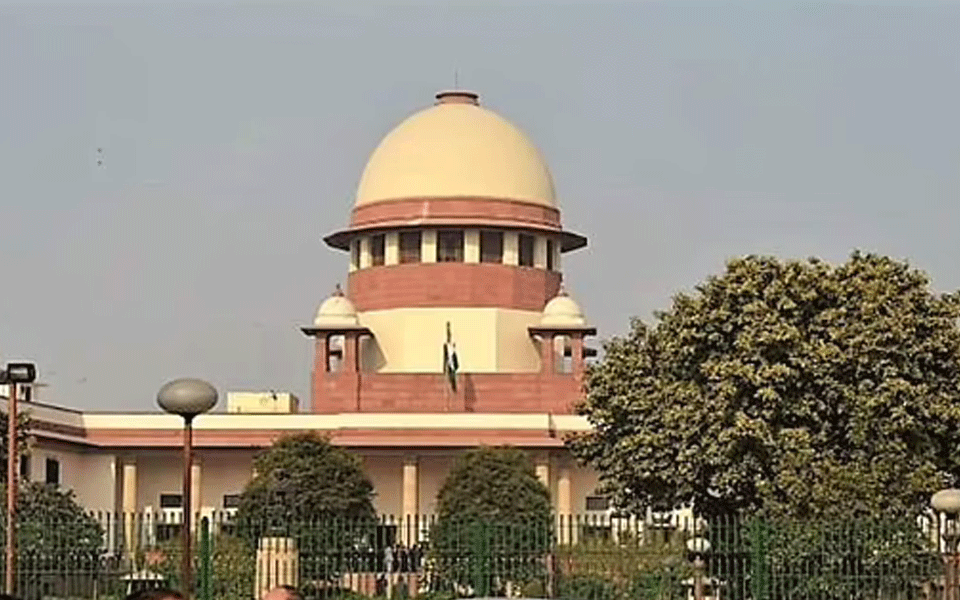
New Delhi (PTI): The Supreme Court-appointed panels probing the unauthorised use of Pegasus found some kind of malware in five mobile phones out of the 29 examined but it could not be concluded that it was due to the Israeli spyware.
The panels also said that the Centre did not cooperate with the Pegasus probe, a Supreme Court bench said on Thursday after perusing the report submitted by former apex court Justice R V Raveendran.
One thing (the) committee has said that the Government of India has not cooperated. The same stand you took here, you have taken there, a bench comprising Chief Justice N V Ramana and Justices Surya Kant and Hima Kohli said.
The bench said the overseeing panel has submitted a lengthy report in three parts and one of the parts suggested amending the law to protect the right to privacy of citizens and ensure cyber security of the nation.
Referring to a report of the technical panel, the bench said it was little concerned as it appeared that out of 29 phones, which were submitted to the technical committee for examination, five had some kind of malware but it cannot be said that these are due to Pegasus .
The bench said the report has suggestions on protecting the citizens' right to privacy, future course of action, accountability, amending the law to improve privacy protection and the grievances redressal mechanism.
It said the report of the overseeing judge Justice Raveendran, which is general in nature, would be uploaded on its website. The bench said it would consider the plea to give redacted part of other reports to the parties.
"It is a huge report. Let us see what portions we can give, it said, adding there was also a request not to release the report.
These are technical issues. So far as Justice Raveendran's report is concerned, we will upload it on the website, the CJI said.
Senior lawyers Kapil Sibal and Rakesh Dwivedi urged the bench to release redacted report to the litigants.
When the bench, on perusal of the report, said the Centre did not cooperate, Solicitor General Tushar Mehta responded by saying he was not aware of that. The court will now hear the matter after four weeks.
The top court on May 20 had extended by four weeks the time for submitting the report by the apex court-appointed technical and supervisory committees to look into the Pegasus row.
The bench, which on October 27, last year had ordered a probe into the allegations of use of Israeli spyware by government agencies for targeted surveillance of politicians, journalists, and activists, has now fixed the case for further consideration in July.
The panel, which included three experts on cyber security, digital forensics, networks, and hardware, was asked to inquire, investigate and determine whether Pegasus spyware was used for snooping on citizens and their probe would be monitored by a former apex court judge R V Raveendran.
The panel members were Naveen Kumar Chaudhary, Prabaharan P, and Ashwin Anil Gumaste.
Justice Raveendran, who is heading the monitoring panel, has been assisted by former IPS officer Alok Joshi and Sundeep Oberoi, Chairman of Sub Committee in International Organisation of Standardisation/ International Electro-Technical Commission/Joint Technical Committee - in monitoring the inquiry of the technical panel.
The committee is requested to prepare the report after a thorough inquiry and place it expeditiously before the court.
The apex court, in its order, had said that the probe panel would be empowered to enquire and investigate what steps or actions have been taken by the Centre after reports were published in 2019 about the hacking of WhatsApp accounts of Indian citizens, using the Pegasus suite of spyware, whether any Pegasus suite was acquired by the Union of India, or any state government, or any central or state agency for use against the citizens of India.
An international media consortium had reported that over 300 verified Indian mobile phone numbers were on the list of potential targets for surveillance using the Pegasus spyware.
Let the Truth be known. If you read VB and like VB, please be a VB Supporter and Help us deliver the Truth to one and all.
Allen, Raghuvanshi, Green power KKR to 29-run win over GT

Kolkata (PTI): Finn Allen blasted a 35-ball 93, while Angkrish Raghuvanshi hit an unbeaten 44-ball 82 as Kolkata Knight Riders kept their playoff hopes alive with a 29-run win over Gujarat Titans in the IPL match here on Saturday.
Sent in to bat, Allen went on a six-hitting spree, smashing 10 maximums and four boundaries to add 95 off 41 balls with Raghuvanshi (82).
Raghuvanshi then shared another 108 off 53 balls with Cameron Green (52 not out) to power KKR to a challenging 247 for 2.
In reply, GT could manage 218-4, riding on skipper Shubman Gill's 49-ball 85 and a 35-ball 57 from Jos Buttler. Opener Sai Sudarsan was retired hurt but returned to make a 28-ball 53 not out.
Sunil Narine (2/29) claimed two wickets and Saurabh Dubey snapped one for KKR.
For GT, Mohammed Siraj (1/50), Sai Kishore (1/38) were the wicket-takers.
Brief Score:
KKR: 247 for 2 in 20 overs (Finn Allen 93, Angkrish Raghuvanshi 82 not out, Camero Green 52 not out; Mohammed Siraj 1/50).
GT: 218 for 4 in 20 overs (Shubman Gill 85, Sunil Narine 2/29).