Personal details of 6.1 mn Facebook users in India leaked online

New Delhi: Personal details such as phone numbers of around 6.1 million (61 lakh) Indians on Facebook have allegedly been leaked online and posted on hacking forums, according to a cybersecurity executive.
According to Alon Gal, co-founder and chief technical officer of cybersecurity firm Hudson Rock, personal data of 533 million Facebook users globally - including names, phone numbers and other details - was allegedly leaked online and posted for free on hacking forums.
"All 533,000,000 Facebook records were just leaked for free. This means that if you have a Facebook account, it is extremely likely the phone number used for the account was leaked," Gal has said in a tweet flagging the issue.
A list of countries that was shared in the tweet, showed that information of 6.1 million users from India, 32.3 million from the US, 11.5 million from the UK and 7.3 million from Australia, was part of the leaked data.
When contacted, a Facebook company spokesperson said: "This is old data that was previously reported on in 2019. We found and fixed this issue in August 2019".
Gal said in early 2020, a vulnerability - which enabled seeing the phone number linked to every Facebook account - was exploited, creating a database containing the information of 533 million users across all countries.
He added that details include phone number, Facebook ID and full name and "bad actors will certainly use the information for social engineering, scamming, hacking and marketing".
In the past too, Facebook - which had 2.80 billion monthly active users (MUAs) as of December 31, 2020 - has faced challenges around data security.
In March 2018, Facebook data of over 5.62 lakh Indians was allegedly compromised as UK-based Cambridge Analytica had accessed information of about 87 million users globally. India is among the biggest markets for Facebook and its group companies, WhatsApp and Instagram. According to government data, India has 53 crore WhatsApp users, 41 crore Facebook users, and 21 crore users of Instagram.
Recently, the Indian government tightened rules governing social media, requiring them to take down contentious content quicker, appoint grievance redressal officers and assist in investigations.
The rules, announced in February, have been designed to curb misuse of social media platforms, mandate that platforms appoint executives to coordinate with law enforcement, remove contentious content flagged by the government or legal order quickly and that user grievances be resolved within 15 days.
The government is also crafting data protection law to ensure privacy, safety and security of user data. These include provisions around the handling of data of adults and minors, storage within the Indian borders and penalties for non-compliance.
Let the Truth be known. If you read VB and like VB, please be a VB Supporter and Help us deliver the Truth to one and all.
Bhojshala case: Disputed structure built from remains of pre-existing temples, claims ASI
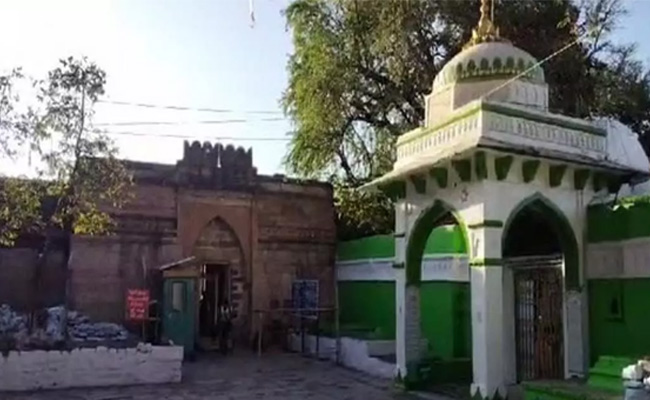
Indore (PTI): The ASI has told the Madhya Pradesh High Court that a massive structure dating back to the Paramara kings' rule existed at the disputed Bhojshala temple-Kamal Maula mosque complex, and the current structure was built from the remains of temples.
The Archaeological Survey of India (ASI) made the claim on Tuesday based on its 98-day scientific survey and over 2,000-page report.
The Hindu community considers Bhojshala a temple dedicated to Vagdevi (Goddess Saraswati), while the Muslim side claims the monument as the Kamal Maula Mosque. The disputed complex is protected by the ASI.
During the hearing before Justices Vijay Kumar Shukla and Alok Awasthi of the HC's Indore bench, Additional Solicitor General Sunil Kumar Jain, representing the ASI, presented a detailed account of the scientific survey conducted two years ago at the complex.
Referring to the ASI's survey report, he said, "Retrieved architectural remains, sculptural fragments, large slabs of inscriptions with literary texts, Nagakarnika inscriptions on pillars, etc, suggest that a large structure associated with literary and educational activities existed at the site. Based on scientific investigations and archaeological remains recovered during the investigations, this pre-existing structure can be dated to the Paramara period."
It can be said that the existing structure was made from the parts of earlier temples, based on scientific investigations, survey and archaeological excavations conducted, study and analysis of retrieved finds, study of architectural remains, sculptures, and inscriptions, art and sculptures, Jain said quoting the report.
Summarising the report, he also drew the court's attention to the fact that the archaeological study identifies that many architectural components, such as pillars and beams, were originally part of temple structures before being repurposed for a mosque.
"The evidence of this transition includes Sanskrit and Prakrit inscriptions that were damaged or hidden, alongside sculptures of deities and animals that were often mutilated or defaced," Jain contended.
The report also states that "all Sanskrit and Prakrit inscriptions are older than the Arabic and Persian inscriptions, indicating that users or engravers of the Sanskrit and Prakrit inscriptions occupied the place earlier".
In light of the Muslim side's earlier objections, the bench wanted to know why there were some discrepancies in the ASI's responses regarding the status of the disputed complex in the cases filed over the years.
The Additional Solicitor General argued that earlier studies of the complex involved only officials, while the current survey involved scientists and the use of advanced technologies such as Ground Penetrating Radar (GPR).
The hearing in the Bhojshala case will continue on Wednesday.
The high court has been regularly hearing four petitions and one writ appeal regarding the religious nature of the Bhojshala temple-Kamal Maula mosque complex since April 6.