Personal liberty important aspect of constitutional mandate, arrest should not be routinely made: SC
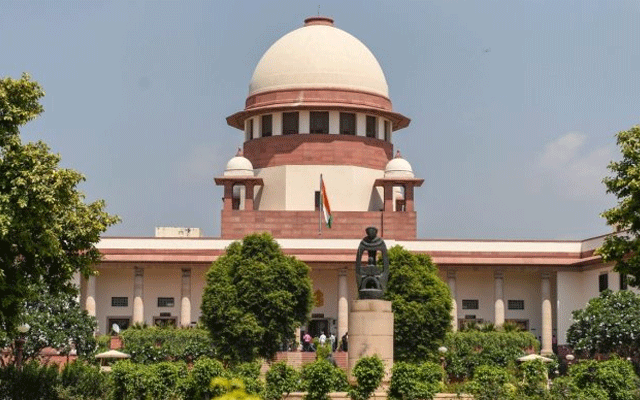
New Delhi: Merely because an arrest can be made as it is lawful does not mandate that it must be made, the Supreme Court has said, while observing that personal liberty is an important aspect of constitutional mandate.
The apex court said if arrest is made routine, it could cause "incalculable harm" to the reputation and self-esteem of a person.
A bench of Justices Sanjay Kishan Kaul and Hrishikesh Roy said if the investigating officer of a case does not believe that the accused will abscond or disobey the summons, he or she is not required to be produced before the court in custody.
"We may note that personal liberty is an important aspect of our constitutional mandate. The occasion to arrest an accused during investigation arises when custodial investigation becomes necessary or it is a heinous crime or where there is a possibility of influencing the witnesses or accused may abscond," the bench said in its order passed earlier this week.
The top court passed the order while hearing a plea against the Allahabad High Court verdict which had dismissed an application seeking anticipatory bail in a case in which FIR was registered seven years ago.
The bench noted that contrary to the observations made in the apex court verdict of 1994 on how a police officer has to deal with a scenario of arrest, the trial courts are stated to be insisting on arrest as a pre-requisite formality to take charge sheet on record in view of provisions of section 170 of the Code of Criminal Procedure (CrPC).
Section 170 of the CrPC deals with cases to be sent to magistrate when evidence is sufficient.
The top court said the word 'custody' appearing in section 170 of the CrPC does not contemplate either police or judicial custody but it merely connotes the presentation of accused by the investigating officer before the court while filing charge sheet.
It noted that section 170 of the CrPC does not impose an obligation on the officer-in-charge to arrest the accused at the time of filing of charge sheet.
"Merely because an arrest can be made because it is lawful does not mandate that arrest must be made," the bench said, adding, "If arrest is made routine, it can cause incalculable harm to the reputation and self-esteem of a person."
While setting aside the high court order, the bench noted that the petitioner had already joined the investigation before approaching the apex court and charge sheet was ready to be filed.
"If the investigating officer has no reason to believe that the accused will abscond or disobey summons and has, in fact, throughout cooperated with the investigation, we fail to appreciate why there should be a compulsion on the officer to arrest the accused," it said.
It referred to judgements delivered by high courts on the issue which said that criminal courts cannot refuse to accept a charge sheet simply because accused has not been arrested and produced before it.
"We are in agreement with the aforesaid view of the high courts and would like to give our imprimatur to the said judicial view," it said, adding, "We have, in fact, come across cases where the accused has cooperated with the investigation throughout and yet on the charge sheet being filed, non-bailable warrants have been issued for his production premised on the requirement that there is an obligation to arrest the accused and produce him before the court."
It noted that a distinction must be made between the existence of the power to arrest and the justification for exercising it.
Referring to the case before it, the bench said when the petitioner has joined the investigation which is complete and he has been roped in after seven years of lodging of FIR, there is no reason why at this stage he must be arrested before the charge sheet is taken on record.
Let the Truth be known. If you read VB and like VB, please be a VB Supporter and Help us deliver the Truth to one and all.
Tamil Nadu: Cong stages statewide protests against guv over govt formation
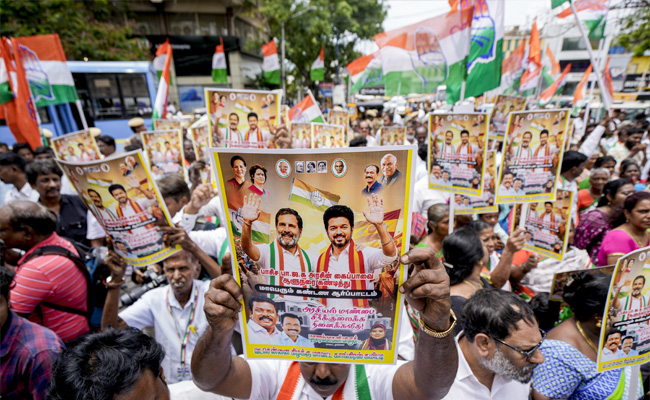
Chennai (PTI): TNCC on Friday launched a statewide protest against Governor Rajendra Vishwanath Arlekar for his refusal to invite the TVK to form the government despite it emerging as the single largest party in the recently concluded Assembly elections.
Leading a spirited demonstration at Anna Salai in Chennai, AICC in-charge for Tamil Nadu, Girish Chodankar, and TNCC President K Selvaperunthagai accused the Raj Bhavan of acting as a "puppet" of the BJP-led Centre and subverting democratic norms.
Speaking to reporters at the protest site, Chodankar launched a scathing attack on the Governor's delay in government formation.
"The Governor has a mission, but he is following (Union Home Minister) Amit Shah. That is his problem," Chodankar charged.
ALSO READ: UP govt sacks five doctors, orders action against 16 health officials for negligence
When asked about mounting speculation regarding a potential "outside support" arrangement between traditional rivals DMK and AIADMK to keep the TVK-Congress combine out of power, Chodankar said, "Let them come together. Let everyone get exposed before the people of Tamil Nadu.”
According to him, if that happens people will know who is really secular and who is ready to stand by them in this situation.
"I am confident that many secular parties are not ready to see BJP or RSS rule enter Tamil Nadu and will definitely oppose it," said Chodankar.
Addressing his party's recent exit from the DMK-led alliance to support actor-turned-politician Vijay's TVK, Chodankar dismissed allegations of "backstabbing" by his party's former ally.
"In a democracy, people are the masters. We have respected the people's mandate," he stated.
Selvaperunthagai demanded that the Governor immediately invite the single largest party to form the government.
"The Governor must implement the Constitution. That is our only demand, and that is why we are protesting today," Selvaperunthagai said.
The Congress, which recently snapped its long-standing ties with the DMK, has aligned itself with the TVK, which won 108 seats. The party cadres held demonstrations across all district headquarters, raising slogans against the Governor and the Union government, while demanding that the democratic mandate of the 2026 elections be respected without further delay.
The protests come amid a tense political climate in the state, as the DMK and AIADMK -- who both suffered significant losses to the TVK -- reportedly explore tactical manoeuvres to navigate the hung assembly.
TVK with 108 seats has the support of Congress' five MLAs but the party is still short of five legislators to form government.