Places of Worship Act 1991 cannot be enforced in dispute between two sects of same religion: SC
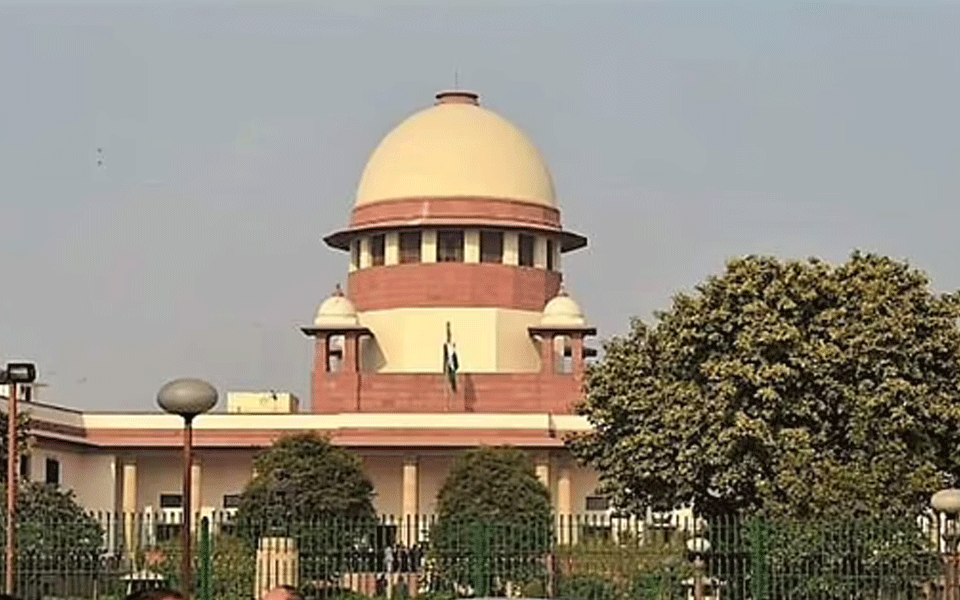
New Delhi(PTI): The Places of Worship (Special Provisions) Act 1991 cannot be enforced in a dispute between two sects of the same religion, the Supreme Court has said while refusing to entertain a petition related to a dispute between two segments of the Jain community on "conversion" of places of worship.
The top court was hearing the plea filed by Sharad Zaveri and others, followers of Mohjit Samuday of the Tapagacch denomination of Shwetamber Murtipujak Jains, seeking enforcement of the 1991 Act and prevention of the conversion, implicit or explicit, of the places of worship.
The Act prohibits conversion of any place of worship and provides for maintenance of the religious character of any place of worship as it existed on August 15, 1947.
The plea also sought to ensure that places of worship where Tapagacch followers are entitled to exercise religious rights are open to all members of the denomination including monks.
A bench of justices D Y Chandrachud and J B Pardiwala noted that the dispute in the present case is between two segments of the same denomination, namely, the Tapagacch denomination of the Shwetamber Murtipujak Jain community.
The resolution of the above dispute cannot take place merely on the basis of the averments in the petition under Article 32 and counter affidavits in opposition,"' the top court said.
The mere fact that the petitioners invoke the Places of Worship (Special Provisions) Act 1991 is not ground enough to entertain a petition under Article 32 of the Constitution when the underlying facts on the basis of which such a claim is made would have to be duly established in the course of the trial of a civil suit, it said.
The nature of the rights which the petitioners claim would have to be established on the basis of evidence. The rights which are claimed and the alleged infraction of rights would also have to be established on the basis of evidence, the bench said.
The apex court said sufficient remedies are available in the form of a suit under Section 92 of the Code of Civil Procedure 1908 or, even otherwise.
In this backdrop, this court is not inclined to entertain a petition under Article 32 of the Constitution. The petitioners are granted liberty to pursue their civil remedies as available in law. Nothing contained in this order would amount to an expression of opinion on the rights which the petitioners' claim or their entitlement in fact or in law, the bench said.
Let the Truth be known. If you read VB and like VB, please be a VB Supporter and Help us deliver the Truth to one and all.
Vijay unable to prove majority, not invited for CM oath ceremony: Sources
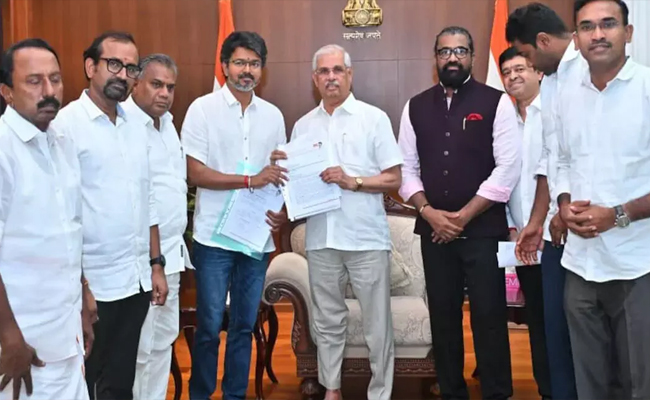
Chennai: Actor-politician Vijay has reportedly not been invited to take oath as Chief Minister of Tamil Nadu after failing to demonstrate support from the required number of MLAs, sources in Raj Bhavan said.
According to media reports that quoted sources in the office of R.N. Ravi Arlekar, Vijay could not prove the backing of 118 legislators, the majority mark in the 234-member Tamil Nadu Assembly.
Despite last-minute efforts to secure support from the Viduthalai Chiruthaigal Katchi (VCK), Amma Makkal Munnetra Kazagam (AMMK), and an IUML legislator, Vijay reportedly managed support from only 116 MLAs, falling short by two members.
Sources said Vijay failed to submit letters of support from the VCK and the Indian Union Muslim League (IUML).
Later, the IUML issued a statement clarifying that it was not part of the TVK-led alliance.
Meanwhile, AMMK leader T.T.V. Dhinakaran is also said to have informed the Governor that his party would support the All India Anna Dravida Munnetra Kazhagam (AIADMK) instead.
Earlier in the evening, Vijay had met Governor Arlekar and staked claim to form the government, stating that he enjoyed the support of 118 MLAs.