'Please, release my father', appeals daughter of CoBRA commando kidnapped by Naxals
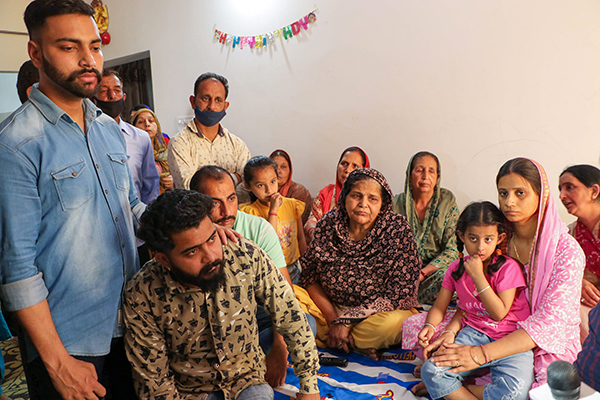
Jammu: "Please, release my father", pleaded five-year-old Shragvi, the daughter of a CoBRA commando held hostage by Naxals after an ambush in Chhattisgarh.
This is all a sobbing Shragvi could utter as she wiped away her tears.
The family of Commando Rakeshwar Singh Minhas was in deep shock after the news of the deadly ambush on Saturday and his disappearance broke out.
At least 22 security personnel were killed in the attack on the CoBRA battalion of CRPF by the Naxals who claimed that they had abducted Minhas after the ambush.
"We came to know about the attack and that he went missing during action from news channels. Nobody from the government or the CRPF informed us about the incident," Meenu, the wife of Minhas, told reporters at her residence in Barnai area on Jammu-Akhnoor road.
She said she made frantic efforts to reach out to the CRPF headquarters in Jammu to know the whereabouts of Minhas. "I was told that there is nothing we can share with you. Once we get a clear picture, we will come to you," Meenu said as having been told by the CRPF officers.
With her daughter in her lap who also pleaded for the safe return of her father, she said an officer also visited her house and repeated the assurance.
She said Minhas had not picked up the phone since "we talked for the last time" on Friday at 9.30 pm when he was leaving for duty.
Meenu said it was the government's duty to ensure his safe return to his family.
"My husband served the country for the last 10 years and now it is the turn of the government to ensure that he returns to us hale and hearty," she said surrounded by relatives who were there to support the family through the ordeal.
"Minhas joined the CRPF in 2011 and he has been serving the nation for the last 10 years. He was transferred to Chhattisgarh only three months back from Assam," she said, holding back her tears.
"I got a telephone call from a person who introduced himself as a local reporter from Chhattisgarh. He wanted me to send a picture of my husband along with an appeal to the Naxals," Meenu said.
However, she did not respond to his calls after discussing the matter with her family.
Meenu appealed to Lt Governor Manoj Sinha to take up the matter with the Union government and urge the prime minister and home minister for his safe return.
Let the Truth be known. If you read VB and like VB, please be a VB Supporter and Help us deliver the Truth to one and all.
Bhojshala case: Disputed structure built from remains of pre-existing temples, claims ASI
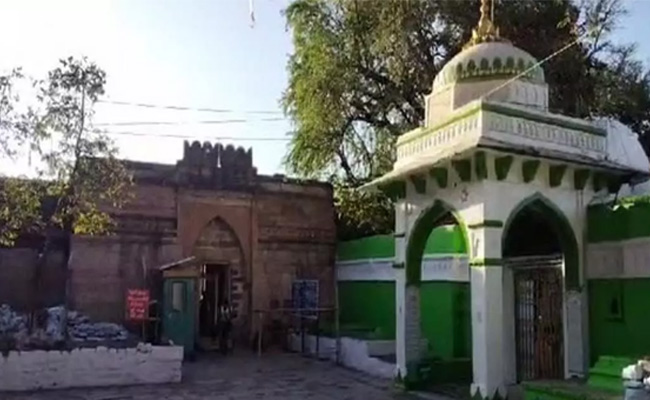
Indore (PTI): The ASI has told the Madhya Pradesh High Court that a massive structure dating back to the Paramara kings' rule existed at the disputed Bhojshala temple-Kamal Maula mosque complex, and the current structure was built from the remains of temples.
The Archaeological Survey of India (ASI) made the claim on Tuesday based on its 98-day scientific survey and over 2,000-page report.
The Hindu community considers Bhojshala a temple dedicated to Vagdevi (Goddess Saraswati), while the Muslim side claims the monument as the Kamal Maula Mosque. The disputed complex is protected by the ASI.
During the hearing before Justices Vijay Kumar Shukla and Alok Awasthi of the HC's Indore bench, Additional Solicitor General Sunil Kumar Jain, representing the ASI, presented a detailed account of the scientific survey conducted two years ago at the complex.
Referring to the ASI's survey report, he said, "Retrieved architectural remains, sculptural fragments, large slabs of inscriptions with literary texts, Nagakarnika inscriptions on pillars, etc, suggest that a large structure associated with literary and educational activities existed at the site. Based on scientific investigations and archaeological remains recovered during the investigations, this pre-existing structure can be dated to the Paramara period."
It can be said that the existing structure was made from the parts of earlier temples, based on scientific investigations, survey and archaeological excavations conducted, study and analysis of retrieved finds, study of architectural remains, sculptures, and inscriptions, art and sculptures, Jain said quoting the report.
Summarising the report, he also drew the court's attention to the fact that the archaeological study identifies that many architectural components, such as pillars and beams, were originally part of temple structures before being repurposed for a mosque.
"The evidence of this transition includes Sanskrit and Prakrit inscriptions that were damaged or hidden, alongside sculptures of deities and animals that were often mutilated or defaced," Jain contended.
The report also states that "all Sanskrit and Prakrit inscriptions are older than the Arabic and Persian inscriptions, indicating that users or engravers of the Sanskrit and Prakrit inscriptions occupied the place earlier".
In light of the Muslim side's earlier objections, the bench wanted to know why there were some discrepancies in the ASI's responses regarding the status of the disputed complex in the cases filed over the years.
The Additional Solicitor General argued that earlier studies of the complex involved only officials, while the current survey involved scientists and the use of advanced technologies such as Ground Penetrating Radar (GPR).
The hearing in the Bhojshala case will continue on Wednesday.
The high court has been regularly hearing four petitions and one writ appeal regarding the religious nature of the Bhojshala temple-Kamal Maula mosque complex since April 6.