PM Modi, President Trump agree to move forward on India-US civil nuclear cooperation
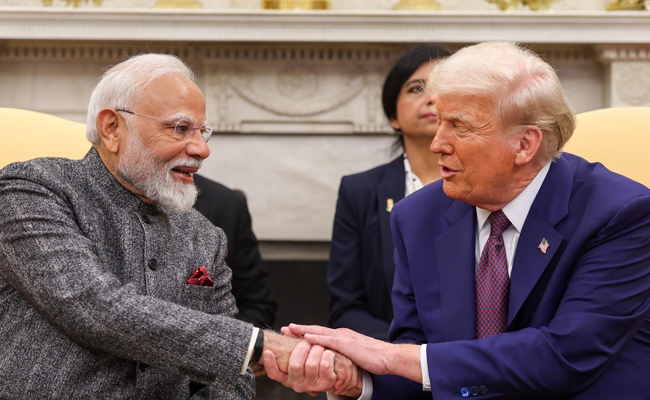
Washington (PTI): Prime Minister Narendra Modi and US President Donald Trump vowed to move forward to facilitate building American-designed nuclear reactors in India under the framework of the epochal civil nuclear deal sealed by the two nations over 16 years back.
In their talks at the White House on Thursday, the two leaders decided to significantly expand energy cooperation.
The civil nuclear deal changed India's overall engagement with the US as it paved the way for building the bonds of a strategic partnership, especially in areas of high technology and defence.
"The leaders announced their commitment to fully realise the US-India 123 Civil Nuclear Agreement by moving forward with plans to work together to build US-designed nuclear reactors in India through large-scale localisation and possible technology transfer," according to a joint statement.
Finance Minister Nirmala Sitharaman, while presenting the Union budget on February 1, announced plans to amend India's nuclear liability law as well as the Atomic Energy Act.
Certain clauses in India's Civil Liability for Nuclear Damage Act, 2010 have emerged as hurdles in moving forward in the implementation of the civil nuclear deal.
Both sides welcomed the recent budget announcement by the government of India to take up amendments to the Atomic Energy Act and the Civil Liability for Nuclear Damage Act (CLNDA) for nuclear reactors, the statement said.
It said the two sides further decided to establish bilateral arrangements in accordance with CLNDA, that would address the issue of civil liability and facilitate the collaboration of Indian and US industry in the production and deployment of nuclear reactors.
The Atomic Energy Act of 1962 prohibits investments by the private sector in nuclear power plants. The proposed amendment is expected to remove this provision.
In January, the US removed restrictions on Bhabha Atomic Research Center (BARC), Indira Gandhi Atomic Research Centre (IGCAR) and the Indian Rare Earths (IRE), a move that was seen as Washington's intent to move forward on civil nuclear cooperation with India.
India and the US unveiled an ambitious plan to cooperate in civil nuclear energy in July 2005 following then Prime Minister Manmohan Singh's meeting with American President George W Bush.
The historic civil nuclear agreement was finally sealed around three years later following a series of negotiations.
It was expected to pave the way for allowing the US to share civilian nuclear technology with India.
However, the planned cooperation did not move forward for a variety of reasons including the strict liability laws in India.
US nuclear reactor makers such as General Electric and Westinghouse had shown keen interest in setting up nuclear reactors in India.
In the last few years, India has been in talks with a number of countries including the US and France on cooperation in small modular reactors (SMRs).
Let the Truth be known. If you read VB and like VB, please be a VB Supporter and Help us deliver the Truth to one and all.
Actress sexual assault: Court says Prosecution 'miserably' failed to prove conspiracy against Dileep
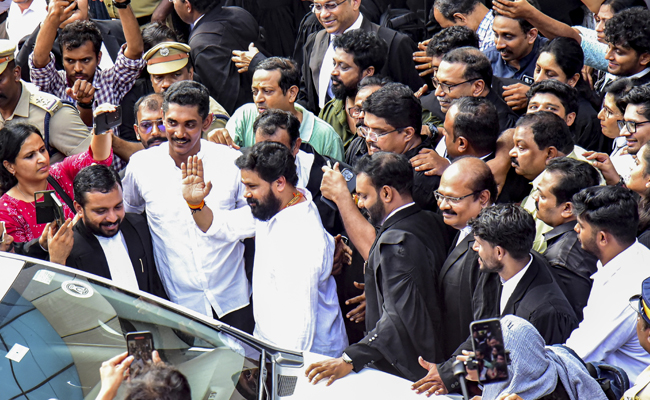
Kochi (PTI): The prosecution had "miserably" failed to prove the conspiracy charge against Dileep in the sensational 2017 actress sexual assault case, a local court has observed while citing inconsistencies and lack of sufficient evidence against the Malayalam star.
The full judgement of Ernakulam District and Principal Sessions Court Judge Honey M Varghese was released late on Friday, and has revealed the judge also pointing out at unsustainable arguments put forth by the prosecution.
"The prosecution miserably failed to prove the conspiracy between accused No.1 (Pulsar Suni) and accused No.8 (Dileep) in executing the offence against the victim," the court held.
It examined in detail, the prosecution's allegation that Dileep had hired the prime accused to sexually assault the survivor and record visuals, including close-up footage of a gold ring she was wearing, to establish her identity.
On page 1130 of the judgment, under paragraph 703, the court framed the issue as whether the prosecution's contention that NS Sunil (Pulsar Suni) recorded visuals of the gold ring worn by the victim at the time of the occurrence, so as to clearly disclose her identity, was sustainable.
The prosecution contended Dileep and Suni had planned the recording so that the actress' identity would be unmistakable, with the video of the gold ring intended to convince Dileep that the visuals were genuine.
However, the court noted that this contention was not stated in the first charge sheet and was introduced only in the second one.
As part of this claim, a gold ring was seized after the victim produced it before the police.
The court observed that multiple statements of the victim were recorded from February 18, 2017, following the incident, and that she first raised allegations against Dileep only on June 3, 2017.
Even on that day, nothing was mentioned about filming of the ring as claimed by the prosecution, the court said.
The prosecution failed to explain why the victim did not disclose this fact at the earliest available opportunities.
It further noted that although the victim had viewed the sexual assault visuals twice, she did not mention any specific recording of the gold ring on those occasions, which remained unexplained.
The court also examined the approvers' statements.
One approver told the magistrate that Dileep had instructed Pulsar Suni to record the victim's wedding ring.
The court observed that no such wedding ring was available with her at that time.
During the trial, the approver changed his version, the court said.
The Special Public Prosecutor put a leading question to the approver on whether Dileep had instructed the recording of the ring, after which he deposed that the instruction was to record it to prove the victim's identity.
The court observed that the approver changed his account to corroborate the victim's evidence.
When the same question was put to another approver, he repeated the claim during the trial but admitted he had never stated this fact before the investigating officer.
The court noted that the second approver even went to the extent of claiming Dileep had instructed the execution of the crime as the victim's engagement was over.
This showed that the evidence of the second approver regarding the shooting of the ring was untrue, as her engagement had taken place after the crime.
The court further observed that the visuals themselves clearly revealed the victim's identity and that there was no need to capture images of the ring to establish identity.
In paragraph 887, the court examined the alleged motive behind the crime and noted that in the first charge sheet, the prosecution had claimed that accused persons 1 to 6 had kidnapped the victim with the common intention of capturing nude visuals to extort money by threatening to circulate them and there was no mention about Dileep's role in it.
The court also rejected the prosecution's claim that the accused had been planning the assault on Dileep's instructions since 2013, noting that the allegation was not supported by reliable evidence.
It similarly ruled out the claim that Suni attempted to sexually assault the victim in Goa in January 2017, stating that witness statements showed no such misconduct when he served as the driver of the vehicle used by the actress there.
The court also discussed various controversies that followed Dileep's arrest and the evidence relied upon by the prosecution, ultimately finding that the case had not been proved.
Pronouning its verdict on the sensational case on December 8, the court acquitted Dileep and three others.
Later, the court sentenced six accused, including the prime accused Suni, to 20 years' rigorous imprisonment.
The assault on the multilingual actress, after the accused allegedly forced their way into her car and held it under their control for two hours on February 17, 2017, had shocked Kerala.
Pulsar Suni sexually assaulted the actress and video recorded the act with the help of the other convicted persons in the moving car.