PM Modi says deepfakes can trigger big crisis, cites his own morphed garba video
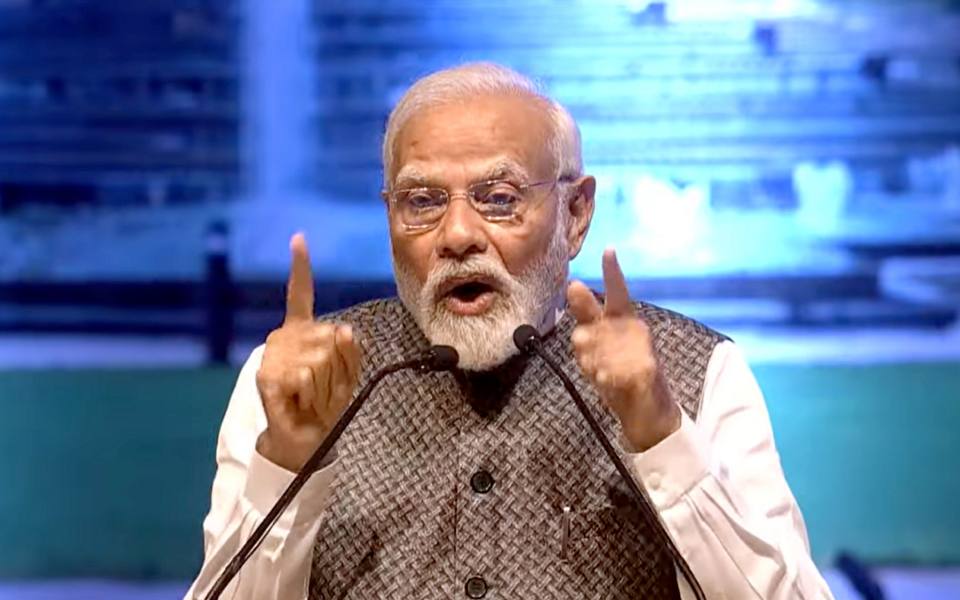
New Delhi, Nov 17: Prime Minister Narendra Modi on Friday cautioned that deepfakes created by artificial intelligence can lead to a big crisis and stoke discontent in society, as he urged the media to raise awareness about its misuse and educate people.
Addressing the media at BJP's 'Diwali Milan' programme at the party's headquarters here, Modi said he recently saw a video of him performing garba even though he has not done so since schooldays. Even those who love him are forwarding the video, he said in a lighter vein.
"In a diverse society like ours, deepfakes can cause a big crisis and even stoke the fire of discontent as people generally trust anything associated with the media in the same way anyone clad in 'gedua' (saffron) tends to get respect from others.
"A new crisis is emerging due to deepfakes produced through artificial intelligence. There is a very big section of society which does not have a parallel verification system," the prime minister told journalists at the programme where he aired views about a few things and sought their support to raise awareness.
Deepfake videos are synthetic media in which a person in an existing image or video is replaced with someone else's likeness.
The prime minister noted that earlier a movie with some controversial comments would come and go, but now it goes on to become a big issue. Even screening of such films becomes difficult on the ground that they have disrespected some section of society irrespective of the huge amount of money spent on making them, he said.
Modi said he had recently suggested to ChatGPT professionals that as products like cigarettes come with health warnings, deepfakes too should carry disclosures.
Of late, deepfake videos featuring several celebrities have surfaced online, including one on Rashmika Mandanna, which led to a police FIR and action by the Union IT ministry.
Referring to his resolve for 'Viksit Bharat' (developed India) by 2047, the prime minister said these are not merely words but a ground reality.
He suggested the 'vocal for local' campaign has found people's support, noting that a business of around Rs 4.5 lakh crore has taken place in the Diwali week, including those related to Chhath.
India's achievements during the COVID-19 pandemic created confidence among people that the country is not going to stop now, he said, adding that about 130 countries attended a Global South summit hosted by India which he addressed before attending the 'Diwali Milan' programme.
A time comes in the life of a nation which can launch it to a higher trajectory and this is what is happening to India, he asserted, urging the media to give strength to the programme for making the country developed by highlighting the country's strengths without resorting to any untruth.
Ideas related to developed India and economy are going to be at the centre of discourse for the next 25 years, and people are accepting the way the country has been progressing, he said.
This era is leading to India becoming a grander country, he said.
With people, especially those from Bihar and eastern Uttar Pradesh, celebrating 'Chhath' in different parts of the country, he said it is good that it is now being observed in different parts of the country. The rise of electronic media has seen festivals like Durga Puja and Navratri going global, he said.
With the BJP hosting the 'Diwali Milan' for the first time in the last several years, the prime minister said a "total disappearance of COVID-19" was visible in the festive joy of people this time.
In his remarks, Modi recalled his recent visit to a tribal region in Shahdol in Madhya Pradesh where he interacted with women self-help groups and youngsters and said he was left much impressed with their successes and rising confidence and aspirations.
It is there, the prime minister said, he seized on the idea of "Lakhpati Didi" to help more than two crore women involved in self-help groups.
This confidence of the masses will lead to the country becoming developed by 2047, he said. He urged the media to take up 10 cities to hold programmes as to how they can grow and become Rs 1 trillion economy or how the size of their economy can be doubled and these cities grow to become driving engine of regional economy.
Rising aspirations is a reason behind the growing market during the festival season, he said, adding that more than 13.5 crore people lifted out of poverty have joined the aspirational class seeking betters things in life. He also praised the media's support to the cleanliness programmes and said it has also led to growing expectations.
Noting that relatively young journalists have fallen to not only the coronavirus but other diseases as well, he emphasised on having regular health check-ups for them saying they also lead a tense and busy life like politicians.
Let the Truth be known. If you read VB and like VB, please be a VB Supporter and Help us deliver the Truth to one and all.
Seven killed as govt hospital’s compound wall collapse due to rain
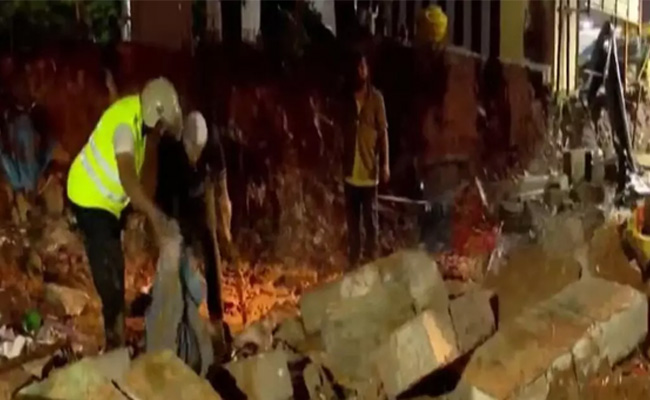
Bengaluru (PTI): Seven people, including three children, were killed when the compound wall of a hospital collapsed here on Wednesday, police said.
The incident occurred in the Bowring and Lady Curzon Hospital, they added.
When the heavy rains, coupled with strong winds, battered the area, the seven victims were taking shelter near the wall, which suddenly came down crashing, police further said. All seven people were killed on the spot, they added.
According to police sources, the victims were street vendors.
Police and emergency services personnel rushed to the spot with an earthmover to bring out the bodies from the debris with the help of residents.