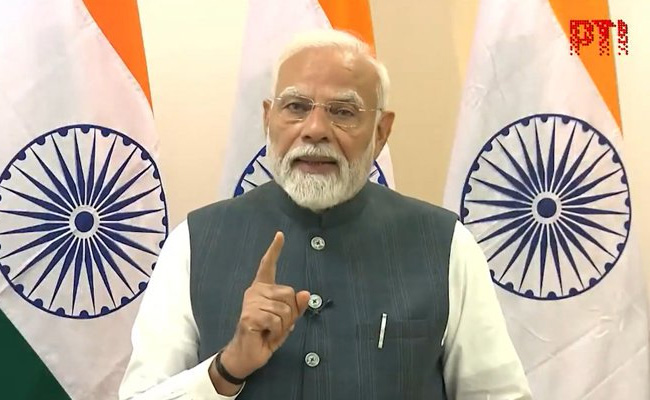
PM Modi speaks to Crown Prince of Saudi Arabia; discusses West Asia situation
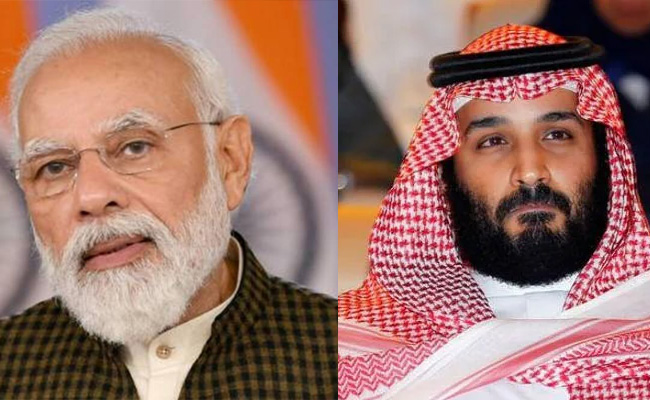
New Delhi (PTI): Prime Minister Narendra Modi on Saturday spoke to Crown Prince and PM of Saudi Arabia, Prince Mohammed bin Salman, discussed with him the ongoing conflict in West Asia and agreed on the need to ensure freedom of navigation.
In his telephonic conversation with the Crown Prince of Saudi Arabia, the prime minister also reiterated India's condemnation of attacks on regional energy infrastructure.
"Spoke with Crown Prince and PM of Saudi Arabia, HRH Prince Mohammed bin Salman and discussed the ongoing conflict in West Asia," he said in a post on X.
ALSO READ: Married persons can’t be in a live-in relationship without obtaining divorce: Allahabad HC
Modi said both leaders agreed on the need to ensure freedom of navigation and keep shipping lines open and secure.
"Thanked him for his continued support for the welfare of the Indian community in Saudi Arabia," he said.
This was the second telephonic conversation between the prime minister and the crown prince of Saudi Arabia since the West Asia conflict started on February 28.
While the US and Israel attacked Iran, the Persian nation targeted its neighbours and Israel.
Iran controls the Strait of Hormuz, a key shipping route through which the world's 20 per cent of energy is transported. Since the conflict, very few ships are allowed by Iran to cross it.
Modi has also spoken to several world leaders since the conflict started and they include those from the UAE, Qatar, Bahrain, Kuwait, Jordan, Iran, France, Israel and Malaysia.
US President Donald Trump has also spoken to Modi following which the prime minister said he "had a useful exchange of views on the situation in West Asia".
Let the Truth be known. If you read VB and like VB, please be a VB Supporter and Help us deliver the Truth to one and all.
Rupee falls 11 paise to 94.27 against US dollar in early trade

Mumbai (PTI): The rupee depreciated 11 paise to 94.27 against US dollar in early trade on Monday driven by persistent dollar demand and a broader shift toward safe-haven assets.
Forex traders said the Indian rupee has hit a rough patch, falling for five consecutive sessions, weighed down by a combination of factors such as the RBI loosening its grip on currency rules and rising oil prices caused by global tensions.
Moreover, investors are becoming cautious again, with foreign institutions pulling money out of the market after a brief period of buying amid rising geopolitical uncertainty.
At the interbank foreign exchange market the rupee opened at 94.25 against the US dollar, then lost some ground and touched 94.27 against the US dollar in initial trade, registering a fall of 11 paise over its previous close. On Friday, the rupee had settled at 94.16 against the American currency.
ALSO READ: Death toll in Mundathikode fireworks explosion rises to 16
Meanwhile, the dollar index, which gauges the greenback's strength against a basket of six currencies, was down 0.09 per cent at 98.44.
Brent crude, the global oil benchmark, was trading higher by 1.16 per cent at USD 106.55 per barrel in futures trade.
A mix of softer economic signals and renewed, even if fragile, hopes of diplomacy pulled the dollar lower again, CR Forex Advisors MD Amit Pabari said, adding that for Rupee, on one hand, a softer dollar offers relief. On the other, uncertainty remains the dominant force.
Meanwhile, India’s forex reserves have crossed USD 703 billion as of April 17, reflecting a consistent build-up of buffers.
"For now, the rupee continues to lean toward gradual weakness. Uncertainty remains the dominant force, shaping both global flows and local reactions," Pabari said.
He further noted that any dips are likely to be bought into, with the 92.80–93.20 zone acting as a strong support. On the upside, 93.50 to 94.50 is expected to define the near-term range.
On the domestic equity market front, the 30-share benchmark index Sensex was trading 518.96 points or 0.68 per cent higher at 77,183.17, while the broader Nifty was trading up 131.30 points or 0.55 per cent at 24,029.25.
Foreign Institutional Investors offloaded equities worth Rs 8,827.87 crore on Friday, according to exchange data.