PM’s words of praise boosts local hero Mohsin Ali who set Dal Lake ablaze during KIWSF
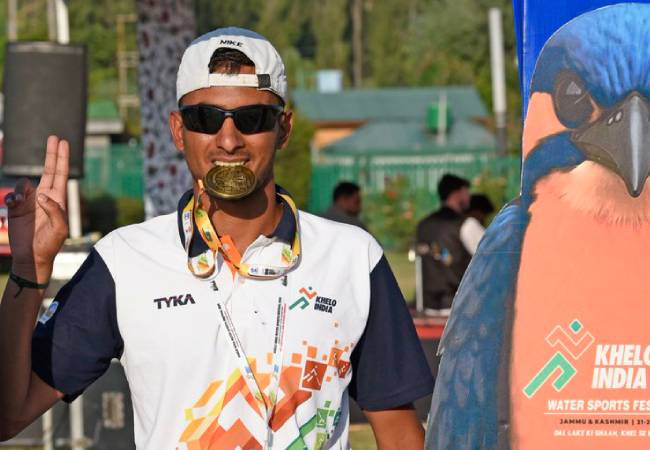
Srinagar (PTI): Eighteen-year-old Mohsin Ali had been earning accolades ever since he set the Dal Lake ablaze by clinching gold in the 1,000m kayaking event at the inaugural Khelo India Water Sports Festival (KIWSF) held here recently.
On Sunday, Ali became a local hero after receiving a special mention from Prime Minister Narendra Modi, who praised the Srinagar boy for his achievement in the 125th edition of his monthly radio programme ‘Mann Ki Baat’.
Organised from August 21-23 at the iconic Dal Lake, the KIWSF featured six sporting disciplines – rowing, canoeing, kayaking, water skiing, shikara race, and dragon boat race – in which 28 states and Union territories took part.
Ali now has his sights fixed on the ultimate goal – an Olympic gold.
The 18-year-old’s story is proof that greatness can be found anywhere, even on a single-paddled boat across a glinting lake.
“I was thrilled to speak to the prime minister. His words will work as an encouragement not only for me but for the youth in general, who want to represent the country at the highest stage,” Ali told PTI.
In 'Mann Ki Baat', the prime minister singled out Jammu and Kashmir for two special achievements – holding the water sports event successfully, and the inaugural day-night cricket match in Pulwama.
Modi spoke to Ali and another sportsperson – Odisha's canoeing champion Rashmita Sahu.
The KIWSF was a collaborative initiative of the Jammu and Kashmir government and the Sports Authority of India (SAI), which saw more than 800 participants from across the country, with female athletes almost matching their male counterparts.
While Madhya Pradesh bagged the most number of medals, Ali's triumph triggered a renewed interest in water sports in the Union territory.
Ali, whose father works as a labourer to support his family of seven, said he was motivated to take up kayaking after seeing shikaras (boats) on Dal Lake.
He attributed his achievement to his coach Bilquis Mir, a prominent canoeist and kayaker from Srinagar, who became the first Indian woman to serve as a jury member at the 2024 Paris Olympics.
According to Mir, Ali's triumph is a reflection of the talent present in Jammu and Kashmir. She also said his victory at the KIWSF motivated new athletes, with 80 youths enrolling in the training programme at the end of the festival.
“It was a moment of pride for all of Jammu and Kashmir that a local boy won gold at the KIWSF. Ali’s performance will surely boost water sports in J-K, more so as he won in a field where most of his competitors had a lot of foreign exposure and access to state-of-the-art facilities,” Mir said.
Talking to Ali, the prime minister complimented his family and Mir on his success.
After Modi said the youth of Jammu and Kashmir have so much potential, Ali said, "My dream is to win a medal in the Olympics.”
The prime minister replied, "Wow! Well done! Look, I got goosebumps just by hearing that from you. When the son of a labourer's family dreams so big, it means the country is going to progress a lot.”
Modi concluded the four-minute conversation by saying, "Really enjoyed talking to you. Please convey my special thanks to your father, because he made your life by working as a labourer. On your father's words, you worked hard for 10 years without taking any rest. I also congratulate your coach, who worked so hard to train you.”
On Srinagar successfully hosting the water sports event, Modi said, “What a special place to organise such a festival. The objective was to make water sports more popular in Jammu and Kashmir. More than 800 athletes from all over India took part in KIWSF. Women athletes were also not far behind… Their participation was almost at par with men.”
The prime minister also mentioned the Royal Premier League cricket tournament in Pulwama, in which 12 teams from Jammu and Kashmir are taking part.
“Thousands of enthusiasts, especially youth, are enjoying cricket at night in Pulwama... It is truly a sight to behold," Modi said.
Royal Premier League organiser Irfan Ahmad thanked the prime minister for appreciating their efforts, and invited him to the last match of the tournament to be held in September.
Ahmad said the event aims to serve as a healthy outlet for the young people amid increasing unemployment and drug use in the area.
“I am really thankful to the prime minister for taking note of this event. The whole of Kashmir, especially Pulwama, is happy that he talked about it in ‘Mann Ki Baat’.
“The youth are depressed amid growing unemployment, which needs to be addressed. We organised the league to encourage the youth and keep them away from drugs," Ahmad said, adding that he rented lights from Delhi to facilitate day-night cricket in Pulwama.
Let the Truth be known. If you read VB and like VB, please be a VB Supporter and Help us deliver the Truth to one and all.
PM Modi holds 14-km roadshow in Varanasi, offers prayers at Kashi Vishwanath temple
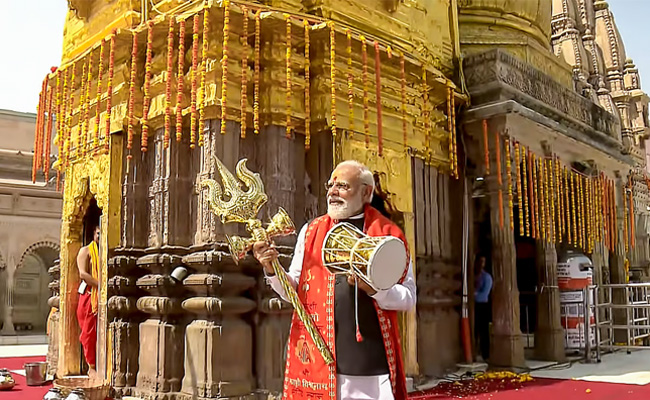
Varanasi (UP) (PTI): Prime Minister Narendra Modi held a roadshow in Varanasi on Wednesday morning, the second day of his two-day visit, drawing large crowds along the route, party leaders said.
The roadshow commenced from Banaras Locomotive Works (BLW) and passed through Lahartara, Kachahri, Ambedkar Chauraha, Chaukaghat, Teliyabag, Lahurabir and Maidagin before culminating at the Kashi Vishwanath Dham.
At the temple, the prime minister offered prayers and performed rituals amid Vedic chants. After completing the prayers, Modi was welcomed by local representatives, who presented him with a trishul, damru and a traditional stole. The prime minister acknowledged the gesture and greeted the gathering.
As he emerged from the temple complex, devotees raised slogans of "Har Har Mahadev", to which Modi responded by waving and folding his hands.
He also briefly interacted with children present at the Kashi Vishwanath Corridor.
BJP media in-charge Arvind Mishra said people in Varanasi were eager to catch a glimpse of the prime minister, with a large number of party workers, office-bearers and local residents lining the entire route.
Devotees and supporters were seen raising slogans such as "Har Har Mahadev" and "Jai Shri Ram" to welcome the prime minister, who greeted them by waving and folding his hands.
Mishra said multiple welcome points had been set up along the route, where party workers and locals welcomed the prime minister with rose petals, drum beats and conch shells.
The roadshow, stretching around 14 kilometres, is being described by party leaders as one of the largest ever in the city.
Heavy crowds were seen on both sides of the roads throughout the route, officials said.
After the visit to Varanasi, his Lok Sabha constituency, the PM is scheduled to inaugurate the Ganga Expressway in Uttar Pradesh later on Wednesday.