Priyanka Gandhi declares assets worth Rs 12 crore
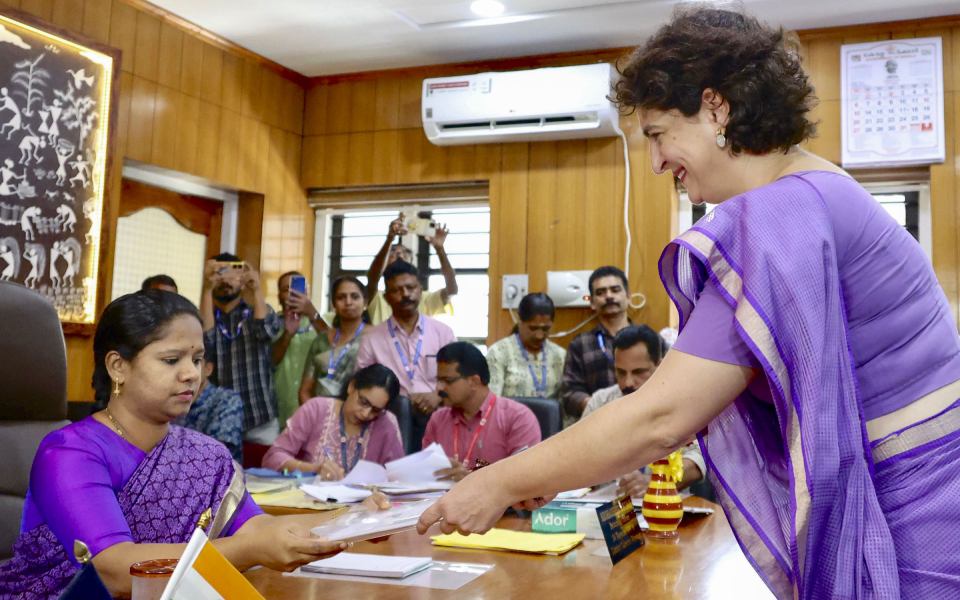
Wayanad(Kerala), Oct 23: Congress general secretary Priyanka Gandhi, who on Wednesday made her electoral debut by filing a nomination as a Congress candidate for Wayanad Lok Sabha bypolls, has declared assets worth over Rs 12 crore.
In her nomination paper, Priyanka also declared a total income of over Rs 46.39 lakh in the financial year 2023-2024 which includes rental income and interest from banks and other investments.
Giving details of her assets and liabilities in the affidavit filed along with her nomination papers, Priyanka said she has movable assets of over Rs 4.24 crore that include deposits of varying amounts in three bank accounts, investments in mutual funds, PPF, a Honda CRV car gifted by her husband Robert Vadra, and over 4400 grams (gross) of gold worth Rs 1.15 crore.
Her immovable assets are worth over Rs 7.74 crore, which includes two inherited half shares of agricultural land in Mehrauli area of New Delhi and a half share in a farmhouse building located therein, all of which together are now worth over Rs 2.10 crore.
Besides that, she has a self-acquired residential property in Shimla in Himachal Pradesh, which is presently worth over Rs 5.63 crore, according to her affidavit.
In her affidavit, Priyanka has also given details of her husband's movable and immovable assets.
Robert Vadra has movable assets worth over Rs 37.9 crore and immovable assets worth over Rs 27.64 crore, according to the affidavit.
Priyanka, who has a Post Graduate Diploma in Buddhist Studies through distance learning from University of Sunderland, UK and a BA Hons degree in Psychology from Delhi University, has liabilities of Rs 15.75 lakh.
She is also facing Income Tax reassessment proceedings for the assessment year 2012-13, as per which she has to pay over Rs 15 lakh as taxes, her affidavit said.
Additionally, there are two FIRs and a forest department's notice against her, the affidavit stated.
One of the FIRs, registered in 2023 in Madhya Pradesh, is under sections 420 (cheating) and 469 (forgery) of the IPC and is based on a private person's complaint alleging that she posted some misleading tweets, the affidavit said.
The other FIR, registered in 2020 in Uttar Pradesh, is under sections 188 (disobedience to order duly promulgated by public servant), 269 (negligent act likely to spread infection of disease dangerous to life) and 270 (malignant act likely to spread infection of disease dangerous to life) of the IPC for her alleged protest against the Hathras incident of 2020.
Both Rahul and Priyanka were booked for alleged violation of prohibitory orders issued under CrPC section 144 and violation of the orders related to the Epidemic Diseases Act, imposed in view of the COVID-19 outbreak, for walking towards Hathras to meet a Dalit rape victim's family.
Let the Truth be known. If you read VB and like VB, please be a VB Supporter and Help us deliver the Truth to one and all.
Sujit Nair raises concerns over speculation of DMK-AIADMK understanding to block TVK
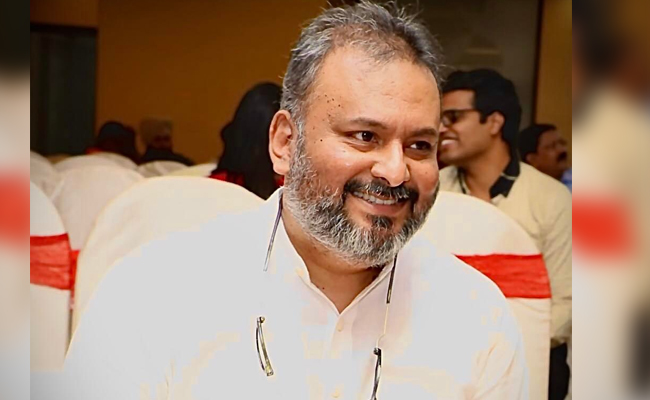
Chennai: Journalist and political commentator Sujit Nair has expressed concern over speculation that the Dravida Munnetra Kazhagam and the All India Anna Dravida Munnetra Kazhagam could explore a post-poll understanding to prevent Vijay-led Tamilaga Vettri Kazhagam from forming the government in Tamil Nadu.
In a social media post, Sujit Nair said the election verdict in Tamil Nadu reflected a clear public demand for political change and argued that the mandate should be respected irrespective of political preferences.
Referring to reports and political discussions surrounding a possible understanding between the DMK and AIADMK, he said he hoped such developments remained only speculative conversations and did not turn into reality.
Nair stated that if such an alliance were to take shape, it would raise serious questions about ideological politics in the country. He said TVK had emerged through a democratic electoral process and that the legitimacy to govern in a parliamentary democracy comes from the people’s verdict.
According to him, attempts to prevent an electoral winner from forming the government through unexpected political arrangements may be constitutionally valid, but many people could view them as politically opportunistic.
He further said that such a move could particularly affect the political image of the DMK, which has historically projected itself around ideology, social justice and opposition politics. Nair said that in ideological terms, the DMK appeared closer to TVK than to the AIADMK, and joining hands with its long-time political rival only to remain in power could weaken its broader political narrative.
He added that the same questions would apply to the AIADMK as well, as the party had spent decades positioning itself against the DMK and such an arrangement could create discomfort among its cadre and supporters.
Drawing a comparison with Maharashtra politics in 2019, Nair said he had expressed similar views when the Shiv Sena formed an alliance with the Indian National Congress and the Nationalist Congress Party after the Assembly elections.
He said post-poll alliances between long-standing political rivals often create a public perception that ideology and electoral mandates become secondary when political power equations come into play.
Nair also said such developments increase public cynicism towards politics and reinforce the belief among voters that ideology is often sidelined after elections.
He maintained that the Tamil Nadu verdict was emphatic and said respecting both the spirit and substance of the mandate was important for the credibility of democratic politics.