Pune Porsche case: Is it not confinement if juvenile is kept in custody after bail, asks HC
Mumbai (PTI): The Bombay High Court on Friday queried if it amounted to confinement when the juvenile accused in the Pune Porsche case was granted bail but was taken back in custody and kept in an observation home.
A division bench of Justices Bharati Dangre and Manjusha Deshpande said there was no denying that the accident was unfortunate.
“Two people have lost their lives. There was trauma but the child (juvenile) was also in trauma,” the court said.
The bench also questioned the police under what provision of law, the order granting bail to the minor accused in the Porsche accident case was amended and how he has been kept in “confinement”.
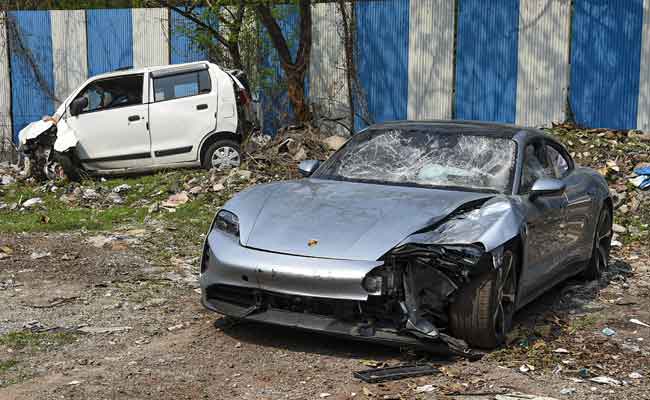
In the early hours of May 19, the juvenile was allegedly driving a Porsche car at very high speed in an intoxicated state when the vehicle crashed into a bike, killing two software engineers – Aneesh Awadhiya and Ashwini Koshta – in Pune’s Kalyani Nagar.
The 17-year-old was granted bail the same day by the Juvenile Justice Board (JJB), which ordered that he be kept under the care and supervision of his parents and grandfather. He was also asked to write a 300-word essay on road safety.
Amid a nationwide uproar over the quick bail, the police appealed to the JJB to amend the bail order. On May 22, the board ordered the boy to be taken into custody and remanded him to an observation home.
Last week, the teenager’s paternal aunt filed a habeas corpus (produce person) petition claiming that he was illegally detained and sought his immediate release.
The bench, while hearing the arguments in the plea on Friday, noted that till date, the police have not filed any application before a higher court seeking cancellation of the bail order passed by the JJB.
Instead, an application was filed seeking amendment of the bail order, HC said, adding that based on this application, the bail order was amended, the boy was taken in custody and remanded to an observation home.
“What type of remand is this? What is the power to remand? What kind of procedure is this where a person has been granted bail and then a remand is passed taking him in custody,” the court said.
The bench added that the minor was taken away from the care and supervision of his family members and sent to an observation home.
“He is a person who has been granted bail, but now he has been confined to an observation home. Is this not confinement? We would like to know your source of power,” HC said.
The bench said it also expected the Juvenile Justice Board to be responsible.
The court questioned why the police did not move an application for cancellation of the bail.
The court reserved its order on the plea and said it would be passed on Tuesday (June 25).
Public prosecutor Hiten Venegaonkar submitted that the remand orders passed by the board were all valid and hence no interference was required.
On May 19, Venegaonkar said, the JJB bail order was “rightly or wrongly” passed, and also the blood samples of the juvenile were tampered with.
“Action has been taken against the errant officers and doctors. We have to send a strong message to society. Just writing a 300-word essay is not enough,” Venegaonkar said.
Senior counsel Aabad Ponda argued that the boy's fundamental rights were violated.
“A free citizen's personal liberty has been trampled upon. Can a child be taken in custody when he has been granted bail and the bail order is in force," Ponda said.
He added that there was no provision under the law where such a review of a bail order can be sought and passed.
“You cannot turn back the clock. Had bail been refused, CCL could have been sent to an observation home. But having been granted bail how can he be sent back to an observation home,” Ponda said.
The senior counsel said such things are not even done in serious offences under the stringent Maharashtra Control of Organised Crime Act and Terrorist and Disruptive Activities (Prevention) Act. How the police can do this in a juvenile's case, he asked.
The boy's aunt in the plea claimed that because of the public uproar coupled with “political agenda”, the police deviated from the right course of investigation concerning the minor thus defeating the entire purpose of the Juvenile Justice (Care and Protection of Children) Act.
The teenager is currently in an observation home till June 25.
Let the Truth be known. If you read VB and like VB, please be a VB Supporter and Help us deliver the Truth to one and all.
Man arrested with Rs 2.54-crore heroin in Mumbai

Mumbai (PTI): Police have arrested a man and seized over 500 grams of heroin worth Rs 2.54 crore in the illicit market from him in Mumbai, officials said on Friday.
The police's Anti-Narcotics Cell (ANC) made the drug seizure in Santacruz in the western suburbs. The operation was conducted by the Kandivali unit of the ANC on Thursday as part of a special crackdown against drug trafficking in the area, they said.
Acting on specific inputs, an ANC team conducted a raid in Santacruz (East) and intercepted a man. During a search, the team recovered 508 grams of high-grade heroin from his possession, an official said.
The seized contraband, a highly addictive, opioid drug derived from morphine, is estimated to be worth Rs 2.54 crore in the international market, he informed.
Following the seizure, a case was registered against the man under relevant sections of the Narcotic Drugs and Psychotropic Substances (NDPS) Act, 1985, and he was formally placed under arrest in the early hours of Friday.
The police are currently investigating the source of the drug and trying to identify the intended recipients of the consignment, he said.