Rahul Gandhi attacks govt on Cyprus' 'golden passport' scheme
asks why brothers of 'param mitra' left country in 'Amrit Kaal'
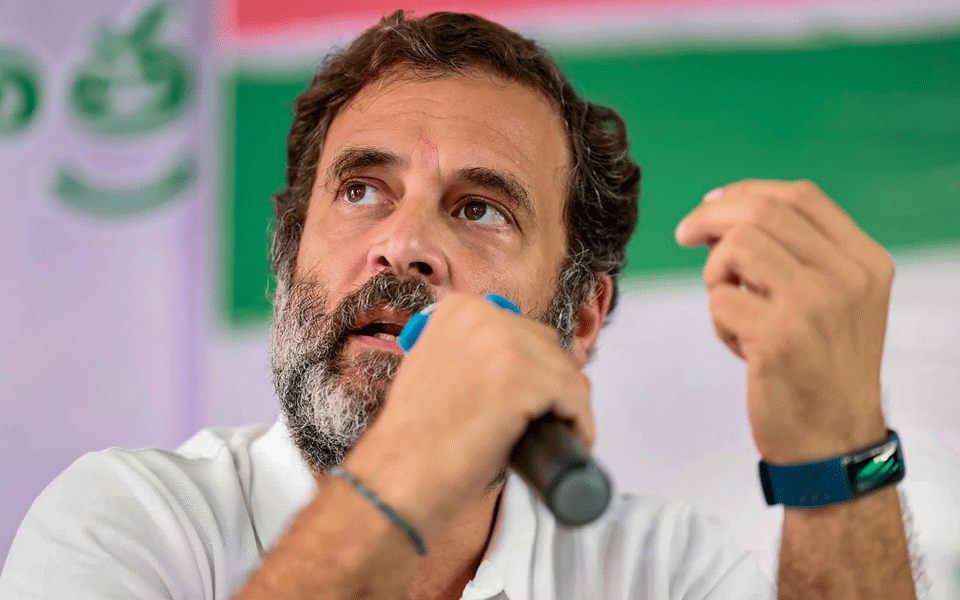
New Delhi, Nov 15: Former Congress president Rahul Gandhi on Wednesday questioned why the brothers of the "param mitra" left India during "Amrit Kaal" after reports that some businessmen, including Gautam Adani's elder brother Vinod Adani, were among the 66 Indians who got the "golden passport" in Cyprus.
"Why did the brothers of the 'param mitra' leave India during 'Amrit Kaal'? 'Golden passport' means a golden opportunity for theft -- steal public money, form a shell company and spend abroad," Gandhi said in a post in Hindi on X.
He said this following media reports that Vinod Adani and Pankaj Oswal were among the 66 Indians who got the "golden passport". The "golden passport" scheme was also called the "Cyprus Investment Programme" after it was introduced in 2007 and it facilitated the grant of Cypriot citizenship to financially prominent individuals, thereby bringing in foreign direct investments (FDI) into the country.
Ruling Bharatiya Janata Party's (BJP) IT cell in-charge Amit Malviya hit back at Gandhi, saying it was under the Congress-led United Progressive Alliance (UPA) government that the India-Cyprus tax treaty created a haven for tax evaders.
"You practically rolled out the red carpet for investors to bypass Capital Gains tax, with Cyprus not imposing such taxes either. Add to that the low withholding tax rate, and you have got yourself a perfect recipe for creating a tax haven, luring businesses and individuals to funnel money into Cyprus.
"But when the BJP led NDA came into power, we saw through this charade and took immediate, decisive action. In 2016, we didn't just tweak the Double Taxation Avoidance Agreement (DTAA) with Cyprus; we overhauled it. Our revision, effective retrospectively from, Nov 2013, was a game-changer. It shifted the taxation of capital gains right back to where the income is made -- the source country -- rather than letting investors hide behind the veil of their country of residence. This wasn't just a policy shift; it was a direct challenge to the tax avoidance circus you had running," Malviya claimed in a post on X.
Responding to Gandhi's post on the microblogging website, he said, "Let's talk about the grandfathering clause we introduced for investments made before April 1, 2017. It wasn't just a clause; it was a statement. We ensured a fair transition to the new regime, where capital gains would be taxed in the investor's country of residence for investments made before this deadline."
"This shift was monumental. It wasn't just about fair taxation; it slammed the door shut on using offshore entities for tax evasion. The so-called 'Golden Passport' that you accuse us of promoting? It's a relic of your governance, a symbol of the opaque, underhand dealings you endorsed," he said.
"So, let us set the record straight. Those who have left are your 'Param Mitras'. Their departure is on you. Your legacy of promoting tax havens and opaque financial practices is what drove them out. Our reforms have not only plugged these gaps but have showcased our unwavering commitment to transparent and accountable tax governance. Your accusations don't just fall flat; they're a stark reminder of your party's dubious past," Malviya claimed.
'अमृत काल' में 'परम मित्र' के भाई भारत छोड़ कर क्यों भागे?
— Rahul Gandhi (@RahulGandhi) November 15, 2023
'गोल्डन पासपोर्ट' मतलब चोरी का सुनहरा मौका - जनता का पैसा चुराओ, Shell कम्पनी बनाओ और विदेश में उड़ाओ। pic.twitter.com/ueXiWqPKvD
Let the Truth be known. If you read VB and like VB, please be a VB Supporter and Help us deliver the Truth to one and all.
Karnataka: College student dies by suicide in Dharwad, 3 policemen suspended

Dharwad (Karnataka) (PTI): A college student allegedly died by suicide here, following which three policemen were suspended over allegations of harassment linked to his death by the victim's family.
Aditya Myageri, a BSc student at a private college here, was among 18 students detained by the Vidyagiri police on April 25 during an anti-drug drive, police said on Wednesday.
He hailed from Belur village in Bagalkot district, but was staying with his friends at a rented accommodation in Girinagar area of Dharwad city, police said.
Among the 18 students tested, Aditya was among the 10 who had tested negative for ganja consumption and was subsequently released.
Some of his roommates, however, tested positive.
According to police, Aditya's family alleged that despite testing negative, he was harassed by police. They also claimed some policemen demanded Rs 2,000 to settle the matter and threatened legal action if he failed to pay.
He had called his mother asking for money, but she could not arrange it immediately, the family claimed.
On Monday night, Aditya allegedly died by suicide by hanging from a ceiling fan at his rented accommodation, with his family alleging police harassment and pressure over demand for money drove him to the extreme step, a senior police officer said.
Police Commissioner N Shashi Kumar told PTI that an unnatural death case has been registered at Vidyagiri police station. Three policemen have been suspended over the allegations, and further investigation is underway.