Rahul promises farm loan waiver in C'Garh, says money will come from Ambani, Mallya
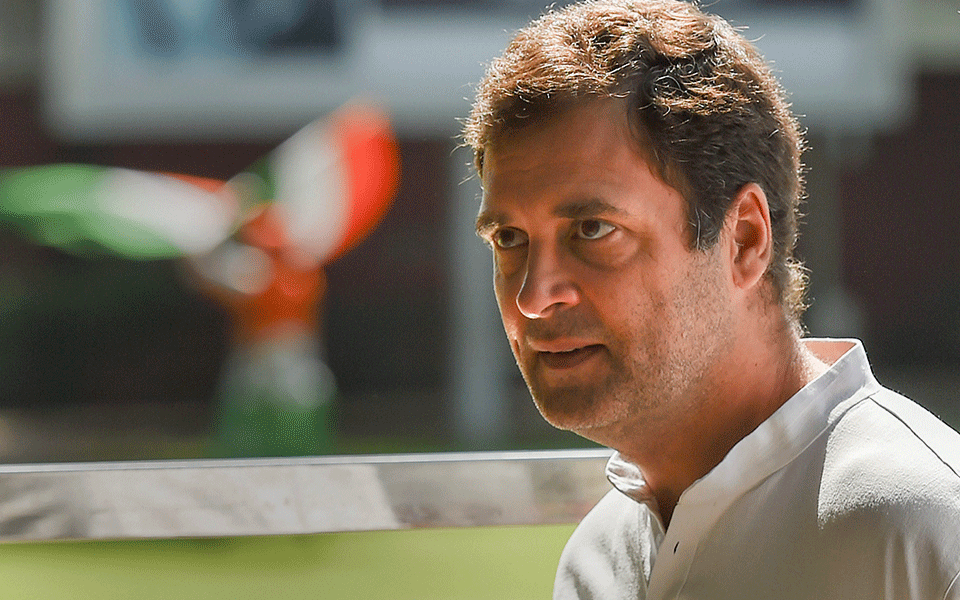
Raipur, Nov 17: Congress president Rahul Gandhi Saturday promised to waive farm loans in Chhattisgarh within 10 days of assuming power in the state and said the money for it would come from the "likes of" Vijay Mallya, Nirav Modi and Anil Ambani.
Stepping up his attack on Prime Minister Narendra Modi over demonetisation ahead of the second and final phase of the Chhattisgarh polls, Gandhi alleged that Modi made the honest people suffer through the 2016 exercise, but spared the rich.
Addressing a poll rally in Koriya district, he alleged that the prime minister had waived loans worth Rs 3.5 lakh crore of a few rich people, but not those of the poor farmers.
"As soon as the Congress forms the government here, Modiji, you count 10 days. The Congress will waive the loans of each farmer in Chhattisgarh within 10 days," Gandhi said.
He claimed that BJP leaders used to question the previous Congress-led UPA government about the source of money for granting loan waiver.
"Modiji, the money for the loan waiver for Chhattisgarh's farmers will come from the likes of Vijay Mallya, Nirav Modi, Anil Ambani...We will take their money and implement the loan waiver," the Congress chief said.
He alleged that "liquor baron Mallya fled the country with Rs 10,000 crore of the banks, while Nirav Modi and Mehul Choksi fled with Rs 35,000 crore".
Addressing a rally in Ambikapur, Modi had Friday claimed that the Congress was "worried" because he took away all the money it's "minions and friends" had stashed under their beds and in sacks in one stroke.
"Something rankles them (Congress) in such a way that they are still not able to sleep...No one sitting here is crying. Only one family is crying," Modi had said, while justifying demonetisation.
Gandhi reiterated his charge that the prime minister had helped industrialist Anil Ambani get Rs 30,000 crore in the "Rafale scam".
Turning to demonetisation, he said Modi "robbed the poor and the honest" through the exercise, which invalidated the old Rs 1,000 and Rs 500 currency notes, and made them stand in queues to exchange the scrapped notes.
"Modiji had said he would fight against black money. He had (recently) said those who had stashed money in their houses and or kept it hidden under pillows were thieves and that he had taken action against them.
"I want to tell you (people) that you have not committed any theft. The person who has committed a theft is Narendra Modi. He made the honest people stand in queues. Have you ever seen those wearing suit-boot and crorepatis standing in queues (outside banks)?" Gandhi asked the crowd.
He said the Congress had always delivered on its promises, unlike the BJP.
"The intention of the Congress is very clear. It never makes false promises. In fact, you can listen to my speeches of the last 15 years. I never made false promises. Whatever I promised, I fulfilled it," Gandhi said.
He added that the previous UPA government had brought in measures like the Tribal Bill, the Right to Food Act, the Right To Information Act, the Mahatma Gandhi National Rural Employment Guarantee Act (MNREGA), the Land Acquisition Bill etc.
"You can check the records. On the contrary, Modi and Chhattisgarh Chief Minister Raman Singh did not fulfil the promises they had made to farmers," the Congress MP said.
Modi and Singh did not fulfil their promises like good returns to farmers on their produce and loan waiver, he said.
"In the last four-and-a-half years, Modiji has waived loans worth Rs 3.50 lakh crore of a few rich people, but he has not spoken about farm loan waiver. Similarly, Raman Singh has snatched the bonus of the farmers," Gandhi alleged.
He accused the prime minister of remaining "silent" on the "corruption charges" against Singh.
"Modi used to speak about corruption in his earlier speeches, but why has he not spoken about the corruption of Raman Singh?" the Congress chief asked.
He claimed that the names of Singh and his wife had surfaced in the alleged Rs 36,000-crore civil supply scam.
"A Rs 5,000-crore chit fund scam was also perpetrated in the state. His (Singh's) son Abhishek Singh was named in the Panama Papers scandal, but no action was taken in any of these cases," Gandhi said.
The chief minister has denied the allegations against him.
Gandhi alleged that Modi was not acting against Abhishek Singh in the Panama Papers case.
"This, at a time when Pakistan has jailed its former prime minister Nawaz Sharif after his name cropped up in the Panama Papers," he said.
The Congress chief also accused the Raman Singh government of creating "two states" within Chhattisgarh in the last 15 years -- one for the rich and one for the poor.
"The Raman Singh government has created two Chhattisgarh. One belongs to the rich and the industrialists wearing suit-boot, while the other belongs to the common men, women, farmers and labourers. We do not want two Chhattisgarh but one, where everybody gets justice," he said.
When Chhattisgarh was formed, people wanted the locals to get the benefits of its natural resources and money, but that did not happen, Gandhi added.
"The Congress wants to make Chhattisgarh an agricultural hub and a supplier of food to the nation," he said.
The final phase of polling for 72 seats will be held in Chhattisgarh on November 20. The first phase for 18 seats was held on November 12. The results will be announced on December 11.
Let the Truth be known. If you read VB and like VB, please be a VB Supporter and Help us deliver the Truth to one and all.
Maharashtra sets up state vaccination task force to strengthen immunisation programme

Mumbai (PTI): The Maharashtra government has set up a State Vaccination Task Force to strengthen the regular immunisation programme and review the progress of related campaigns, a health department official said on Monday.
The State Vaccination Task Force will comprise at least 29 members and will be headed by the administrative head of the health department, he informed.
The government has also constituted separate district-level and municipal vaccination task forces to improve implementation and address challenges at the grassroots level, he said.
Municipal task forces, chaired by respective civic commissioners, have been constituted in view of the vast urban population in Maharashtra and the role of civic bodies in implementing different health programmes.
The district-level task forces will function under the chairmanship of collectors.
"Complete immunisation of children at the appropriate age is an extremely simple, cost-effective and highly effective measure to reduce child mortality and the prevalence of diseases among kids. Immunisation is a powerful tool for reducing illness in children," maintained the official.
To ensure full vaccination of all children, the state government implements various campaigns from time to time as per the central government guidelines, he pointed out.
"Active participation and cooperation of other relevant government departments are essential (in making these campaigns successful)," according to the official.
The state-level body will review the regular immunisation programme, associated campaigns and vaccine-preventable diseases in detail. It will also conduct focused assessments of high-risk districts and municipal corporations, including vacancies at district, municipal and sub-district levels, availability of cold chain equipment, resource gaps and training requirements, he noted.
The state task force will review allocation and utilisation of funds for immunisation and ensure timely action by officers concerned based on reports from district and municipal task forces and state-level monitoring mechanisms, the official said.
It will also ensure active coordination and participation of other government departments in immunisation drives, while district and municipal task forces will carry out similar functions at their respective levels, the official added.