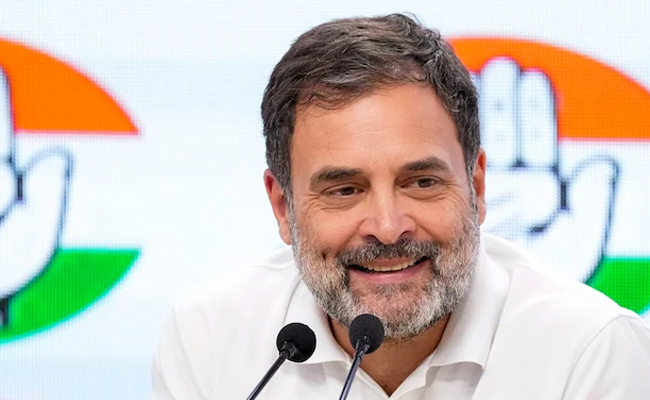
Rahul should apologise for abuses hurled at PM, his late mother during 'Voter Adhikar Yatra': Shah
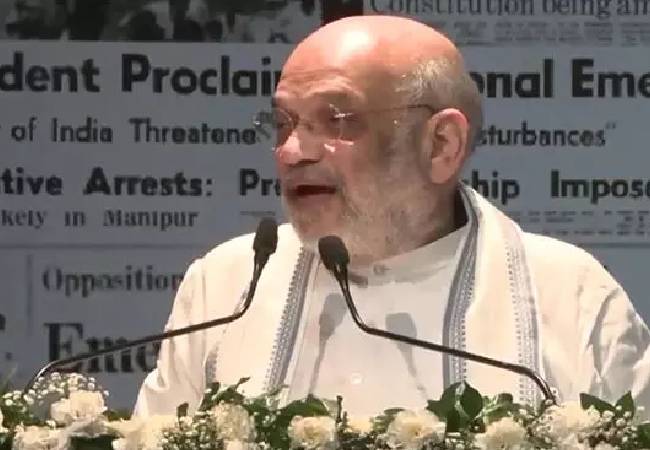
Guwahati (PTI): Union Home Minister Amit Shah on Friday said Rahul Gandhi should apologise for the “abuses” hurled at Prime Minister Narendra Modi and his late mother during the Congress leader’s 'Voter Adhikar Yatra' in Bihar.
Shah claimed that Gandhi’s politics has touched the “lowest level” with his “Ghuspetiya Bachao Yatra (Save Infiltrators Yatra)” in Bihar.
“Rahul Gandhi should apologise to the PM, his late mother and the people of the country if he has any shame left. The nation is watching him and his party in disgust,'' he said, after inaugurating the newly constructed Brahmaputra wing of the Raj Bhawan here.
The Congress and the Leader of Opposition in Lok Sabha have come under heavy attack by the BJP, after a purported video showed an unidentified person using a Hindi expletive against Modi from a dais raised during the yatra in Darbhanga town, from where Gandhi, party general secretary Priyanka Vadra and RJD’s Tejashwi Yadav had left for Muzaffarpur on motorcycles.
''The Ghuspetiya Bachao Yatra is to protect Congress’ vote bank, but in any democracy, election is its soul. How can a nation be safe if infiltrators are allowed to pollute the system by enrolling their names in the voters’ list?'' Shah asked.
“The Congress’ politics is negative... Its leaders have indulged in many hateful acts in the past, but the party crossed all limits with the abuse of the PM and his late mother from the platform of its yatra in Bihar, where Rahul Gandhi was welcomed,'' the home minister said.
There can be no greater decline in public life and politics than “abusing Modi's mother'', who lived in a poor household, but raised a son who is now a world leader, Shah said.
“The issueless and hate politics of the Congress will not raise the party’s stature before the people... it will, instead, take them down to the pit,” asserted Shah.
The senior BJP leader claimed that “the abuse” of Modi is nothing new, and it has been continuing since his Gujarat chief minister days.
“Many Congress leaders, including Sonia Gandhi, have earlier used derogatory language against the PM... But, no amount of abuse can stop the lotus from blooming,” Shah said.
“In every election, they have abused him, but had to bite the dust each time,'' the home minister said.
''The world is watching India's progress with wonder... the PM's respect has increased across the globe, with 27 countries bestowing their highest honour on him,'' said Shah.
Earlier, Shah inaugurated the newly constructed Brahmaputra wing of the Raj Bhawan here on the second day of his two-day visit to Assam.
“The inauguration of the new Assam Raj Bhawan wing is historic, reflecting the journey of the northeast region from struggle to the concept of 'Ashtalakshmi',” he said.
Referring to the Assam agitation against infiltrators from 1979-85, he said what the protesters had sought back then “is being realised by the PM and CM Himanta Biswa Sarma, and this will continue''.
The existing Raj Bhawan was a camp office of the governor when Shillong was the capital of Assam, but the new wing on the banks of the Brahmaputra is ''the most grand and beautiful residence'' of the highest constitutional office in the state, Shah said.
''The northeast has dealt with many twists and turns, but is now a peaceful and developed region, heading towards more progress,'' he said.
Shah also virtually inaugurated the Rs 45-crore National Cyber Forensic Laboratory-North East – the second in the country after Delhi – at the Lachit Barphukan Police Academy in Dergaon, from the Raj Bhawan premises.
Shah virtually inaugurated and laid the foundation for various development projects of the ITBP, SSB and Assam Rifles, too, including housing complexes, barracks and hospitals.
Amid chanting of vedic hymns, he also offered prayers at a temple inside the Raj Bhawan, performed ‘gau pujan’ and planted a 'Sindur' tree.
He was welcomed by Governor Laxmi Prasad Acharya and Chief Minister Himanta Biswa Sarma at the venue.
Let the Truth be known. If you read VB and like VB, please be a VB Supporter and Help us deliver the Truth to one and all.
2nd phase of Bengal poll: 39.97 per cent polling till 11 am amid sporadic violence
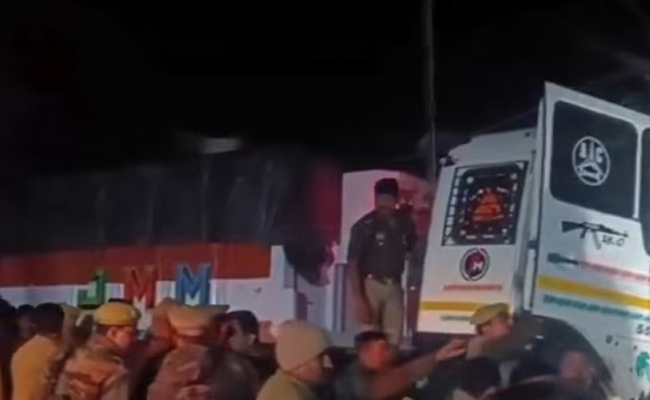
Kolkata (PTI): Nearly 40 per cent of the 3.21 crore electors voted till 11 am of the second phase of polling in West Bengal amid sporadic violence, while tension gripped the Bhabanipur seat briefly as Chief Minister Mamata Banerjee and Suvendu Adhikari took swipes at one another in the same booth area.
Voters queued up from 7 am outside booths in Kolkata, Howrah, Hooghly, Nadia, North and South 24 Parganas and Purba Bardhaman districts, which form Bengal's electoral and political core.
Of the total electorate eligible to vote in this phase, 1.57 crore are women, and 792 are third-gender.
Till 11 am, West Bengal recorded 39.97 per cent polling with Purba Bardhaman registering the highest turnout at 44.50 per cent, followed by Hooghly at 43.12 per cent and Nadia at 40.34 per cent.
ALSO READ: BJP will form govt in Bengal with thumping majority: Nabin
Howrah recorded 39.45 per cent polling, while North 24 Parganas registered 38.43 per cent. Kolkata North and Kolkata South recorded 38.39 per cent and 36.78 per cent turnout, respectively.
South 24 Parganas, a politically crucial district witnessing several high-profile contests, recorded 37.9 per cent voting.
The first phase of polls in 152 Assembly seats of West Bengal on April 23 also recorded more than 41 per cent polling till 11 am.
"Polling is underway peacefully, barring some minor incidents in certain areas. We have sought reports from the officials concerned," a poll panel official said.
The early-morning convergence of Banerjee and Adhikari at the same booth area in Chakraberia turned Bhabanipur -- the chief minister's electoral bastion -- into the centrepiece of the day, reinforcing the symbolic weight of their prestige battle seen as a rematch of Nandigram, where the BJP leader had defeated her in 2021.
Banerjee was already seated outside the booth after receiving complaints of alleged intimidation of local TMC leaders when Adhikari arrived there amid heavy deployment of central forces.
Stepping out of his car, Adhikari declared, "I will not allow any hooliganism", while Banerjee accused the BJP of trying to "rig" the election using central forces, police observers and election officials.
"BJP wants to rig this election. Polls in Bengal are usually peaceful. Is there goonda raj here?" Banerjee told reporters, alleging CRPF personnel had visited the homes of TMC leaders late Tuesday night and unleashed terror in the area.
She alleged that election observers were acting at the BJP's behest and claimed TMC workers were being selectively targeted across districts.
Adhikari dismissed the charges as signs of "frustration", claiming Banerjee had realised that "not a single vote" was coming her way.
Banerjee, who usually steps out of her Kalighat residence late in the day to cast her vote at Mitra Institution School, broke convention and hit the ground before 8 am, moving through Chetla, Padmapukur and Chakraberia, underlining the stakes attached to Bhabanipur and the wider battle for south Bengal.
Reports of violence, vandalism and tension surfaced from several districts.
In Nadia district's Chapra, a BJP polling agent was allegedly assaulted inside a booth during a mock poll. The BJP accused TMC supporters of attacking its agent, while the ruling party denied the charge. In Shantipur, a BJP camp office was found vandalised.
In South 24 Pargana's Bhangar, the ISF alleged that its polling agents were prevented from entering booths.
Howrah's Bally constituency saw tension at a booth in Liluah after an EVM malfunction delayed voting, prompting central forces to lathi-charge agitated voters. Two people were arrested in the matter.
Police and RAF personnel were also seen chasing away crowds near a booth in Amdanga following complaints of unlawful gathering by bike-borne supporters.
In Panihati, BJP candidate Ratna Debnath, the mother of the RG Kar victim, faced protests and her car was allegedly stopped by TMC workers, while in Jagaddal, the recovery of a firearm near a polling booth triggered tension before police and central forces restored order.
BJP candidate from Basanti assembly constituency in South 24 Parganas, Bikash Sardar, on Wednesday, alleged that "200-250 TMC goons" attacked his car and assaulted his driver when he was visiting polling booths in the constituency.
The TMC did not immediately respond to the allegations.
Unlike the first phase, where the BJP sought to defend its north Bengal gains, the final round has shifted the battle squarely to the TMC's strongest belt.
In 2021, the ruling party had won 123 of these 142 seats, leaving just 18 for the BJP and one for the ISF. For the BJP, breaching this southern fortress remains critical if it hopes to mount a serious challenge for power in the state.