Rahul's contest from Wayanad a fight against Left: Pinarayi Vijayan
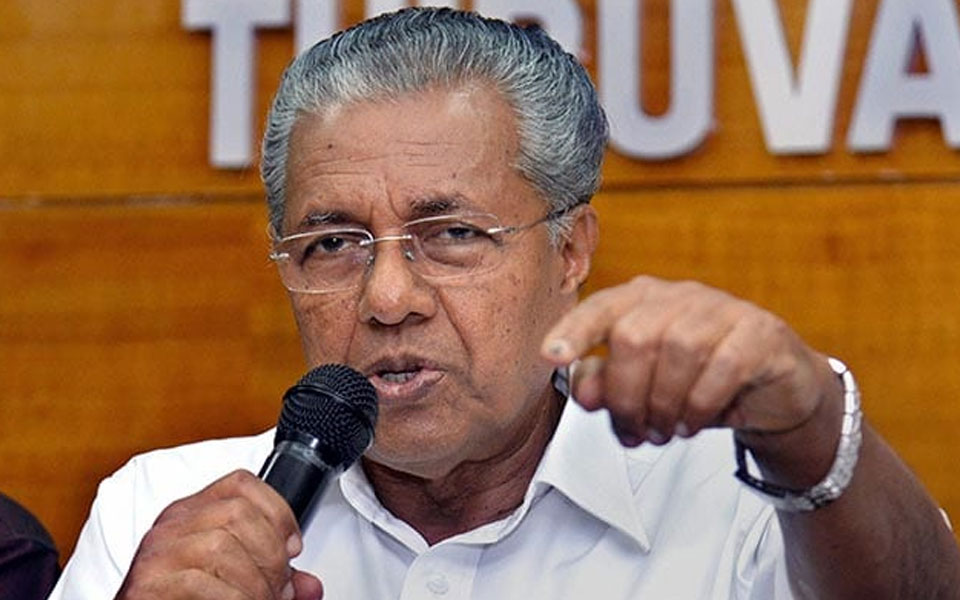
Thiruvananthapuram: Kerala Chief Minister Pinarayi Vijayan Sunday said Congress President Rahul Gandhi's contest in Wayanad in the state could only be seen as a move to fight the Left parties and not the BJP and asserted that the LDF would defeat him in the April 23 Lok Sabha elections.
There was no need to attach any special importance to the Congress President contesting from the state and Gandhi was just one among the 20 candidates of the opposition UDF, who are trying their luck from Kerala, he said.
"If Gandhi's fight is against the BJP, he should have contested against the saffron party. In Kerala, the fight is between LDF and UDF in the elections," Vijayan told a meet-the-press programme at the Press Club here.
He was reacting to the announcement by Congress that Gandhi would contest from the hilly Wayanad, considered a fortress of the party, in addition to the Gandhi family's pocket burrow Amethi seat in Uttar Pradesh in the polls.
"The present move can only be seen as a fight against the Left. But, we have no anxiety...we are fully confident and will strive to defeat him in Wayanad," the CPI-M veteran said.
Gandhi had announced earlier he would retain Amethi in Uttar Pradesh as his constituency after elections, he said.
"So, it is like...Gandhi will continue as the MP from Amethi and in Wayand he is examining if he can defeat the Left", the Chief Minister said asking what message the Congress was conveying to the people through the move.
When asked about the proposed post-poll alliance with the Congress at the national level, Vijayan said it was a matter to be thought off after the elections.
BJP state chief P S Sreedharan Pillai said the Congress decision to field Gandhi from Wayanad showed the "decay" in the grand old party.
"After realising that he will lose from Amethi, Gandhi has decided to contest from wayand", he told reporters here.
The BJP would give a "tough fight" to the Congress candidate, he said adding Gandhi's Wayanad contest was being viewed by the party as "acceptance of defeat".
The state Congress leaders were all in a jubilant mood over the AICC chief's decision.
Leader of the Opposition in the state assembly Ramesh Chennithala said the party'saim was to ensure Gandhi's victory with a massive margin.
"I challenge Pinarayi Vijayan, if he can defeat Rahul Gandhi in Wayanad and we accept the challenge," he told reporters at Alapuzha.
It would be a "historical win" for Gandhi in Wayanad and there would be a "Rahul wave" in the entire state, he claimed.
"A prime ministerial candidate is contesting from Kerala for the first time and this will have an impact in the entire state," he said adding the UDF would win all 20 seats.
Party's state unitPresident Mulapally Ramachandran said the decision to field Gandhi from Wayand would be "a happy news for secular-democratic forces" in the state.
He also remembered how former Congress presidents Indira Gandhi and Sonia Gandhi had scripted impressive victories from South India.
Congress leader M I Shanavas, who died in November last year, had won Wayanad, known for its picturesque locales and spices, in the 2009 and 2014 elections.
The LDF has decided to field CPIs P P Suneer in the constituency this time while BJP-NDA yet to announce its candidate.
Let the Truth be known. If you read VB and like VB, please be a VB Supporter and Help us deliver the Truth to one and all.
EAM Jaishankar meets Jamaican PM, gifts over 10 BHISHM Cubes
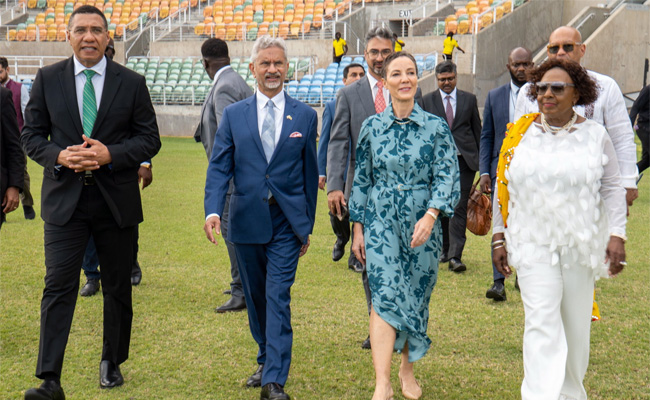
Kingston (PTI): External Affairs Minister S Jaishankar on Monday met Jamaican Prime Minister Andrew Holness and discussed ways to further deepen "political, economic and people-to-people cooperation."
Jaishankar also conveyed greetings from Prime Minister Narendra Modi to Holness.
"Pleased to call on Prime Minister @AndrewHolnessJM in Kingston. Conveyed the greetings of PM @narendramodi," Jaishankar posted on X.
"Discussed deepening our political, economic and people-to-people cooperation. Value his commitment towards further strengthening India-Jamaica relations," the post further read.
Also, the external affairs minister handed over 10 BHISHM (Bharat Health Initiative for Sahyog Hita & Maitri) Cubes as a gift to Jamaica.
"Formally handed over 10 BHISHM Cubes as a gift from India to Jamaica, in the presence of PM @AndrewHolnessJM, Health Minister @christufton and FM @kaminajsmith," Jaishankar posted on X.
"The BHISHM Cube mobile hospital system, designed for rapid deployment, will help Jamaica during disasters and emergencies. The gift of these cubes is a statement of friendship, a commitment to disaster preparedness, and an outcome of innovation," the post said.
Jaishankar arrived in Kingston on Saturday evening, marking the first leg of his nine-day tour of Jamaica, Suriname, and Trinidad and Tobago, aimed at further strengthening India's strategic and cultural ties with the Caribbean nations.
Earlier in the day, he interacted with the Indian diaspora and discussed India's ongoing transformation in infrastructure, human development and technology-driven governance and entrepreneurship with them.
He also highlighted the cricket bond between both countries as India gifted a scoreboard to Jamaica.
A scoreboard was dedicated at Sabina Park in Kingston. It is the home of the Jamaica cricket team and is the only Test cricket ground in the Caribbean island nation.
The minister expressed hope that the new scoreboard would witness many memorable innings, including those symbolising the enduring friendship between the two countries.
Cricket has long been a strong cultural bridge between India and Jamaica, which is part of the West Indies cricket team.
Jamaican players, including Chris Gayle, Courtney Walsh and Michael Holding, have played a major role in shaping the legacy of West Indies cricket in the international arena, contributing to its dominance in earlier decades and its continued global appeal.