Rajasthan: Five BJP MLAs' resort visit sets off speculations amid suspense over CM pick
Jaipur (PTI): Amid suspense over whom the BJP will pick for the chief minister's post in Rajasthan, a visit by five BJP MLAs to a resort on the outskirts of the city created a buzz.
The father of MLA Lalit Meena claimed the newly elected legislator from Kishanganj had been confined there by the other four. After his father informed the party office, Meena was brought there on Wednesday morning.
It was not immediately clear whether the other four stayed back at the resort on Sikar Road.
Meena, however, refused to elaborate on the incident, which is seen as as attempt at 'badabandi' -- holing up elected leaders in resorts as a show of strength.
The Kishanganj MLA's father Hemraj Meena claimed his son was called by another legislator, Kanwar Lal Meena, to the resort for a meeting and was not allowed to leave. Lalit Meena then informed his father about the situation.
"When I got the call, I immediately informed the party leaders. We went to the resort where there was an altercation with Kanwar Lal Meena. However, we brought Lalit to the party office," Hemraj Meena told reporters.
When asked on whose directions the MLAs were staying there, Hemraj Meena said he had no idea about it and Kanwar Lal Meena could explain this. Kanwar Lal Meena could not be contacted for comments.
According to party sources, the five MLAs from the Kota division had checked into the resort on Tuesday night and had plans to shift to another resort in Kotputli.
When contacted, Lalit Meena refused to divulge details. "Whatever happened that night, I informed the party leaders. The party is my family and it is our family matter," he told PTI.
Meanwhile, the BJP's Rajasthan unit president CP Joshi said, "There is no 'badabandi'. The MLAs are in their constituencies," he said, adding that any decision on who will the chief minister will be taken after the legislature party meeting.
"The meeting will be called after the observers are appointed," he told reporters.
Meanwhile, two big posters showing Vasundhara Raje congratulating Prime Minister Narendra Modi for the party's victory in Rajasthan, Madhya Pradesh and Chhattisgarh were put up outside the residence of the former chief minister on Thursday.
Raje, an MLA from Jhalrapatan in Jhalawar district under the Kota division, reached Delhi on Wednesday night.
Suspense over the chief ministerial face in Rajasthan prevailed ever since the party swept the Assembly poll in the state, winning 115 seats. Former chief minister Vasundhara Raje, and Union ministers Gajendra Singh Shekhawat and Arjun Ram Meghwal are considered among the frontrunners for the chief minister's post.
Let the Truth be known. If you read VB and like VB, please be a VB Supporter and Help us deliver the Truth to one and all.
TMC will be voted back to power in Bengal: Tejashwi Yadav
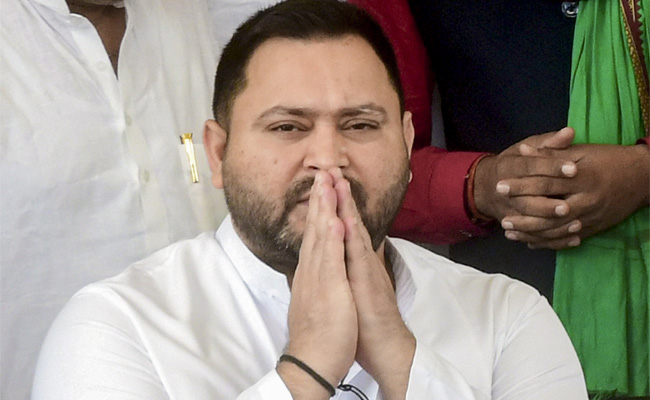
Patna (PTI): Leader of Opposition in Bihar assembly, Tejashwi Yadav, on Tuesday exuded confidence that the Mamata Banerjee-led TMC will again be voted to power in West Bengal.
Yadav returned to Patna after a four-day poll campaign in West Bengal.
“The atmosphere there is euphoric and people want to bring Didi (Mamata Banerjee) back to power. I am fully confident that the TMC will win the election,” he told reporters here.
He said that a large number of people from Bihar living in West Bengal share a lot of love and respect for Mamata Banerjee.
Responding to BJP’s allegations that the TMC had “ruined” West Bengal during its tenure, the RJD leader said the “entire country has been ruined under the Narendra Modi-led government”.
“I want to ask one question to Modi ji – you have been prime minister for more than 11 years, tell me one thing you have done for Bengal,” Yadav said.
The first phase of elections to the 294-member West Bengal assembly was held on April 23, while the second phase will take place on April 29. Votes will be counted on May 4.