Rajput leader's killing: Protest held in parts of Rajasthan, SIT formed to nab accused
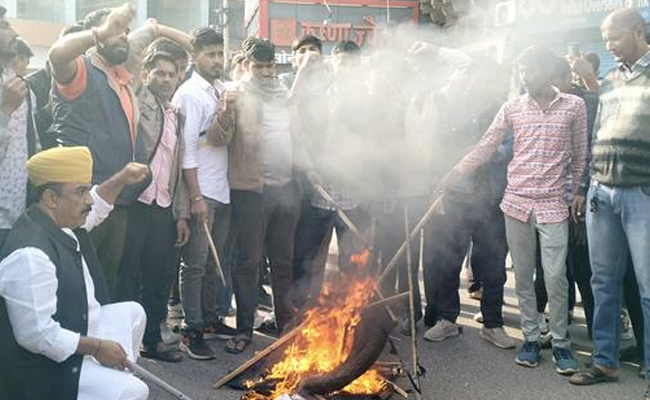
Jaipur (PTI): Markets remained closed in Jaipur and some other districts of Rajasthan on Wednesday after a bandh call by the Rashtriya Rajput Karni Sena to protest the killing of its chief Sukhdev Singh Gogamedi.
Director General of Police Umesh Mishra formed a Special Investigation Team (SIT), to be headed by Additional Director General (Crime) Dinesh MN, to probe the killing while a cash reward of Rs 5 lakh for information leading to the arrest of the two accused was also announced.
The Rajasthan Police also carried out searches to nab the two accused who allegedly killed Gogamedi for "backing" the enemies of gangster Rohit Godara -- said to be linked to the Lawrence Bishnoi gang -- who has taken responsibility for the murder in a Facebook post.
Gogamedi was shot dead in the living room of his house here on Tuesday.
Markets remained closed in Jaipur, Bundi, Ajmer, Sawai Madhopur, Chittorgarh and some other districts while a mass rally was taken out in Udaipur and a demonstration was held at the collectorate circle amid heavy deployment of police.
The supporters of Gogamedi had given a Jaipur bandh call and gathered in the Khatipura area in the morning from where they moved to other parts of the city asking shopkeepers to shut their establishments.
There was no movement of public transport in the capital city and the services of roadways buses were also affected, officials said.
Khatipura road in Jaipur was blocked while Rajput community members in large numbers were sitting outside the Metro Mass Hospital in the Mansarovar area where Gogamedi's body is kept.
Similar protests took place in Jodhpur and Udaipur as well but remained peaceful. The effects of the bandh call were seen in other districts too as people refrained from venturing out.
Governor Kalraj Mishra summoned Chief Secretary Usha Sharma, DGP Mishra, Jaipur Police Commissioner Biju George Joseph and other officials to review the situation.
The governor told the officials to ensure that those behind the killing are arrested soon and asked them to stay alert while asserting that no laxity at any level will be tolerated, according to a Raj Bhawan spokesperson.
Earlier, Joseph told PTI that the accused who shot dead Gogamedi as well as Naveen Singh Shekhawat, who accompanied them to the Rajput leader's residence on Tuesday, have been identified and efforts are being made to trace them.
"One of the accused is from Haryana and the other from Rajasthan," he said.
Joseph said the accused secured access to Gogamedi's house through Shekhawat.
It is a matter of investigation whether Shekhawat, who used to run a cloth shop, was aware of the intentions of the two accused, he said.
The chief secretary informed the governor in the meeting that the situation is being monitored by district collectors.
Mahipal Singh Makrana, national president of Shri Rajput Karni Sena, demanded the removal of the state police chief for failing to provide security to Gogamedi.
"There was intelligence input about the murder of Sukhdev Gogamedi from Punjab Police but the Rajasthan Police did not provide him security. This is a clear failure of the police. The DG should be removed and action must be taken against the negligent police officials," he told PTI.
Makrana said there is huge resentment in the Rajput community which will be forced to hold protests across the country if the accused are not caught soon.
He said that not only the Rajput community but the 'Sarv Samaj' is agitated over the incident.
Gogamedi's supporters have demanded compensation of Rs 11 crore for the family of the slain leader.
"The incident makes it clear that there is 'Jungle Raj' (law of jungle) in Rajasthan. The accused should be killed in an encounter," one of the protesters said.
Let the Truth be known. If you read VB and like VB, please be a VB Supporter and Help us deliver the Truth to one and all.
4 held for sexually assaulting woman, girl on moving bus after social media alert in UP's Agra
Agra (UP) (PTI): Four people were arrested, after a prompt response by police following a social media alert, for allegedly sexually assaulting a woman and a girl inside a moving bus here, officials said on Tuesday.
According to an official police statement, at 12:27 am on April 27, information was received on the social media platform X about an incident of sexual assault on a bus travelling from Kanpur to Ahmedabad, which was approaching Namner crossing in Agra.
Acting under the direction of Police Commissioner Deepak Kumar, the Agra Police social media team immediately alerted the Rakabganj police station within minutes and coordinated with the victims to confirm the incident and obtain the exact location, it stated.
Police teams launched intensive checking at Namner crossing and intercepted the bus as it reached the spot. The four accused involved in the incident were apprehended on the spot, and legal action was initiated against them, the statement said.
The police said the swift response and coordination between the social media team and field units ensured timely action, bringing relief to the victims and other passengers, who expressed gratitude towards the police, it added.