Ramachandra Guha compares his freedom to Umar Khalid’s incarceration, asks why justice delayed

Disclaimer: The following report is based on historian Ramachandra Guha’s opinion piece titled A Life Aborted, published in The Telegraph on November 1, 2025.
Noted historian and author Ramachandra Guha, in his latest artcicle A Life Aborted published in The Telegraph on November 1, 2025, reflected on the academic brilliance of jailed scholar Umar Khalid and the tragic halt to his scholarly career due to his continued imprisonment.
Guha began by recalling his own early research as a historian of forest communities under British colonial rule and how, despite moving to different subjects over the years, he continues to remain attached to that field. He said he recently read a doctoral thesis that impressed him a work on the social and environmental history of what is now Jharkhand.
The thesis, Guha noted, focused on the transformation of Adivasi society in Singhbhum during British colonial rule. It examined how the East India Company took control of the territory and how colonialism reshaped its natural landscape, legal framework, and political and economic systems. The research explored themes such as the commercial orientation of British forest policy, the changing role of local village headmen, and the responses of Adivasi communities to the sweeping changes brought by colonial power.
The scholar, Guha wrote, also paid close attention to intellectual history, offering thoughtful readings of both British officials and Indian anthropologists who studied Singhbhum’s tribal societies.
He went on to list six qualities that made the work stand out:
A strong grasp of previous scholarship – The researcher had a command over writings on Adivasis across India, whether from well-known or obscure authors.
Extensive use of primary sources – The thesis was based on archival work in national, state, and district records, as well as in old essays and books over a century old.
Commitment to fieldwork – The historian had personally visited the area, following Marc Bloch’s advice that a historian needs both thicker boots and thicker notebooks.
Effective use of quotations – The thesis included vivid quotes that brought history alive. One British officer’s account of a forest hunt depicted local tribes dancing, singing, and carrying traditional weapons. Another quote, from a century later during the Non-Cooperation Movement, showed how nationalist sentiment had reached the tribal heartland.
Clarity in writing – Guha praised the author for his simple and powerful language, free from academic jargon.
Balanced argumentation – The scholar avoided the usual stereotypes about tribal life, instead showing how Adivasi communities had diverse responses to colonialism. Some resisted the state, some cooperated, while others used the new system to improve their standing within their own societies.
Guha also pointed out that while the thesis was outstanding, it was not without flaws. It missed certain important secondary sources, such as the works of T.N. Madan on Indian anthropology, and could have included more folklore and oral histories. He also felt that some primary source quotes were unnecessarily long and weakened the narrative.
Despite these minor issues, Guha described it as one of the finest doctoral dissertations he had read by an Indian scholar. He observed that works of such quality often get published as books within a few years of submission, citing examples such as Subalterns and Sovereigns by Nandini Sundar and Fencing the Forest by Mahesh Rangarajan, both of which emerged from doctoral research.
He added that other historians like Bhavani Raman, Aditya Balasubramanian, Nikhil Menon, and Dinyar Patel also saw their doctoral dissertations turn into acclaimed books soon after completion.
Guha then revealed that the remarkable thesis he was praising had been submitted in 2018 by Dr Umar Khalid. However, despite its merit, it has not yet been published as a book because its author has been in prison for more than five years without bail or formal charges.
Guha stated that he has never met Umar Khalid but recalled that both of them had participated in separate peaceful protests in December 2019 against what he described as a discriminatory law, Khalid in Delhi and Guha in Bengaluru. Reflecting on the contrast between their lives since then, Guha wondered if his freedom to continue research and writing was because his name is Ramachandra and not Umar.
Towards the end of the piece, Guha broadened his reflection beyond Khalid, pointing out that many upright Indians scholars, activists, and social workers are facing prolonged imprisonment on questionable charges filed by authorities acting under political pressure. These individuals, he said, have always stood for non-violence and upheld the core values of the Indian Constitution, yet find themselves targeted by what he called “authoritarian and majoritarian tendencies of the ruling regime.”
He lamented that these individuals are spending the best years of their lives behind bars when they could be contributing to the progress of the Republic. Guha concluded his column by urging the judiciary to show both decency and courage to restore their freedom.
Disclaimer: The above report is based entirely on historian Ramachandra Guha’s article A Life Aborted, published in The Telegraph on November 1, 2025.
Let the Truth be known. If you read VB and like VB, please be a VB Supporter and Help us deliver the Truth to one and all.
CSK's Ayush Mhatre ruled out of remainder of IPL 2026 due to hamstring injury
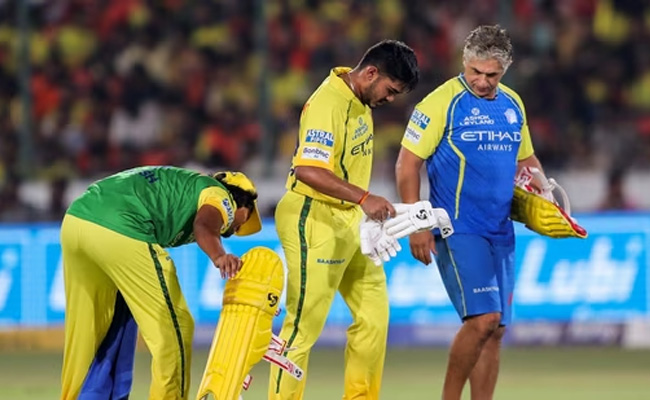
New Delhi (PTI): Chennai Super Kings batter Ayush Mhatre has been ruled out of the remainder of the ongoing IPL season due to a hamstring injury, dealing a major blow to the five-time champions.
The franchise said Mhatre, who sustained the injury during CSK’s previous game against Sunrisers Hyderabad on April 18, will require a rehabilitation period of six to 12 weeks.
"Ayush Mhatre has been ruled out of the remainder of IPL 2026 due to a left hamstring injury sustained while batting during the match against Sunrisers Hyderabad on April 18.
"Ayush's injury will require a rehabilitation period of 6-12 weeks," CSK announced on its social media on Tuesday.
The 18-year-old, who came in as an impact substitute, was seen in visible discomfort and clutched his hamstring while attempting a run during CSK’s 10-run loss to SRH in Hyderabad.
He required on-field treatment and, although he continued briefly, was dismissed soon after.
"It looks pretty bad, unfortunately. And he's going to be a big, big loss because he's been in really nice touch for us," CSK's batting coach Mike Hussey had said at the post-match press conference.
Mhatre has been CSK's standout batter this season. He lea collecting 201 runs from six matches at a strike-rate of 177.87.
Chennai Super Kings have endured a poor start to the 2026 season, losing four of their six matches to languish in eighth place.