Ramesh writes to Oram, flags 'flagrant violation" of rights of tribals in Great Nicobar Project
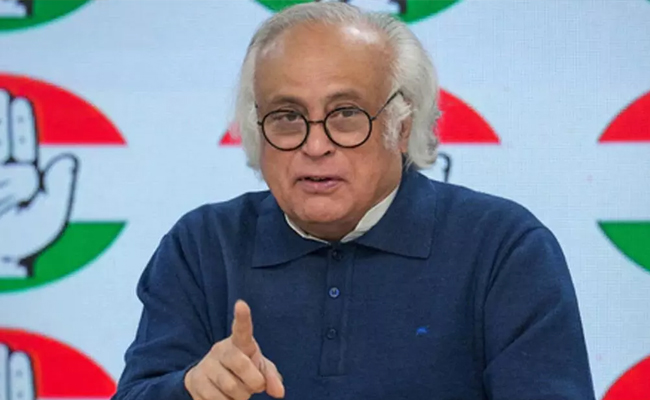
New Delhi (PTI): Senior Congress leader Jairam Ramesh wrote to Tribal Affairs Minister Jual Oram on Wednesday, flagging "flagrant violation" of the rights of tribal communities in the Great Nicobar Island Project and sought remedial action immediately.
In his letter to Oram, the former environment minister termed as "entirely false" the assertion in the government FAQs issued on May 1 that all statutory procedures and policy safeguards for the protection of tribal communities were duly complied with in the project.
"The Great Nicobar Project: FAQs issued by the Union Government on May 1, 2026 stated that 'all statutory procedures and policy safeguards for the protection of tribal communities have been duly complied with in the Great Nicobar Island Project. Necessary consultations were undertaken with competent authorities and domain experts, including the Anthropological Survey of India, Ministry of Tribal Affairs, and other stakeholders, in line with the Jarawa Policy, 2004, and Shompen Policy, 2015. This is entirely false," Ramesh said.
The Ministry of Tribal Affairs as the nodal agency for implementation of the Forest Rights Act, 2006, must take serious note of the "flagrant violation" of the rights of tribal communities and due processes under that historic law in the case of the Great Nicobar Island Project and take credible remedial action immediately, the Congress leader demanded in his letter.
ALSO READ: HC to hear pleas challenging tribal consent process for Great Nicobar project
"The Gram Sabha has necessarily to (i) consider any proposal for diversion of forest lands in which tribal communities live; (i) certify that their claims under the FRA, 2006 have been settled; and only thereafter (iii) consent to the diversion of such forest lands, if indeed that is its decision. The Hon'ble Supreme Court in the Niyamgiri judgment of April 18, 2023, held that such consent is mandatory under the FRA, 2006," he pointed out.
However, for the diversion of more than 13,000 hectares of forest lands for the Great Nicobar project, which includes the traditional, ancestral lands of the Nicobarese and Shompen settlements, the island administration admits to convening gram sabhas of the settler communities in Campbell Bay, Laxmi Nagar and Govind Nagar on August 12, 2022, he said.
The resolutions of these gram sabhas of the settler communities are cited as consent of the gram sabhas under the FRA, 2006, Ramesh noted.
"The illegality in the above exercise is patent and self-explanatory. Only the Nicobarese and Shompen scheduled tribes are entitled to settlement of individual and community rights under the FRA, 2006," he said
Further, the local administration claims that an "NOC" signed by the Chairman of the Tribal council of the Little and Great Nicobar, as part of the proceedings of the Sub-Committee (SLDC) dated August 13, 2022, amounts to obtaining divisional-level consent ot the entire Nicobarese tribe in Great Nicobar, he said.
"Such contention is in contravention of the FRA, 2006. No single person can accord consent on behalf of an entire community that is entitled the rights provided for in FRA, 2006. It is also relevant to note that the Chairman himself later wrote to various authorities including your office on November 22, 2022, withdrawing the 'NOC'. However, this extra-statutory 'NOC' continues to be cited as consent of the Nicobarese," Ramesh wrote.
"The Shompen, as you are aware, are a semi-nomadic group of hunter gatherers in the Great Nicobar Island. They are classified as a Particularly Vulnerable Tribal Group (PVTG) and their habitat, way of life etc. are protected. The A&N administration has claimed that an officer of the Andaman Adim Janjati Vikas Samiti (AAJVS) has consented on behalf of the Shompen tribe. The law does not permit such proxy consent," he asserted.
Besides, there is also a serious conflict of interest arising out of an overlap between the top leadership of the AAJVS and ANIIDCO (Andaman and Nicobar Islands Development Corporation), which is the project proponent in the first place, Ramesh argued.
The certificate dated August 18, 2022, issued by the Nicobar district deputy commissioner, relies on the above fraudulent "consent" and goes on to certify that all rights under the FRA, 2006, have been settled, he said.
"You are aware that even the committees for implementation of the FRA, 2006 in the Great Nicobar Island did not exist prior to July 26, 2022, when the committees under the FRA, 2006 were constituted for the first time. The fact is that the process of settlement of rights has not even commenced. The certificate dated August 18, 2022, is, therefore, patently false," he said.
Incidentally, the FAQs mentions the Jarawa policy, when it is well known that the Jarawas do not live on Great Nicobar Island, Ramesh said.
The Nicobarese, now living in tsunami relief colonies, have been writing repeatedly to the authorities expressing their wish to return to their ancestral, traditional lands and requesting the administration to facilitate their return, but nothing has come of these requests, he said.
"In sum, I urge you as Minister of Tribal Affairs to direct the Andaman and Nicobar administration to withdraw (i) the certificate dated August 18, 2022; (ii) the SDLC proceedings dated August 13, 2022; and (iii) the illegal gram sabha resolutions of the non-tribals of August 12, 2022," Ramesh said.
The FRA 2006 must be implemented in letter and spirit, in provisions and processes in a transparent and accountable manner, the Congress leader asserted.
The letter to Oram comes days after Ramesh wrote to Environment Minister Bhupender Yadav, claiming that the Great Nicobar Island development project would "destroy" the unique ecosystem there, and urging him to pause, reflect, and revisit the venture in its present design and detail.
The opposition party claimed that the Modi government is "rattled" and in damage control mode after Leader of Opposition in the Lok Sabha Rahul Gandhi's recent visit to Great Nicobar.
During his visit to Great Nicobar in the last week of April, Gandhi alleged that the Great Nicobar project at Campbell Bay in Andaman and Nicobar Islands was "one of the biggest scams and gravest crimes against the natural and tribal heritage of the country."
The Centre on May 1 released a detailed statement with answers to FAQs (frequently asked questions).
"The Great Nicobar Project is a strategic initiative to strengthen India's presence in the Andaman Sea. It seeks to balance port-led growth with calibrated environmental safeguards. Protection of indigenous communities remains central to its planning," the government statement read.
ग्रेट निकोबार द्वीप परियोजना को बुलडोज़ करने के दौरान वन अधिकार अधिनियम, 2006 के खुले उल्लंघन को लेकर केंद्रीय जनजातीय कार्य मंत्री को लिखा गया मेरा पत्र। pic.twitter.com/R1glqo3eIq
— Jairam Ramesh (@Jairam_Ramesh) May 13, 2026
Let the Truth be known. If you read VB and like VB, please be a VB Supporter and Help us deliver the Truth to one and all.
AI, fake Army officer profiles and blackmail: UP cops bust extortion racket linked to man's suicide

Sonbhadra (UP) (PTI): The Sonbhadra police have busted with the arrest of five people an inter-state cyber crime racket involving blackmail, extortion and impersonation of Army and police officers on social media, which allegedly drove a man to suicide, officials said on Wednesday.
They said the deceased man was allegedly subjected to sustained online harassment and threats. Five accused from Rajasthan were arrested following a multi-state investigation involving technical surveillance, bank transaction analysis and scrutiny of CCTV footage, police said.
The development comes after complainant Ankita Pathak approached Sonbhadra SP Abhishek Verma on April 29, alleging that her husband Rajendra Pathak had died by suicide on the night of April 7-8 at their newly-constructed house.
Initially, the reasons behind the suicide were unclear. However, family members later examined the deceased's mobile phone and allegedly found chats, call records and evidence showing that unknown persons had been threatening and extorting money from him repeatedly.
Additional SP (Naxal) Rishabh Runwal told PTI that bank statements and mobile conversations revealed that Rajendra Pathak had transferred money multiple times to the accused and was allegedly under severe mental distress due to cyber harassment and blackmail.
"Taking the matter seriously, police registered a case at Robertsganj police station under provisions of the Bharatiya Nyaya Sanhita related to abetment and extortion-linked offences, and formed a joint investigation team comprising the cyber crime police station, Special Operations Group (SOG) and surveillance cell," Runwal, who supervised the investigation, said.
Investigators carried out technical analysis of the victim's mobile phone, including chats, calls and video calls, and found that the video calls had originated from Alwar district in Rajasthan.
Police also found that the bank account into which the money was transferred belonged to Maharashtra, while the cash withdrawals were being made from Bhiwadi in Rajasthan.
Based on electronic surveillance and technical evidence, a police team led by cyber police station in-charge Dhirendra Kumar Chaudhary travelled to Rajasthan. With assistance from local police, investigators analysed CCTV footage from bank ATMs and other locations to identify the accused, the officer said.
On May 10, police arrested five accused allegedly involved in different parts of the racket -- threatening victims, withdrawing money and arranging mule bank accounts and ATM cards, he said.
The arrested accused were identified as Afsil Khan, Noor Mohammad alias Nanda, Rashid, Washim and Barish, all residents of different areas of Rajasthan's Alwar and Khairthal-Tijara districts, he added.
Police said the gang operated in an organised manner and used fake social media identities with photographs of Army and police officers to intimidate victims.
According to investigators, the main accused, Afsil Khan, allegedly used artificial intelligence tools to create obscene videos and then threatened people using those fabricated clips to extort money.
Police said Nanda and Rashid withdrew extorted money through ATM machines. Their identities were established through CCTV footage obtained from a Maharashtra Bank ATM in Bhiwadi.
Investigators further found that accused Washim allegedly arranged fake documents to open bank accounts and procure ATM cards, while Barish allegedly helped provide mule accounts used for routing the money.
Police said the accused used to receive nearly 20 per cent commission on transactions routed through the mule accounts.
Five mobile phones, two ATM cards linked to mule accounts, SIM cards used in the operation and Rs 6,000 cash were recovered from the accused, police said.