RRTS project: SC pulls up Delhi govt for not providing its share of funds
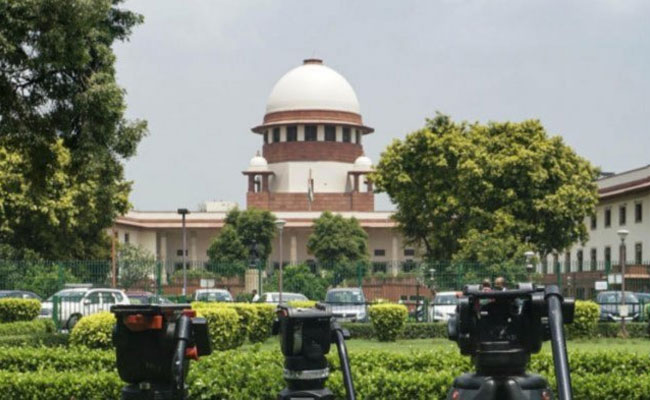
New Delhi (PTI): The Supreme Court on Tuesday pulled up the Delhi government for not providing funds for the Regional Rapid Transit System (RRTS) corridors to Alwar and Panipat, and said if the dues were not paid within a week, the funds allocated by the AAP government for advertisements will be transferred to the project.
The RRTS project entails semi-high speed rail corridors connecting Delhi to Meerut in Uttar Pradesh, Alwar in Rajasthan, and Panipat in Haryana.
The apex court said budgetary provision was something which the state government should look into but if such national projects were to be affected and money was spent on advertisements, it would be inclined to direct that those funds be transferred for this project.
A bench of Justices Sanjay Kishan Kaul and Sudhanshu Dhulia observed that on July 24, the counsel representing the Delhi government had assured the top court that payment would be made towards the project.
"We are thus constrained to direct that funds allocated for advertisement purposes will be transferred to the project in question," the bench said.
"At the request of the counsel for Delhi government, we keep this order in abeyance for one week and if the funds are not transferred, the order will come into operation," it said.
While hearing the matter on July 24, the apex court had berated the Delhi government for "throwing its hands up" over contributing its share towards the two RRTS corridors to Alwar and Panipat, and directed it to provide Rs 415 crore for the project within two months.
On Tuesday, the bench was hearing an application raising the issue of non-payment of funds by the Delhi government for the project.
When the counsel representing the Delhi government said they needed to file a reply in the matter, the bench shot back, "What reply? You have not complied".
"Why did you not comply? I told you that day, I will attach your advertising revenue. I am going to stay the advertising budget," Justice Kaul told the lawyer.
The bench, which posted the matter for hearing on November 28, expressed its displeasure that the Delhi government has not complied with the assurance given to the court in July.
It said the Delhi government did not even come to the court to seek extension of time for making the payment for the project.
"You can't take this court for granted," the bench said.
The Delhi government had earlier expressed its inability to contribute funds for the RRTS project after which the apex court had directed it to place on record funds spent on advertisements in the last three years.
On July 24, the apex court had noted that Delhi government has spent Rs 1,100 crore on advertisements in the last three financial years.
The National Capital Region Transport Corporation (NCRTC) is executing the project, a joint venture between the Centre and the states concerned.
The Delhi-Meerut project is already under construction, and the Arvind Kejriwal government has agreed to pay its share of the costs.
The Delhi government had earlier refused to share the financial burden for the remaining two stretches, citing a paucity of funds.
The top court had earlier directed the Delhi government to contribute Rs 500 crore from the Environment Compensation Charge (ECC) to the RRTS corridor being constructed between Delhi and Meerut.
The estimated cost of the 82.15-km stretch is Rs 31,632 crore. The corridor, with 24 stations, will cover the distance from Sarai Kale Khan in Delhi to Modipuram, Meerut in 60 minutes.
Of the 82.15 km-long corridor, Delhi will have around 13 km with stations at Sarai Kale Khan, New Ashok Nagar and Anand Vihar.
Union Housing and Urban Affairs Minister Hardeep Singh Puri had told the Rajya Sabha in February that the Delhi government has not agreed to provide financial support for the Delhi-Shahjahanpur-Neemrana-Behror and Delhi-Panipat Regional Rapid Transit System corridors.
Let the Truth be known. If you read VB and like VB, please be a VB Supporter and Help us deliver the Truth to one and all.
Bengaluru: KAS officer, driver caught in Rs 30 lakh bribe case
Bengaluru: Lokayukta police have arrested a KAS officer and his driver for allegedly demanding and accepting a Rs 30 lakh bribe to pass a favourable order in a pending RRT case.
The accused have been identified as Nagaprashanth (KAS), serving as Special Assistant Commissioner (North) and Special Land Acquisition Officer-1, KIADB, and Kumar, a driver associated with his office, Deccan Herald reported.
Based on a complaint by Ravi Kumar, a resident of Attur in Yelahanka, Lokayukta team laid a trap.
According to investigators, the accused had demanded Rs 30 lakh, of which Rs 15 lakh was allegedly collected earlier by the driver on the officer’s instructions.
On Wednesday, the driver was caught red-handed while accepting the remaining Rs 15 lakh, leading to the arrest of both him and the officer.
Both accused have been taken into custody, and further investigation is underway.