Rs 15-crore horse, Rs 23-crore buffalo steal spotlight at Rajasthan's Pushkar Fair
Pushkar (PTI): A horse worth Rs 15 crore, a Rs 23-crore buffalo and a cow just 16 inches tall are the star attractions of the Pushkar Cattle Fair in Rajasthan, one of India's most prominent livestock fairs known for showcasing elite breeds and record-breaking valuation of animals.
Although the fair will start from October 30 and continue till November 5, livestock traders and enthusiasts have already started to gather at the site.
Of the more than 4,300 animals, including 3,028 horses and 1,306 camels, that have been registered for the fair, the centrepiece is a two-and-a-half-year-old stallion, Shahbaz, owned by Chandigarh-based breeder Gary Gill, which has drawn a massive crowd.
"Shahbaz has won multiple shows and comes from a prestigious lineage. His covering fee is Rs 2 lakh, and the asking price is Rs 15 crore," Gill said, adding that he has already received offers up to Rs 9 crore for the Marwari breed horse.
Another showstopper is 1,500-kg Anmol, a buffalo priced at Rs 23 crore. Its owner, Palmindra Gill, said the animal is "raised like royalty" and is fed milk, desi ghee, and dry fruits daily.
Joining the line-up is Rana, a buffalo from Ujjain valued at Rs 25 lakh and weighing 600 kg. The animal consumes food worth Rs 1,500 a day, including gram flour, eggs, oil, milk, ghee, and liver tonic.
Also at the fair is Badal, a veteran Marwari stallion and father of 285 colts, who has reportedly attracted offers of up to Rs 11 crore but remains unsold.
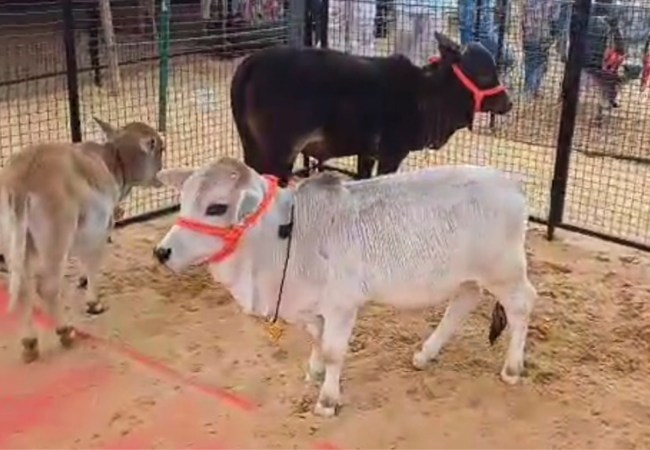
Adding a unique charm to the fair, Abhinav Tiwari from Jaipur's Bagru has brought over 15 cows of different breeds, including one that stands just 16 inches tall, believed to be among the smallest in the fair.
DSP (Ajmer Rural) Ramchandra Chaudhary said that this year, the Pushkar Fair will see a larger police deployment compared to previous years.
"More than 2,000 police personnel will be deployed during the fair. All officers have been briefed properly to ensure that visitors face no inconvenience," he said.
Rajasthan's Animal Husbandry Department has intensified monitoring to ensure the health and safety of the livestock arriving for trade at the fair, an official said.
The department's joint director, Sunil Ghiya, said dedicated checkpoints have been set up on routes being used by traders and herders to bring animals to the fair. "Every animal will be registered, examined by veterinary doctors, and tagged before entry," he said.
The officer noted that such precautions are essential as large gatherings of livestock increase the risk of communicable diseases. "The department has deployed veterinary teams and officials on a 24-hour duty schedule at the fairgrounds," Ghiya added.
He further said that animal records, particularly for camels, cows, buffaloes and horses, are being digitised as part of a larger initiative to ensure transparency and traceability in livestock management.
The fairground is abuzz with tourists and traders. Livestock trading and competitions like best milk producer, best horse breed, and best-dressed camel are underway, an official said.
Let the Truth be known. If you read VB and like VB, please be a VB Supporter and Help us deliver the Truth to one and all.
Man booked for duping 7 persons of Rs 91 lakh on promise of awarding govt works

Mumbai (PTI): The Mumbai police have registered a case against a man for allegedly duping seven persons of Rs 91 lakhs on the promise of awarding them works of different government departments, an official said on Tuesday.
The accused was identified as Satish Kadam, a resident of Nanded in Marathwada region, an official said.
A complaint was filed by Hanumant Vadje, who alleged that the accused cheated him and six others of around Rs 91 lakh by promising to give them various works of Urban Development and Social Justice Department, he said.
The fraud occurred between 2024 and 2026, with Kadam collecting money in cash and into his accounts, police said, adding he had returned some amount to them partially.
Multiple cheques issued by the accused bounced, prompting the victim to lodge a complaint at the Marine Drive police station. Based on the complaint, a case of cheating and criminal breach of trust was registered against him.
The case is under further investigation, the official said.